Using Great Language
One of the problems with the emphasis on the practical, "put your cookies on the lowest shelf, use simple words" approach to Bible teaching is the missed opportunities to zing their imagination with beautiful, uplifting, inspiring language.
It's wonderful to hear the hymn writer describe God as a "shoreless ocean."
I recommend you read this helpful article about using inspiring language in sermons. Think about how to h
By the way, a good way to develop your ability to speak in language that fires the imagination is to study good Christian fiction. Check out my recommendations on the best fiction for Bible teachers.
Friday, October 07, 2005

Thursday, October 06, 2005
 Read the New Testament in Less than a Month
Here's a special free report I put together describing a you-can-really-do-it plan to read through the New Testament in less than a month. Try this. You'll be amazed at what the Lord teaches you!
Get the plan, pick a day soon, and start.
What Happens When We Don't Teach Well
There are a lot of practical habits that new believers need to learn in order to be strong disciples. It takes time, and it takes someone who is willing to teach and encourage them.
Chuck Lawless talks about this in an excellent, short article titled "Discipleship : 2 Guidelines for Growth."
"Tim’s problem was that he really did not know how to initiate and maintain these spiritual disciplines . . . because no one in his church had ever taught him. His church told him to read the Word, but no one showed him how. They told him to "pray without ceasing" but did not teach him what that phrase meant. Nobody taught him how to face and overcome temptation. Leaders encouraged him to "keep up the good work" with witnessing, but they failed to help him overcome discouragement when others did not respond. Yet the same leaders put Tim in a position of spiritual leadership, teaching others the Word of God."
Are you doing enough work in your teaching ministry to build good habits and practical spiritual disciplines?
There are a lot of practical habits that new believers need to learn in order to be strong disciples. It takes time, and it takes someone who is willing to teach and encourage them.
Chuck Lawless talks about this in an excellent, short article titled "Discipleship : 2 Guidelines for Growth."
"Tim’s problem was that he really did not know how to initiate and maintain these spiritual disciplines . . . because no one in his church had ever taught him. His church told him to read the Word, but no one showed him how. They told him to "pray without ceasing" but did not teach him what that phrase meant. Nobody taught him how to face and overcome temptation. Leaders encouraged him to "keep up the good work" with witnessing, but they failed to help him overcome discouragement when others did not respond. Yet the same leaders put Tim in a position of spiritual leadership, teaching others the Word of God."
Are you doing enough work in your teaching ministry to build good habits and practical spiritual disciplines?
Free teaching tips by email
Like what you read here? Sign up and get free weekly teaching tips by email.
Like what you read here? Sign up and get free weekly teaching tips by email.
Tuesday, October 04, 2005
Fun exercise with mature believers
One challenge with mature believers is that all the texts are "familiar" to them. But Scripture must never become too comfortable. We must push ourselves, and those in our classes, to see things a-fresh. Try different translations occasionally -- that can be effective.
Here's an exercise you might consider.
When you're teaching on a familiar passage, don't let your students open the Bible at first. Ask them to take a sheet of paper and write down everything they remember about the story. (Or do this as a group conversation.) Don't react if anyone gets a fact wrong, just write it all down. Give them time to do a thorough job, at least 10 minutes.
Then turn to the passage and read it out loud. Ask the people what they missed.
By doing this, you're taking advantage of what we know about how our brains work. We are particularly good at spotting the things that are different, or unexpected.
Even the 'toughest' person in class is not going to get it all right, and everyone is much more likely to remember the passage more clearly in the future. Especially the parts they didn't get right the first time you asked!
Tip: make sure everyone (or almost everyone) is familiar with the story. This strategy only frustrates people who don't have a clue about the passage you selected.
One challenge with mature believers is that all the texts are "familiar" to them. But Scripture must never become too comfortable. We must push ourselves, and those in our classes, to see things a-fresh. Try different translations occasionally -- that can be effective.
Here's an exercise you might consider.
When you're teaching on a familiar passage, don't let your students open the Bible at first. Ask them to take a sheet of paper and write down everything they remember about the story. (Or do this as a group conversation.) Don't react if anyone gets a fact wrong, just write it all down. Give them time to do a thorough job, at least 10 minutes.
Then turn to the passage and read it out loud. Ask the people what they missed.
By doing this, you're taking advantage of what we know about how our brains work. We are particularly good at spotting the things that are different, or unexpected.
Even the 'toughest' person in class is not going to get it all right, and everyone is much more likely to remember the passage more clearly in the future. Especially the parts they didn't get right the first time you asked!
Tip: make sure everyone (or almost everyone) is familiar with the story. This strategy only frustrates people who don't have a clue about the passage you selected.
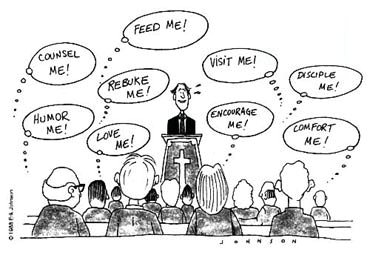
What are your students thinking about?
Keep in mind that your students will have many unexpressed needs. You can't know them all, but the Lord does. That's why I promote preparation methods that are heavy on prayer and study, so the Lord will direct you to teach precisely what these people need at this time.
Remember Who is Doing the Real Work
Teaching ministry can be very hard work. We need to pour ourselves out in prayer, study, and preparation. That's what we're called to do. But spiritual transformation is work done only by the Lord. We must not think too much of ourselves!
I like this story, because it's a good illustration of how God uses even weak preaching/teaching to grip a heart:
Presbyterian minister Fred Rogers, creator and host of television's "Mr. Roger's Neighborhood," recently gave an address describing the time he was a student at Pittsburgh Theological Seminary and attended a different church each Sunday in order to hear a variety of preachers.
One Sunday he was treated to "the most poorly crafted sermon (he) had ever heard." But when he turned to the friend who had accompanied him, he found her in tears.
"It was exactly what I needed to hear," she told Rogers.
"That's when I realized," he told his audience, "that the space between someone doing the best he or she can and someone in need is holy ground. The Holy Spirit had transformed that feeble sermon for her—and as it turned out, for me too."
Teaching ministry can be very hard work. We need to pour ourselves out in prayer, study, and preparation. That's what we're called to do. But spiritual transformation is work done only by the Lord. We must not think too much of ourselves!
I like this story, because it's a good illustration of how God uses even weak preaching/teaching to grip a heart:
Presbyterian minister Fred Rogers, creator and host of television's "Mr. Roger's Neighborhood," recently gave an address describing the time he was a student at Pittsburgh Theological Seminary and attended a different church each Sunday in order to hear a variety of preachers.
One Sunday he was treated to "the most poorly crafted sermon (he) had ever heard." But when he turned to the friend who had accompanied him, he found her in tears.
"It was exactly what I needed to hear," she told Rogers.
"That's when I realized," he told his audience, "that the space between someone doing the best he or she can and someone in need is holy ground. The Holy Spirit had transformed that feeble sermon for her—and as it turned out, for me too."
Sunday, October 02, 2005
Teachers as Leaders
Not all Bible teachers are leaders, but many are. Tony Morgan has a useful checklist you should review:
"10 Easy Ways to Know You're NOT a Leader
You're waiting on a bigger staff and more money to accomplish your vision.
You think you need to be in charge to have influence.
You're content.
You tend to foster division instead of generating a helpful dialogue.
You think you need to say something to be heard.
You find it easier to blame others for your circumstances than to take responsibility for solutions.
It's been some time since you said, "I messed up."
You're driven by the task instead of the relationships and the vision.
Your dreams are so small, people think they can be achieved.
No one is following you."
Great Bible Teachers do a lot of these things well:
They're not content, and always learning.
They generate helpful dialogue so people can learn.
They know when to listen, rather than speak.
They have big dreams for thousands and thousands of disciples, beginning with those God has given them to teach right now.
Not all Bible teachers are leaders, but many are. Tony Morgan has a useful checklist you should review:
"10 Easy Ways to Know You're NOT a Leader
You're waiting on a bigger staff and more money to accomplish your vision.
You think you need to be in charge to have influence.
You're content.
You tend to foster division instead of generating a helpful dialogue.
You think you need to say something to be heard.
You find it easier to blame others for your circumstances than to take responsibility for solutions.
It's been some time since you said, "I messed up."
You're driven by the task instead of the relationships and the vision.
Your dreams are so small, people think they can be achieved.
No one is following you."
Great Bible Teachers do a lot of these things well:
They're not content, and always learning.
They generate helpful dialogue so people can learn.
They know when to listen, rather than speak.
They have big dreams for thousands and thousands of disciples, beginning with those God has given them to teach right now.
Useful word
Christians are people called into community. I like what Bill Kinnon writes about volunteerism in the Church:
"The word 'volunteer' works well in a culture that celebrates the individual. 'I' decide of my own 'free will' that I will help. But in a culture that celebrates community and communion, we are really called to be 'conspirators.' People who breathe together. (Conspire -- Latin root, to breathe together.)"
Useful word, that -- conspirators!
Christians are people called into community. I like what Bill Kinnon writes about volunteerism in the Church:
"The word 'volunteer' works well in a culture that celebrates the individual. 'I' decide of my own 'free will' that I will help. But in a culture that celebrates community and communion, we are really called to be 'conspirators.' People who breathe together. (Conspire -- Latin root, to breathe together.)"
Useful word, that -- conspirators!
Wednesday, September 28, 2005
Exhortation
In most teaching situations, not everyone in your group or class is a believer. Charles Spurgeon exhorting with great passion because he was convinced that half of his congregation was not yet saved! Therefore, teach with conviction and boldness, but understand that some of God's message will not yet be understood:
"The man without the Spirit does not accept the things that come from the Spirit of God, for they are foolishness to him, and he cannot understand them, because they are spiritually discerned." (2 Cor 2:14)
But even if spiritual things are not yet accepted or understood, spiritual truth has power that does work on the souls of men. Do not be put off by what your eyes see, but continue in faith and confidence. If the Lord can save you, dear teacher, He is able to save anyone. Sow, sow, sow!
In most teaching situations, not everyone in your group or class is a believer. Charles Spurgeon exhorting with great passion because he was convinced that half of his congregation was not yet saved! Therefore, teach with conviction and boldness, but understand that some of God's message will not yet be understood:
"The man without the Spirit does not accept the things that come from the Spirit of God, for they are foolishness to him, and he cannot understand them, because they are spiritually discerned." (2 Cor 2:14)
But even if spiritual things are not yet accepted or understood, spiritual truth has power that does work on the souls of men. Do not be put off by what your eyes see, but continue in faith and confidence. If the Lord can save you, dear teacher, He is able to save anyone. Sow, sow, sow!
Monday, September 26, 2005
Sunday School information
Interesting facts in this artilce about the Assembly of God denomination declaring Sept 25 as "National Sunday School Day" :
"A Barna Group study taken earlier this year found that churches continue to rely on Sunday school. It reported that 96 percent of Protestant churches offer a Sunday school where people receive some form of Bible instruction in a class setting."
My limited research across denominations suggests that while many churches create Sunday School environments for all the children, adult class participation is much lower.
"According to the Assemblies of God, 66 million people across the nation study Scripture in Sunday school. In the Assemblies of God alone, over 120,000 people volunteer to teach Bible study lessons to over one million people every week."
Way to go!
Interesting facts in this artilce about the Assembly of God denomination declaring Sept 25 as "National Sunday School Day" :
"A Barna Group study taken earlier this year found that churches continue to rely on Sunday school. It reported that 96 percent of Protestant churches offer a Sunday school where people receive some form of Bible instruction in a class setting."
My limited research across denominations suggests that while many churches create Sunday School environments for all the children, adult class participation is much lower.
"According to the Assemblies of God, 66 million people across the nation study Scripture in Sunday school. In the Assemblies of God alone, over 120,000 people volunteer to teach Bible study lessons to over one million people every week."
Way to go!
Sunday, September 25, 2005
Recruiting and Supporting Teachers
Roberta Hestenes wrote an excellent article for Christianity Today about recruiting teachers.
Check out her excellent comments on:
Roberta Hestenes wrote an excellent article for Christianity Today about recruiting teachers.
Check out her excellent comments on:
- recruiting people to find their ministry, not just fill a job opening
- making the recruiting process a relationship building process
- how to help people work through excuses -- especially the "I'm inadequate" excuse
- giving teachers the kind of support system they need
Saturday, September 24, 2005
TurboCharge Discussion with the Best Teaching Questions
My new book, 52 Model Questions, will be available soon. It's a set of questions that have been field-tested and proven effective with
Any type of class or group
Any size group (from 1-on-1 to 1-on-500)
Any church
Any Christian denomination
Any level of spiritual maturity
Across cultures
These are the best questions I've found for generating good discussion and real learning in a Bible study situation.
I'll let you know when it's ready.
My new book, 52 Model Questions, will be available soon. It's a set of questions that have been field-tested and proven effective with
Any type of class or group
Any size group (from 1-on-1 to 1-on-500)
Any church
Any Christian denomination
Any level of spiritual maturity
Across cultures
These are the best questions I've found for generating good discussion and real learning in a Bible study situation.
I'll let you know when it's ready.
Where do they need to go?
Terry Storch writes "Take people where they need to go, not necessarily where they want to go!" That's good counsel for Bible teachers!
And how do you know where they need to go? You pray. Let the Lord lead you. He's trustworthy.
Terry Storch writes "Take people where they need to go, not necessarily where they want to go!" That's good counsel for Bible teachers!
And how do you know where they need to go? You pray. Let the Lord lead you. He's trustworthy.
Wednesday, September 21, 2005
Make Your Teaching Spectacular
I get teased periodically about my delight in using a large vocabulary. So I liked what Bruce Johnson wrote about Shakespeare's writing -- he calls it "spectacular." And then he gives an excellent charge for Great Bible Teachers:
"So my question for you (and for me) is, how can you take what you're currently doing and make it spectacular? How can you turn it from ordinary to extraordinary? It doesn't have to be a book or play that you're working on, it could be a making a meal or designing a room. It could be coaching a sports team or preparing a lesson for a Sunday School class. It could be putting together a party or designing an accounting package. It could be developing a sales team theme for the year or planning a karate tournament. It really doesn't matter what you're doing, it's a mindset that I'm after—a mindset that says, "I don't want to go through life doing ordinary things in ordinary ways, I want to leave whatever I'm doing with a touch of the spectacular." If you'll do that, you'll have a lived a life worth living."
I get teased periodically about my delight in using a large vocabulary. So I liked what Bruce Johnson wrote about Shakespeare's writing -- he calls it "spectacular." And then he gives an excellent charge for Great Bible Teachers:
"So my question for you (and for me) is, how can you take what you're currently doing and make it spectacular? How can you turn it from ordinary to extraordinary? It doesn't have to be a book or play that you're working on, it could be a making a meal or designing a room. It could be coaching a sports team or preparing a lesson for a Sunday School class. It could be putting together a party or designing an accounting package. It could be developing a sales team theme for the year or planning a karate tournament. It really doesn't matter what you're doing, it's a mindset that I'm after—a mindset that says, "I don't want to go through life doing ordinary things in ordinary ways, I want to leave whatever I'm doing with a touch of the spectacular." If you'll do that, you'll have a lived a life worth living."
Monday, September 19, 2005
Interactive Google Map of the Holy Land
Check out this interactive Bible map on the ESV Bible Blog. You can jump from Bible-time cities to Scripture passages to satellite images (of contemporary Israel and surround). Neat!
Check out this interactive Bible map on the ESV Bible Blog. You can jump from Bible-time cities to Scripture passages to satellite images (of contemporary Israel and surround). Neat!
Sunday, September 18, 2005
Helping People Think Biblically Through Terror & Suffering
John Piper's September 11th sermon is a wonderful outline on the Biblical perspective of suffering. It's studded with Scripture. This would be great to adapt to a short set of Sunday School lessons or small group Bible study.
John Piper's September 11th sermon is a wonderful outline on the Biblical perspective of suffering. It's studded with Scripture. This would be great to adapt to a short set of Sunday School lessons or small group Bible study.
Discipleship, Spiritual Formation
Check out this short interview with Richard Foster and Dallas Willard for insights about spiritual formation. Is your church teaching you how to love your enemies, and bless those who curse you?
Check out this short interview with Richard Foster and Dallas Willard for insights about spiritual formation. Is your church teaching you how to love your enemies, and bless those who curse you?
Saturday, September 17, 2005
The Best Answers and Insights
If you've been involved in brainstorming sessions with a group, you know that it's very rare for the best ideas to surface immediately. And you might have to go through some "kinda weird" ideas to get to the best ones. It seems we have to generate a significant quantity of ideas before we can figure out which ones are the best.
Pay attention to this phenomenon when you are teaching group lessons or leading group discussions. When you ask a question that does not have a single right answer (e.g., "What might have this character been thinking about?"), don't be satisifed with the first answer that comes. Be a patient teacher, and get several answers.
Don't worry if some seem "weird" or outlandish -- if you as the teacher/leader make any criticism of the person who answered you can forget about future participation from that person! It's appropriate to test answers against what's in the text. But do this gently, and with respect.
If you are willing to work at this, you'll see some amazing progress in people's ability to learn from Scripture. Encourage them to be disatisfied with only one answer, even when they're studying on their own.
Note: you may need to plan to cover less material in a lesson. That's fine -- your objective is not to blast through X volume of material to make you look good, but to develop people and see God work to change their lives!
Also, pay attention to this phenomenon when you're doing in depth personal Bible study. You want to meditate on passages for some time. New insights will surface (and some won't be right when you test them against the rest of Scripture). It's rare that your best insights surface immediately.
My book outlines a number of strategies for in-depth Bible study that will help you. For example, take a short book like Ephesians and read it every day for a month. You'll hit some dry days, but you'll also be amazed at what you begin to understand that you would miss if you only read through it once or twice a year.
If you've been involved in brainstorming sessions with a group, you know that it's very rare for the best ideas to surface immediately. And you might have to go through some "kinda weird" ideas to get to the best ones. It seems we have to generate a significant quantity of ideas before we can figure out which ones are the best.
Pay attention to this phenomenon when you are teaching group lessons or leading group discussions. When you ask a question that does not have a single right answer (e.g., "What might have this character been thinking about?"), don't be satisifed with the first answer that comes. Be a patient teacher, and get several answers.
Don't worry if some seem "weird" or outlandish -- if you as the teacher/leader make any criticism of the person who answered you can forget about future participation from that person! It's appropriate to test answers against what's in the text. But do this gently, and with respect.
If you are willing to work at this, you'll see some amazing progress in people's ability to learn from Scripture. Encourage them to be disatisfied with only one answer, even when they're studying on their own.
Note: you may need to plan to cover less material in a lesson. That's fine -- your objective is not to blast through X volume of material to make you look good, but to develop people and see God work to change their lives!
Also, pay attention to this phenomenon when you're doing in depth personal Bible study. You want to meditate on passages for some time. New insights will surface (and some won't be right when you test them against the rest of Scripture). It's rare that your best insights surface immediately.
My book outlines a number of strategies for in-depth Bible study that will help you. For example, take a short book like Ephesians and read it every day for a month. You'll hit some dry days, but you'll also be amazed at what you begin to understand that you would miss if you only read through it once or twice a year.
Thursday, September 15, 2005
Good "Oxymorons" for Teachers
Wayne Cordiero is credited with these "oxymorons." I think there is a lot of wisdom here for those whom God has called to be teachers:
To stay current, stay ancient.
To move forward, remain anchored.
To serve more people, get alone more.
To accomplish more, do less.
To make a statement, be quiet and listen.
To be more fruitful, prune.
Wayne Cordiero is credited with these "oxymorons." I think there is a lot of wisdom here for those whom God has called to be teachers:
To stay current, stay ancient.
To move forward, remain anchored.
To serve more people, get alone more.
To accomplish more, do less.
To make a statement, be quiet and listen.
To be more fruitful, prune.
Tuesday, September 13, 2005
Keep Them In the Word
My senior pastor addressed the adult Sunday School teachers for our church yesterday to teach and encourage us. Here are some important points I captured on the theme of keeping the Scriptures central in our teaching:
"Your methodology should be to constantly ask, 'Where stands it written?'"
"Keep your finger on the text."
"If someone doesn't have a Bible with them, they ought to feel left out because you're going back to the Word so frequently."
"The Word of God will do it."
If you want to teach to change lives, then keep them in the Word. The people in your small group, Bible study, or Sunday School class are not there to hear from you. They need to hear from God.
My senior pastor addressed the adult Sunday School teachers for our church yesterday to teach and encourage us. Here are some important points I captured on the theme of keeping the Scriptures central in our teaching:
"Your methodology should be to constantly ask, 'Where stands it written?'"
"Keep your finger on the text."
"If someone doesn't have a Bible with them, they ought to feel left out because you're going back to the Word so frequently."
"The Word of God will do it."
If you want to teach to change lives, then keep them in the Word. The people in your small group, Bible study, or Sunday School class are not there to hear from you. They need to hear from God.
What about a Bible Commentary?
I'm regularly asked for advice and recommendations onBible commentaries.
I posted an article with my views for your benefit:
http://www.teachtochangelives.com/commentary.htm
In this article I outline where I believe commentaries fit in your Bible study toolkit, and tell you what one Bible commentary I do recommend.
I'm regularly asked for advice and recommendations onBible commentaries.
I posted an article with my views for your benefit:
http://www.teachtochangelives.com/commentary.htm
In this article I outline where I believe commentaries fit in your Bible study toolkit, and tell you what one Bible commentary I do recommend.
Monday, September 12, 2005
Coming Up
I'm working on several writing projects, small and large.
There are two larger projects.One is a new book giving details on 52 model questions that Bible teachers can use in almost any teaching situation. I also want to write a minibook on creating and using biblical frameworks for thinking through complex issues (e.g., bioethics).
One small project I hope to complete soon is a full answer to the question I hear from Bible students: what Bible commentary do you recommend?
Please pray for me to discern God's best as I work on these. Thanks!
I'm working on several writing projects, small and large.
There are two larger projects.One is a new book giving details on 52 model questions that Bible teachers can use in almost any teaching situation. I also want to write a minibook on creating and using biblical frameworks for thinking through complex issues (e.g., bioethics).
One small project I hope to complete soon is a full answer to the question I hear from Bible students: what Bible commentary do you recommend?
Please pray for me to discern God's best as I work on these. Thanks!
Sunday, September 11, 2005
Authenticity
Our objective must be to teach to change lives. A HUGE stumbling block to this level of teaching is "faking it" to impress others. I believe there is a strong correlation between authenticity of the person teaching and God's willingness to use that person to change lives.
I'm pleading with you to take the only course the Lord laid out: seek His face, and repent. Ask Him to make you into an authentic teacher and leader and lover of souls.
It may help to meditate on these lyrics from Casting Crown's song "Stained Glass Masquerade":
Stained Glass Masquerade Lyrics
Is there anyone that failsIs there anyone that falls
Am I the only one in church today feelin’ so small
Cause when I take a look around
Everybody seems so strongI know they’ll soon discover
That I don’t belong
So I tuck it all away, like everything’s okay
If I make them all believe it, maybe I’ll believe it too
So with a painted grin, I play the heart again
So everyone will see me the way that I see them
Are we happy plastic people
Under shiny plastic steeples
With walls around our weakness
And smiles to hide our pain
But if the invitation’s open
To every heart that has been broken
Maybe then we close the curtain
On our stained glass masquerade
Is there anyone who’s been there
Are there any hands to raise
Am I the only one who’s traded
In the altar for a stage
The performance is convincing
And we know every line by heart
Only when no one is watching
Can we really fall apart
But would it set me free
If I dared to let you see
The truth behind the person
That you imagine me to be
Would your arms be open
Or would you walk away
Would the love of Jesus
Be enough to make you stay
Our objective must be to teach to change lives. A HUGE stumbling block to this level of teaching is "faking it" to impress others. I believe there is a strong correlation between authenticity of the person teaching and God's willingness to use that person to change lives.
I'm pleading with you to take the only course the Lord laid out: seek His face, and repent. Ask Him to make you into an authentic teacher and leader and lover of souls.
It may help to meditate on these lyrics from Casting Crown's song "Stained Glass Masquerade":
Stained Glass Masquerade Lyrics
Is there anyone that failsIs there anyone that falls
Am I the only one in church today feelin’ so small
Cause when I take a look around
Everybody seems so strongI know they’ll soon discover
That I don’t belong
So I tuck it all away, like everything’s okay
If I make them all believe it, maybe I’ll believe it too
So with a painted grin, I play the heart again
So everyone will see me the way that I see them
Are we happy plastic people
Under shiny plastic steeples
With walls around our weakness
And smiles to hide our pain
But if the invitation’s open
To every heart that has been broken
Maybe then we close the curtain
On our stained glass masquerade
Is there anyone who’s been there
Are there any hands to raise
Am I the only one who’s traded
In the altar for a stage
The performance is convincing
And we know every line by heart
Only when no one is watching
Can we really fall apart
But would it set me free
If I dared to let you see
The truth behind the person
That you imagine me to be
Would your arms be open
Or would you walk away
Would the love of Jesus
Be enough to make you stay
For PDA fans
I know a few of you are really interested in using your PDAs rather than a Bible and notes while teaching. Check out this article, and the link to a guide to "the paperless pulpit" for some ideas that may help you.
I know a few of you are really interested in using your PDAs rather than a Bible and notes while teaching. Check out this article, and the link to a guide to "the paperless pulpit" for some ideas that may help you.
Thursday, September 08, 2005
Got Your Prayer Team Going?
Great Bible Teachers must have a prayer team. You need a few people who will support and encourage you, and be committed to pray for you.
Where do you stand? What's it going to take to get 2 or 3 people (not just your spouse or your mom, though you need them, too!) lined up with the right information to pray specifically for your teaching ministry?
If this sounds complicated, it doesn't have to be. Contact people whom you trust and whom love you, and give them prayer requests on a regular basis. Let me them what you're learning about, the lessons you're preparing, and information about the people you are teaching. Tell them about your concerns, your fears, and testify to God's power and grace working through you when you see lives being changed!
Looking for more help? Check out
http://www.teachtochangelives.com/partners.htm for some recommendations.
Great Bible Teachers must have a prayer team. You need a few people who will support and encourage you, and be committed to pray for you.
Where do you stand? What's it going to take to get 2 or 3 people (not just your spouse or your mom, though you need them, too!) lined up with the right information to pray specifically for your teaching ministry?
If this sounds complicated, it doesn't have to be. Contact people whom you trust and whom love you, and give them prayer requests on a regular basis. Let me them what you're learning about, the lessons you're preparing, and information about the people you are teaching. Tell them about your concerns, your fears, and testify to God's power and grace working through you when you see lives being changed!
Looking for more help? Check out
http://www.teachtochangelives.com/partners.htm for some recommendations.
Wednesday, September 07, 2005
How I Use My Thompson's Chain Reference Bible
I've written before about why I think the Thompson's Chain Reference Bible is the superior study Bible tool for great Bible teachers.
I suspect it's not as popular as it should be because people get overwhelmed with the numbering system and helps. Also, frankly, I think people don't want to have to dig into related passages, they would just rather have some "expert" tell them what it means. The power of the Thompson's method is that it does not interject an author's bias, however well-meaning. Scripture is used to interpret Scripture.
(Side note: my favorite definition of the word 'expert': ex, meaning 'former' and spurt, meaning drip under pressure.)
Here are three ways I use my Thompson's.
First, when I'm studying a passage closely, I will look up the related Scriptures referenced as chain topics in the margin. You simply turn to the index, find the number, and the Bible verses are listed there. Those verses in turn let me move to other related chain topics and verses. Sometimes I feel that I'm working outward in a spiral of related information. My understanding of the passage always increases, but in the context of the Bible itself, not opinions of others.
Second, I like the book outlines. Each of the 66 books of the Bible has a nice outline -- brief information about author and dates, the overall structure of the book, and key verses. These are very helpful to get the broad strokes of a book in my head as I'm studying the details.
Third, I use Thompson's to prepare for topical lessons. I look up a topic in the general index of chain references to get the key ideas and Bible passages. Thompson's already has those structured into categories. For example, if I want to prepare a lesson about forgiveness, I will immediately have this nice outline, with supporting Scripture :
Divine forgiveness promised
Human forgiveness commanded
Examples of divine forgiveness
Examples of human forgiveness
I also have notes linking me to the topics and verses for pardon, restoration, repentance, God's promises, mercy, duty to enemies, retaliation, good for evil, and sin forgiven.
Note: I also use Nave's Topical Bible. Thompson's has more chain reference topics than Nave's Topical Bible, but Nave's tends to include more verses under key topics. Both are valuable. I rely on Thompson's to give me the seminal verses for a topic, and Nave's for a more complete study. Nave's does not link topics together as well as the Thompson's Chain Reference Bible.
I also love the many helps available in the Thompson's -- character biographies, maps, archeological information, harmonies of the Gospels, and lots more.
I urge you to get a Thompson's and use it. I've written a free special report about this essential tool that you may want to read. It's at
http://www.teachtochangelives.com/thompsons.htm
I've written before about why I think the Thompson's Chain Reference Bible is the superior study Bible tool for great Bible teachers.
I suspect it's not as popular as it should be because people get overwhelmed with the numbering system and helps. Also, frankly, I think people don't want to have to dig into related passages, they would just rather have some "expert" tell them what it means. The power of the Thompson's method is that it does not interject an author's bias, however well-meaning. Scripture is used to interpret Scripture.
(Side note: my favorite definition of the word 'expert': ex, meaning 'former' and spurt, meaning drip under pressure.)
Here are three ways I use my Thompson's.
First, when I'm studying a passage closely, I will look up the related Scriptures referenced as chain topics in the margin. You simply turn to the index, find the number, and the Bible verses are listed there. Those verses in turn let me move to other related chain topics and verses. Sometimes I feel that I'm working outward in a spiral of related information. My understanding of the passage always increases, but in the context of the Bible itself, not opinions of others.
Second, I like the book outlines. Each of the 66 books of the Bible has a nice outline -- brief information about author and dates, the overall structure of the book, and key verses. These are very helpful to get the broad strokes of a book in my head as I'm studying the details.
Third, I use Thompson's to prepare for topical lessons. I look up a topic in the general index of chain references to get the key ideas and Bible passages. Thompson's already has those structured into categories. For example, if I want to prepare a lesson about forgiveness, I will immediately have this nice outline, with supporting Scripture :
Divine forgiveness promised
Human forgiveness commanded
Examples of divine forgiveness
Examples of human forgiveness
I also have notes linking me to the topics and verses for pardon, restoration, repentance, God's promises, mercy, duty to enemies, retaliation, good for evil, and sin forgiven.
Note: I also use Nave's Topical Bible. Thompson's has more chain reference topics than Nave's Topical Bible, but Nave's tends to include more verses under key topics. Both are valuable. I rely on Thompson's to give me the seminal verses for a topic, and Nave's for a more complete study. Nave's does not link topics together as well as the Thompson's Chain Reference Bible.
I also love the many helps available in the Thompson's -- character biographies, maps, archeological information, harmonies of the Gospels, and lots more.
I urge you to get a Thompson's and use it. I've written a free special report about this essential tool that you may want to read. It's at
http://www.teachtochangelives.com/thompsons.htm
Tuesday, September 06, 2005
Bible origins, answers to questions
The American Bible Society has a nice page with answers to questions like these:
When was the Bible written?
How were the books of the Bible chosen?
Why do some Bibles have a section called the Apocrypha?
In what language was the Bible first written?
What are the Dead Sea Scrolls?
Why are there so many versions of the English Bible?
Is the Bible we have today in English the same as the original Bible?
How was the Bible distributed before the printing press was invented in 1455?
How many different languages has the Bible been published into?
Great Bible teachers should be familiar with these answers -- or know how to get them readily!
The American Bible Society has a nice page with answers to questions like these:
When was the Bible written?
How were the books of the Bible chosen?
Why do some Bibles have a section called the Apocrypha?
In what language was the Bible first written?
What are the Dead Sea Scrolls?
Why are there so many versions of the English Bible?
Is the Bible we have today in English the same as the original Bible?
How was the Bible distributed before the printing press was invented in 1455?
How many different languages has the Bible been published into?
Great Bible teachers should be familiar with these answers -- or know how to get them readily!
Sunday, September 04, 2005
Godliness and Holiness
Godliness means that the image of God shines in us; some of the attributes of God are evident in our lives. These include love, faithfulness, truth-telling, compassion, patience, gentleness, generosity, courage, and righteous anger.
[Are you surprised I listed 'righteous anger'? Check the Bible. God gets angry about sin. Jesus was not melba toast bland -- He was very angry about sin, and not just at the Temple. Righteous anger over the horror of sin is part of godliness.]
One thing to remember is that the appearance of godliness can be powered by something sinful. Many greedy investors are patient people. Child molesters can be generous. But their motives are driven by something other than the power of the Lord. See 2 Tim 3:5.
Holiness is to be set apart for God. There is no source for holiness except the Lord. It cannot be faked, and is not motivated by anything other than the Lord. God is intrinsically Holy, and his holiness confers holiness on others and other things.
Godliness means that the image of God shines in us; some of the attributes of God are evident in our lives. These include love, faithfulness, truth-telling, compassion, patience, gentleness, generosity, courage, and righteous anger.
[Are you surprised I listed 'righteous anger'? Check the Bible. God gets angry about sin. Jesus was not melba toast bland -- He was very angry about sin, and not just at the Temple. Righteous anger over the horror of sin is part of godliness.]
One thing to remember is that the appearance of godliness can be powered by something sinful. Many greedy investors are patient people. Child molesters can be generous. But their motives are driven by something other than the power of the Lord. See 2 Tim 3:5.
Holiness is to be set apart for God. There is no source for holiness except the Lord. It cannot be faked, and is not motivated by anything other than the Lord. God is intrinsically Holy, and his holiness confers holiness on others and other things.
Saturday, September 03, 2005
Katrina and Intelligent Design
John Piper has an excellent short reponse to Daniel Schorr's demand that the "Bush's intelligent designer answer for Katrina." Read this. Let's strengthen our understanding of the sovereignty of God, of sin, of grace and mercy.
John Piper has an excellent short reponse to Daniel Schorr's demand that the "Bush's intelligent designer answer for Katrina." Read this. Let's strengthen our understanding of the sovereignty of God, of sin, of grace and mercy.
Friday, September 02, 2005
The Word for teachers
"I want you to know how much I am struggling for you and for those at Laodicea, and for all who have not met me personally. My purpose is that they may be encouraged in heart and united in love, so that they may have the full riches of complete understanding, in order that they may know the mystery of God, namely, Christ, in whom are hidden all the treasures of wisdom and knowledge. I tell you this so that no one may deceive you by fine-sounding arguments.'
-- Colossians 2:1-4
Note that Paul's purpose is to encourage their hearts and see them experience unity in Christ's love. Then the Colossians could get complete understanding.
He's not teaching to their heads first.
Great Bible teaching is wholistic teaching to hearts, heads, and hands.
"I want you to know how much I am struggling for you and for those at Laodicea, and for all who have not met me personally. My purpose is that they may be encouraged in heart and united in love, so that they may have the full riches of complete understanding, in order that they may know the mystery of God, namely, Christ, in whom are hidden all the treasures of wisdom and knowledge. I tell you this so that no one may deceive you by fine-sounding arguments.'
-- Colossians 2:1-4
Note that Paul's purpose is to encourage their hearts and see them experience unity in Christ's love. Then the Colossians could get complete understanding.
He's not teaching to their heads first.
Great Bible teaching is wholistic teaching to hearts, heads, and hands.
Wednesday, August 31, 2005
Terrific Resource
If you like to listen to sermons and presentations, be sure to check out sermonaudio.com.
If you use it more than a little, please consider making a donation to cover their expenses.
Finally, if you want to adapt material in your own teaching, be sure to give credit appropriately. Your students will not think less of you. Really.
If you like to listen to sermons and presentations, be sure to check out sermonaudio.com.
If you use it more than a little, please consider making a donation to cover their expenses.
Finally, if you want to adapt material in your own teaching, be sure to give credit appropriately. Your students will not think less of you. Really.

Contest Winner
Thanks for all the entries to my illustration contest! Matthew Miller is the winner and will get a free copy of Teach the Bible to Change Lives! I also sent a special report on praying continually to all the other people who entered.
Here is Matthew's illustration:
"This picture is a box isn't it? But it is a box without sides allowing us to peer straight through it. It is also a box that appears to be confused, with one normally farther edge oddly overlapping a normally closer edge. Look closely! Isn't that weird?
Sides would prevent us from seeing this anomally wouldn't it? But because it is an open box we see everything inside, whether good or weird.
Have you ever tried to cover up something on the inside: confusion, frustration or even sin?
Often times we are like boxes, we keep our sides up and closed to protect ourselves, to keep others from seeing the real us, the anomalies, the frustrations, the questions, the sins.
Unfortunately many people base their love for others on what that exterior looks like. If our sides, our appearance looks fine, then everything is cool, but too much information about reality scares them away.
But here the wonder and beauty and goodness of God comes in. God sees us completely and He still loves us. We all have contorted insides, broken and bent motivations and thoughts that we want to hide. But Jesus came to seek and to save the lost. Jesus came to die for us while we were still sinners. So we don't have to be ashamed to pull away our exteriors and let God work through us and in us. That is what He longs to do, He longs for us to open ourselves completely to Him so He can lavish His forgiveness and grace upon us and through us."
Tuesday, August 30, 2005
There is Always an Exam Coming
If God has called you to be a teacher, then He has preparation work to do in you. Even if there is no class or lesson in your immediate future.
I plead with you to be steady in His Word, open to His instruction, and mindful. We spend far too much of our lives in mental dullness and miss out on much that is useful for building others up. If you know the exam is coming, then you pay more attention, right? Let's simply settle it as fact that new exams are perpetually upon us, and be alert.
The book of Daniel is instructive in this regard. We see only a few episodes over 80+ years. Daniel and his friends were prepared for those big events because of daily choices they made when no "exam" loomed over them.
If God has called you to be a teacher, then He has preparation work to do in you. Even if there is no class or lesson in your immediate future.
I plead with you to be steady in His Word, open to His instruction, and mindful. We spend far too much of our lives in mental dullness and miss out on much that is useful for building others up. If you know the exam is coming, then you pay more attention, right? Let's simply settle it as fact that new exams are perpetually upon us, and be alert.
The book of Daniel is instructive in this regard. We see only a few episodes over 80+ years. Daniel and his friends were prepared for those big events because of daily choices they made when no "exam" loomed over them.
Sunday, August 28, 2005
Managing the Ending
Peter Davidson has some tips for ending a presentation with power. Though this was written about secular presentations, I think a lot of this applies to a good solid Bible lesson or sermon.
"Don’t step back. If anything, take a half-step toward your listeners at the end. Don’t step back verbally, either, by softening your request to “I surely hope something…” or worse, “There seems to be a need…” Keep saying “we” and “you” to the end.
Don’t look away. Some people harken back to the last visual-aid, as if for reinforcement. Some people look aside, unwilling to confront listeners head-on at the last words, the murmured “thank you,” or the instant of silence that follows. Stay with them. Don’t move on the last word. Hold still for a half-beat after the “you” in “thank you.” You don’t want to look anxious to get out of there. If anything, you want to let people know you’ve enjoyed being with them and are sorry you have to go. Don’t rush off.
Don't raise your hands. In our seminars, we recommend “clean and firm endings” to actually show people you’re finished. You must “let them go” visually. If you keep you hands up at waist level, you look as if you have something more to say. You’re still “holding them.” (You can see this same phenomenon in one-on-one seated conversations: the person whose hands are up still “holds the floor” and the listener will not begin talking until the hands themselves are finished.) In speaking, think of yourself as the gracious host or hostess as you drop your hands with an appreciative “thank you.” That image prompts you to be warm and natural.
Don’t rush to collect your papers. Or visual aids, or displays. Stop and chat with people if the meeting is breaking up, then begin to tidy up in a calm, unhurried manner. Otherwise you might be contradicting your calm, confident demeanor as a presenter.
Never blackball yourself with a critical grimace, a shake of the head, eyes rolled upward, a disgusted little sigh. So what if you’re displeased with yourself? Don’t insult your audience by letting them know you were awful; they probably thought you were pretty good. One lip curl in those last three seconds can wreck 30 minutes of credibility."
Peter Davidson has some tips for ending a presentation with power. Though this was written about secular presentations, I think a lot of this applies to a good solid Bible lesson or sermon.
"Don’t step back. If anything, take a half-step toward your listeners at the end. Don’t step back verbally, either, by softening your request to “I surely hope something…” or worse, “There seems to be a need…” Keep saying “we” and “you” to the end.
Don’t look away. Some people harken back to the last visual-aid, as if for reinforcement. Some people look aside, unwilling to confront listeners head-on at the last words, the murmured “thank you,” or the instant of silence that follows. Stay with them. Don’t move on the last word. Hold still for a half-beat after the “you” in “thank you.” You don’t want to look anxious to get out of there. If anything, you want to let people know you’ve enjoyed being with them and are sorry you have to go. Don’t rush off.
Don't raise your hands. In our seminars, we recommend “clean and firm endings” to actually show people you’re finished. You must “let them go” visually. If you keep you hands up at waist level, you look as if you have something more to say. You’re still “holding them.” (You can see this same phenomenon in one-on-one seated conversations: the person whose hands are up still “holds the floor” and the listener will not begin talking until the hands themselves are finished.) In speaking, think of yourself as the gracious host or hostess as you drop your hands with an appreciative “thank you.” That image prompts you to be warm and natural.
Don’t rush to collect your papers. Or visual aids, or displays. Stop and chat with people if the meeting is breaking up, then begin to tidy up in a calm, unhurried manner. Otherwise you might be contradicting your calm, confident demeanor as a presenter.
Never blackball yourself with a critical grimace, a shake of the head, eyes rolled upward, a disgusted little sigh. So what if you’re displeased with yourself? Don’t insult your audience by letting them know you were awful; they probably thought you were pretty good. One lip curl in those last three seconds can wreck 30 minutes of credibility."
Wednesday, August 24, 2005
Finding Leaders
A fairly common challenge in churches is finding leaders for ministry work. Most teachers are also leaders in their church fellowship or local ministries. Check out Sue Mallory's advice in "What Do You Do When No One Signs Up?"
A fairly common challenge in churches is finding leaders for ministry work. Most teachers are also leaders in their church fellowship or local ministries. Check out Sue Mallory's advice in "What Do You Do When No One Signs Up?"
Monday, August 22, 2005
Good Article Resource
Josh Hunt has a wonderful collection of articles about adult Sunday Schools, Bible teaching, and church growth. Worth checking out.
Josh writes that "the number one predictor of the growth of any class is the teaching ability of the teacher."
Josh Hunt has a wonderful collection of articles about adult Sunday Schools, Bible teaching, and church growth. Worth checking out.
Josh writes that "the number one predictor of the growth of any class is the teaching ability of the teacher."
Spiritual Formation
I encourage you to read this excellent interview with Dallas Willard and Dieter Zander. They address the question, "Why don't Christians look more like Christ?"
Here's a terrific quote from Willard: "Instead of counting Christians, we need to weigh them. We weigh them by focusing focusing on the most important kind of growth -- love, joy, peace, longsuffering, gentleness, goodness, kindness, and so on -- fruit in keeping with the gospel and the kingdom."
That's teaching to change lives!
If you are interested in spiritual formation, also check out Bruce MacLaren. He writes clearly about "learning Christ," vs. "learning about Christ." Too many educated Christians have gotten lots of information but are the least Christ-like.
Dallas Willard's book, Renovation of the Heart, belongs on your bookshelf.
I encourage you to read this excellent interview with Dallas Willard and Dieter Zander. They address the question, "Why don't Christians look more like Christ?"
Here's a terrific quote from Willard: "Instead of counting Christians, we need to weigh them. We weigh them by focusing focusing on the most important kind of growth -- love, joy, peace, longsuffering, gentleness, goodness, kindness, and so on -- fruit in keeping with the gospel and the kingdom."
That's teaching to change lives!
If you are interested in spiritual formation, also check out Bruce MacLaren. He writes clearly about "learning Christ," vs. "learning about Christ." Too many educated Christians have gotten lots of information but are the least Christ-like.
Dallas Willard's book, Renovation of the Heart, belongs on your bookshelf.
 | Renovation of the Heart: Putting On the Character of Christ By Dallas Willard / Nav Press We aren't born to stay the way we are. But how many times have we looked around us in dismay at the lack of spiritual maturity in fellow believers? It is evident in the rising rate of divorces among Christian couples. We find it in the high percentages of Christians, even pastors, who regularly view pornography. And we face it each time a well-known leader in the Christian community is found in sexual sin or handling finances dishonestly. Perhaps you have struggled with your own character issues for years, even decades, to little avail. There is good news. In Renovation of the Heart best-selling author Dallas Willard calls it "the transformation of the spirit" - a divine process that "brings every element in our being, working from inside out, into harmony with the will of God or the kingdom of God." In the transformation of our spirits, we become apprentices of Jesus Christ. |
Reminder about Contest
Send in your entry for the contest (see posting below) by August 30th. I've already received several creative responses. I'll give the winner a free copy of Teach the Bible to Change Lives.
Send in your entry for the contest (see posting below) by August 30th. I've already received several creative responses. I'll give the winner a free copy of Teach the Bible to Change Lives.
Wednesday, August 17, 2005
“Let me be a man of one book.”
John Piper’s marvelous book, The Supremacy of God in Preaching, is good reading for any Bible teacher. I highly recommend it.
Let me give you an example passage, so you get a good lesson:
“I urge you to be like John Wesley in this matter of relying on the Spirit in His Word, the Bible. He said, “O give me that book! At any price give me the book of God! I have it: here is knowledge enough for me. Let me be a man of one book!”
It is not that reading other books or knowing the contemporary world is unimportant, but the greater danger is to neglect the study of the Bible. When you finish seminary and are in the church ministry, there are no courses, no assignments, no teachers to make you study. Just you and your Bible and your books. And the vast majority of preachers fall far short of the resolution that Jonathan Edwards made when he was in his twenties: “Resolved, to study the Scriptures so steadily, constantly, and frequently, as that I may find, and plainly perceive, myself to grow in the knowledge of the same.”
The really effective preachers have been ever-growing in the Word of God. Their delight is in the law of the Lord and on his law they meditate day and night (Psalm 1:1). Spurgeon said of John Bunyan, “Prick him anywhere; and you will find that his blood is Bibline, the very essence of the Bible flows from him. He cannot speak without quoting a text, for his soul is full of the Word of God.” And ours should be, too. That’s what it means to rely on the gift of the Spirit’s Word.”
This slim volume is loaded with this kind of writing. Get a copy, read it, and plan to reread it periodically.
John Piper’s marvelous book, The Supremacy of God in Preaching, is good reading for any Bible teacher. I highly recommend it.
Let me give you an example passage, so you get a good lesson:
“I urge you to be like John Wesley in this matter of relying on the Spirit in His Word, the Bible. He said, “O give me that book! At any price give me the book of God! I have it: here is knowledge enough for me. Let me be a man of one book!”
It is not that reading other books or knowing the contemporary world is unimportant, but the greater danger is to neglect the study of the Bible. When you finish seminary and are in the church ministry, there are no courses, no assignments, no teachers to make you study. Just you and your Bible and your books. And the vast majority of preachers fall far short of the resolution that Jonathan Edwards made when he was in his twenties: “Resolved, to study the Scriptures so steadily, constantly, and frequently, as that I may find, and plainly perceive, myself to grow in the knowledge of the same.”
The really effective preachers have been ever-growing in the Word of God. Their delight is in the law of the Lord and on his law they meditate day and night (Psalm 1:1). Spurgeon said of John Bunyan, “Prick him anywhere; and you will find that his blood is Bibline, the very essence of the Bible flows from him. He cannot speak without quoting a text, for his soul is full of the Word of God.” And ours should be, too. That’s what it means to rely on the gift of the Spirit’s Word.”
This slim volume is loaded with this kind of writing. Get a copy, read it, and plan to reread it periodically.
Quote the text
John Piper does something consistently in his sermons that every teacher should do: he quote the biblical text. He repeats the specific part of the verse that he is referring to. He does not say, “As Jesus said in John…” but says, “Look at John 17:7.” “Now they know that everything you have given me comes from you.” Then he explains his points.
Quote the text directly, and out loud. Do your learners a tremendous favor and quote specifically. Don’t leave them scratching their heads wondering which verse you got that idea from. You want to them to be able to put their fingers right on the text.
It’s ok and appropriate to repeat key texts two or three times. The Word is meant to be heard.
John Piper does something consistently in his sermons that every teacher should do: he quote the biblical text. He repeats the specific part of the verse that he is referring to. He does not say, “As Jesus said in John…” but says, “Look at John 17:7.” “Now they know that everything you have given me comes from you.” Then he explains his points.
Quote the text directly, and out loud. Do your learners a tremendous favor and quote specifically. Don’t leave them scratching their heads wondering which verse you got that idea from. You want to them to be able to put their fingers right on the text.
It’s ok and appropriate to repeat key texts two or three times. The Word is meant to be heard.
Guides for Interpreting Scripture
Great Bible Teachers need to be careful students of the Word, and are often in the role of interpreting Scripture. Here are two short articles worth reading that speak this important issue.
Bruce Johnson writes that we must be responsible interpreters, not certain knowers.
Eric Evers does a terrific job debunking the “contemporary” interpretation of Jesus’ response to the Canaanite women in Matthew 15:21-28. Here’s the best quote:
“Any reading of a Bible text that allows the interpreter to sit back comfortably and watch their own assumptions be reaffirmed is immediately suspect. If you’re reading the Bible in a way that doesn’t cut you, the reader, to the core, then you’re probably mis-reading it.”
Great Bible Teachers need to be careful students of the Word, and are often in the role of interpreting Scripture. Here are two short articles worth reading that speak this important issue.
Bruce Johnson writes that we must be responsible interpreters, not certain knowers.
Eric Evers does a terrific job debunking the “contemporary” interpretation of Jesus’ response to the Canaanite women in Matthew 15:21-28. Here’s the best quote:
“Any reading of a Bible text that allows the interpreter to sit back comfortably and watch their own assumptions be reaffirmed is immediately suspect. If you’re reading the Bible in a way that doesn’t cut you, the reader, to the core, then you’re probably mis-reading it.”
The danger of trying to make everyone happy
Inside I secretly wish I could avoid all conflict and make everyone happy. I intellectually know this is run-off from the chicken coop, but it’s a wish that haunts me now and then.
That’s probably why I really liked this comment from Tony Morgan, pastor of Granger Church in Indiana: “We learned long ago that to try to make everyone happy, you have to be comfortable with this ‘zone of mediocrity.’ It’s a place where there are few critics but it’s also a place where few people become really passionate about ministry and their relationship with Christ.”
Oh, Lord, help me to be Hot for you in all the right ways, not cold or lukewarm. (Revelation 3:15-16)
Inside I secretly wish I could avoid all conflict and make everyone happy. I intellectually know this is run-off from the chicken coop, but it’s a wish that haunts me now and then.
That’s probably why I really liked this comment from Tony Morgan, pastor of Granger Church in Indiana: “We learned long ago that to try to make everyone happy, you have to be comfortable with this ‘zone of mediocrity.’ It’s a place where there are few critics but it’s also a place where few people become really passionate about ministry and their relationship with Christ.”
Oh, Lord, help me to be Hot for you in all the right ways, not cold or lukewarm. (Revelation 3:15-16)
The All-Important Hook
Bruce Johnson, a pastor, has written two related articles about introductions and hooks. Read these:
The Number One Mistake Most Preachers and Communicators Make
How to Fix the Most Common Preaching/Communication Problem
This second article outlines a step-by-step process to analyze an audience and identify their felt needs – the key to creating a great hook.
Great stuff! I recommend you print these and put them in your files. Plan to reread them again a few months.
Bruce Johnson, a pastor, has written two related articles about introductions and hooks. Read these:
The Number One Mistake Most Preachers and Communicators Make
How to Fix the Most Common Preaching/Communication Problem
This second article outlines a step-by-step process to analyze an audience and identify their felt needs – the key to creating a great hook.
Great stuff! I recommend you print these and put them in your files. Plan to reread them again a few months.
Thursday, August 11, 2005

Choosing Your Lesson Material
The reason why this cartoon is funny is because there's more than a grain of truth in it.
How many times have you had a good story or joke or "hook" line, and then wondered how you could use it?
My advice -- put that in your journal or notebook, and let it simmer. Don't force material to come together. Let the Holy Spirit remind you of things at the right time.
Start with the Biblical text. Many, many theological errors and false teaching result from a well-intentioned teacher starting with a joke or story and scrambling to find even the flimsiest connection with a verse.
P.S. The picture came from a weekly Church Laughs list from Christianity Today. You can sign up to get these for free -- another good source of ideas and illustrations for your classes!
Copyright 2005 Robertson and Christianity Today International/BuildingChurchLeaders.com Used with permission.
Tuesday, August 09, 2005

Contest -- Win a free copy of Teach the Bible to Change Lives
How would you use this picture as an illustration for a class or small group?
Send your idea to info@teachtochangelives.com by August 30th. I'll give away a free copy of my book to the best entry.
Ask, Don't Tell
I worked through the Gospels again recently, as part of my effort to read the whole Bible in 30-40 days (See my book if you want an action plan on how to do this -- it will change forever the way you look at the Bible!)
This time through I paid specific attention to how Jesus interacted with people.
Jesus, the very Image of God, did not insult anyone's intelligence, but expected them to THINK. Even His enemies. How do I know this? Because he almost never gives people an answer, but instead asks them questions or tells them parables so they discover the answers.
We should do likewise as Bible teachers and witnesses for Christ.
Let's be great askers -- of the Lord in prayer, and of men and women by questions that help them to think.
I worked through the Gospels again recently, as part of my effort to read the whole Bible in 30-40 days (See my book if you want an action plan on how to do this -- it will change forever the way you look at the Bible!)
This time through I paid specific attention to how Jesus interacted with people.
Jesus, the very Image of God, did not insult anyone's intelligence, but expected them to THINK. Even His enemies. How do I know this? Because he almost never gives people an answer, but instead asks them questions or tells them parables so they discover the answers.
We should do likewise as Bible teachers and witnesses for Christ.
Let's be great askers -- of the Lord in prayer, and of men and women by questions that help them to think.
Saturday, July 30, 2005
Friday, July 29, 2005
Thursday, July 28, 2005
Catalyst for Change
Good teachers are catalysts -- they promote positive change.
In chemistry, catalysts are substances that speed up a reaction, or make it happen with less energy input. The reaction or change can happen at a slow rate, or at a low frequency.
God uses Bible teachers to catalyze life change in the people He loves. He uses teachers to help people understand more, put things together faster, get practical ideas that will help them grow into spiritual maturity.
You are a powerful catalyst in the hands of the living God! Let him use you to change lives. Get excited about what the Holy Spirit is doing to honor Jesus and the Father!
Good teachers are catalysts -- they promote positive change.
In chemistry, catalysts are substances that speed up a reaction, or make it happen with less energy input. The reaction or change can happen at a slow rate, or at a low frequency.
God uses Bible teachers to catalyze life change in the people He loves. He uses teachers to help people understand more, put things together faster, get practical ideas that will help them grow into spiritual maturity.
You are a powerful catalyst in the hands of the living God! Let him use you to change lives. Get excited about what the Holy Spirit is doing to honor Jesus and the Father!
Tuesday, July 26, 2005
Great Bible teaching is hampered by 7 deadly problems
Every teacher has to face off and overcome 7 deadly problems in order to teach the Bible to change lives. I put together a free six page report that outlines the problems and tells you how to overcome them.
There is a "half" problem that you should also recognize!
Check it out at
http://www.teachtochangelives.com/7Problems.pdf
If you think you're immune, think again. My teaching ministry has been hit by more than one of these!
Every teacher has to face off and overcome 7 deadly problems in order to teach the Bible to change lives. I put together a free six page report that outlines the problems and tells you how to overcome them.
There is a "half" problem that you should also recognize!
Check it out at
http://www.teachtochangelives.com/7Problems.pdf
If you think you're immune, think again. My teaching ministry has been hit by more than one of these!
Monday, July 25, 2005
Great Armstrong quote
I remember watching Neil Armstrong step out on to the moon. We were crowded around the B&W family TV in 1969, transfixed by what we saw. You probably remember what he said: "One small step for man, one giant step for mankind."
But I learned only recently what Neil Armstrong said to a joint session of Congress later that year.
"To those of you who have advocated looking high we owe our sincere gratitude, for you have granted us the opportunity to see some of the grandest views of the Creator."
Could you use that as a teaching illustration or in an opener?
How do you find quotes and stories like this? You can find out one free way (let Google do the heavy lifting for you!) at
http://www.teachtochangelives.com/alerts.pdf
I remember watching Neil Armstrong step out on to the moon. We were crowded around the B&W family TV in 1969, transfixed by what we saw. You probably remember what he said: "One small step for man, one giant step for mankind."
But I learned only recently what Neil Armstrong said to a joint session of Congress later that year.
"To those of you who have advocated looking high we owe our sincere gratitude, for you have granted us the opportunity to see some of the grandest views of the Creator."
Could you use that as a teaching illustration or in an opener?
How do you find quotes and stories like this? You can find out one free way (let Google do the heavy lifting for you!) at
http://www.teachtochangelives.com/alerts.pdf
Friday, July 22, 2005
Getting ready to speak
Perry Noble shares how he gets prepared for a sermon. This is worth reading because he outlines an excellent, iterative process that
allows room for God to speak to him
helps him tailor it to the needs of the audience
engages others to help him shape the message
It's about 2 pages, and I recommend it for teachers. I really liked this section:
"Let me be very up front--I believe in being prepared--and being prepared as a speaker involves a lot of time. This has not always been a conviction of mine...I used to sort of have the attitude that I would get up to speak, have a passage in mind, read it--and then "let the Spirit move me" in whatever direction He wished.
But since that time I have discovered that the moving and working of the Holy Spirit is not limited to a one hour window on Sundays. The Holy Spirit moves me to always be thinking about the message that I will be speaking on--He is present with me in my times of study--He is present with me as I am preparing and running through the message in my living room--and He is present with me as I present the message.
I can honestly say that every message that I speak is Spirit led--I usually have about 90% of what I want to say in mind when I step out on stage to speak every Sunday--and He always moves and gives me about 10% more than I had planned to say.
I believe God honors those who honor Him through loving Him and the people who are going to be in attendance. How do we honor God & those people--if we are the speaker--it means that when we step up--we are prepared. I am guided by the conviction that people are willing to give me 30-40 minutes of their time every week...and I do not want to communicate in that time that God is boring or meaningless--so I prepare."
That's a great message for teachers to hear and live by. Your teaching ministry is a God-thing, a work of the spirit. But you need to cooperate, and that means work.
Perry Noble shares how he gets prepared for a sermon. This is worth reading because he outlines an excellent, iterative process that
allows room for God to speak to him
helps him tailor it to the needs of the audience
engages others to help him shape the message
It's about 2 pages, and I recommend it for teachers. I really liked this section:
"Let me be very up front--I believe in being prepared--and being prepared as a speaker involves a lot of time. This has not always been a conviction of mine...I used to sort of have the attitude that I would get up to speak, have a passage in mind, read it--and then "let the Spirit move me" in whatever direction He wished.
But since that time I have discovered that the moving and working of the Holy Spirit is not limited to a one hour window on Sundays. The Holy Spirit moves me to always be thinking about the message that I will be speaking on--He is present with me in my times of study--He is present with me as I am preparing and running through the message in my living room--and He is present with me as I present the message.
I can honestly say that every message that I speak is Spirit led--I usually have about 90% of what I want to say in mind when I step out on stage to speak every Sunday--and He always moves and gives me about 10% more than I had planned to say.
I believe God honors those who honor Him through loving Him and the people who are going to be in attendance. How do we honor God & those people--if we are the speaker--it means that when we step up--we are prepared. I am guided by the conviction that people are willing to give me 30-40 minutes of their time every week...and I do not want to communicate in that time that God is boring or meaningless--so I prepare."
That's a great message for teachers to hear and live by. Your teaching ministry is a God-thing, a work of the spirit. But you need to cooperate, and that means work.
Wednesday, July 20, 2005
Promote Bible reading
By now several million people -- of all ages -- have read the latest Harry Potter book. Many of them read it in the first twenty-four ours. They sat transfixed, absorbed, putting off sleep or food or other distractions to focus on the prize. They turned page after page, hungry with desire to see how the story works out.
You don't see this happen with the Bible very often.
But the Bible is far, far superior to a Harry Potter book. It's God's very Word to us. It's a love letter from the Lord to us. It's the message of hope in this world, the most wonderful story of redemption ever told!
I remember reading the whole New Testament in three days after being challenged to actually read what I was criticizing. I was transfixed, absorbed, astounded, and awed. This Jesus was not like what I had imagined. And later, after accepting Christ, I read verses like John 16:23 and ran into my roommate's room to wake him up I was so excited. "Do you know what this says? Wow!"
I think there are two (and a half) reasons why few people get excited about reading the Bible like millions do for a Harry Potter book.
1. The majority of people -- even Christians -- perceive the Bible is hard to understand and dull. Let us repent of how we as contributed to this perception! Dads, pastors, and teachers all need to give the children and adults in their charge an accurate picture of the Bible. We frequently voice concern about "dumbing down" Scripture, and we should. Let us be careful about making the Bible seem like a book only experts and weirdos would enjoy.
2. Very few people have models or coaching on how to read large amounts of Scripture, in order to develop breadth. Nearly all Bible studies push for depth. Which is important. But love for the Bible also should lead us into breadth of study. We celebrate people who read the Bible in a year, or even a chapter a day. That's good. But we would also do well to challenge people to read the Bible over and over again. I outline specific strategies to help people read the Bible in 30-40 days in my book, Teach the Bible to Change Lives. I get gasps of "you've got to be kidding" when I lay out this challenge. But people (of all ages) who take up the challenge consistently tell me it has transformed their view of the Word, and of God. Dads, pastors, and teachers need to lead the way and model this.
The half-reason is that Satan cares not a whit if people read Harry Potter or watch CNN or clean their garage. He just wants to steer people away from the Word of God, and from prayer.
My prayer is that the Holy Spirit will work powerfully in the hearts of His people, and give them an unquenchable desire for His Word. May it begin with dads, pastors, and teachers everywhere!
The Bible is the coolest, most wonderful book in the world. Settle that fact in your heart, and everything else will fall into place.
By now several million people -- of all ages -- have read the latest Harry Potter book. Many of them read it in the first twenty-four ours. They sat transfixed, absorbed, putting off sleep or food or other distractions to focus on the prize. They turned page after page, hungry with desire to see how the story works out.
You don't see this happen with the Bible very often.
But the Bible is far, far superior to a Harry Potter book. It's God's very Word to us. It's a love letter from the Lord to us. It's the message of hope in this world, the most wonderful story of redemption ever told!
I remember reading the whole New Testament in three days after being challenged to actually read what I was criticizing. I was transfixed, absorbed, astounded, and awed. This Jesus was not like what I had imagined. And later, after accepting Christ, I read verses like John 16:23 and ran into my roommate's room to wake him up I was so excited. "Do you know what this says? Wow!"
I think there are two (and a half) reasons why few people get excited about reading the Bible like millions do for a Harry Potter book.
1. The majority of people -- even Christians -- perceive the Bible is hard to understand and dull. Let us repent of how we as contributed to this perception! Dads, pastors, and teachers all need to give the children and adults in their charge an accurate picture of the Bible. We frequently voice concern about "dumbing down" Scripture, and we should. Let us be careful about making the Bible seem like a book only experts and weirdos would enjoy.
2. Very few people have models or coaching on how to read large amounts of Scripture, in order to develop breadth. Nearly all Bible studies push for depth. Which is important. But love for the Bible also should lead us into breadth of study. We celebrate people who read the Bible in a year, or even a chapter a day. That's good. But we would also do well to challenge people to read the Bible over and over again. I outline specific strategies to help people read the Bible in 30-40 days in my book, Teach the Bible to Change Lives. I get gasps of "you've got to be kidding" when I lay out this challenge. But people (of all ages) who take up the challenge consistently tell me it has transformed their view of the Word, and of God. Dads, pastors, and teachers need to lead the way and model this.
The half-reason is that Satan cares not a whit if people read Harry Potter or watch CNN or clean their garage. He just wants to steer people away from the Word of God, and from prayer.
My prayer is that the Holy Spirit will work powerfully in the hearts of His people, and give them an unquenchable desire for His Word. May it begin with dads, pastors, and teachers everywhere!
The Bible is the coolest, most wonderful book in the world. Settle that fact in your heart, and everything else will fall into place.
Tuesday, July 19, 2005
Imagination exercise
From surveys and educated guesses, I believe most of my readers are teaching in comfortable, often suburban churches in the US.
Let me stretch your imagination a little bit. How would your teaching be different if you were teaching in a poor country? In a missionary setting where many people have never heard the Gospel?
I suspect you immediately thought about the less important things -- setting, equipment, education level of your students, the temperature or insect population.
But how should your teaching be the same? What are the key things to focus on? Content. How to help people learn. Using illustrations. Sharpening yourself to have a deeper understanding (breadth and depth) of God's Word.
Use this kind of imagination exercise to teach your very best, no matter what the setting.
From surveys and educated guesses, I believe most of my readers are teaching in comfortable, often suburban churches in the US.
Let me stretch your imagination a little bit. How would your teaching be different if you were teaching in a poor country? In a missionary setting where many people have never heard the Gospel?
I suspect you immediately thought about the less important things -- setting, equipment, education level of your students, the temperature or insect population.
But how should your teaching be the same? What are the key things to focus on? Content. How to help people learn. Using illustrations. Sharpening yourself to have a deeper understanding (breadth and depth) of God's Word.
Use this kind of imagination exercise to teach your very best, no matter what the setting.
Monday, July 18, 2005
Want to promote learning? Promote talking.
"I often don't know what I really know or think until I hear myself in conversation with interested and positively-focused folks." -- David Allen
David Allen (of Getting Things Done fame -- a book I recommend) has hit upon an important truth about how many people learn.
Most learners will remember a small fraction of what they heard. But they will remember virtually everything they said. Speaking reinforces and sharpens fuzzy thoughts. I'm sure you know some people who rattle on, and they may even say they're "thinking out loud." This is all good news for learning.
So as you are preparing lessons, engineer opportunities for your students to speak. Challenge them to paraphrase a passage, summarize a point, or give two reasons why they like this passage. Their retention and understanding will skyrocket.
Are there exceptions to this pattern? Certainly. But they're relatively few people who learn better without their voice being engaged.
P.S. By the way, as I discuss in my book, Teach the Bible to Change Lives, speaking out loud promotes greater understanding of Scripture. That's why I recommend reading the Bible aloud as you study it -- you'll engage more of your brain, and you're much more likely to comprehend it.
"I often don't know what I really know or think until I hear myself in conversation with interested and positively-focused folks." -- David Allen
David Allen (of Getting Things Done fame -- a book I recommend) has hit upon an important truth about how many people learn.
Most learners will remember a small fraction of what they heard. But they will remember virtually everything they said. Speaking reinforces and sharpens fuzzy thoughts. I'm sure you know some people who rattle on, and they may even say they're "thinking out loud." This is all good news for learning.
So as you are preparing lessons, engineer opportunities for your students to speak. Challenge them to paraphrase a passage, summarize a point, or give two reasons why they like this passage. Their retention and understanding will skyrocket.
Are there exceptions to this pattern? Certainly. But they're relatively few people who learn better without their voice being engaged.
P.S. By the way, as I discuss in my book, Teach the Bible to Change Lives, speaking out loud promotes greater understanding of Scripture. That's why I recommend reading the Bible aloud as you study it -- you'll engage more of your brain, and you're much more likely to comprehend it.
Thursday, July 14, 2005
Training the Mind is Important
John Piper has some excellent thoughts here. He is talking about training children to read and think critically, which I applaud. Keep in mind that many adults today have not really learned how to read well and think through Scripture. (This wasn't something they emphasized on Sesame Street.) No matter what age, nor current skill level, we all have room to improve. 'Love the Lord your God with all your heart and with all your soul and with all your mind.' (Matthew 22:37)
I've reproduced the FreshWords article here; you can get a copy at Desiring God. (Better yet, sign up to receive Pastor Piper's sermons and writings by email each week -- no charge.)
Thoughts on the Significance of Reading
July 13, 2005
I was reading and meditating on the book of Hebrews recently, when it hit me forcefully that a basic and compelling reason for education—the rigorous training of the mind—is so that a person can read the Bible with understanding.
This sounds too obvious to be useful or compelling. But that’s just because we take the preciousness of reading so for granted; or, even more, because we appreciate so little the kind of thinking that a complex Bible passage requires of us.
The book of Hebrews, for example, is an intellectually challenging argument from Old Testament texts. The points that the author makes hang on biblical observations that come only from rigorous reading, not light skimming. And the understanding of these Old Testament interpretations in the text of Hebrews requires rigorous thought and mental effort. The same could be said for the extended argumentation of Romans and Galatians and the other books of the Bible.
This is an overwhelming argument for giving our children a disciplined and rigorous training in how to think an author’s thoughts after him from a text—especially a biblical text. An alphabet must be learned, as well as vocabulary, grammar, syntax, the rudiments of logic, and the way meaning is imparted through sustained connections of sentences and paragraphs.
The reason Christians have always planted schools where they have planted churches is because we are a people of THE BOOK. It is true that THE BOOK will never have its proper effect without prayer and the Holy Spirit. It is not a textbook to be debated; it is a fountain for spiritual thirst, and food for the soul, and a revelation of God, and a living power, and a two-edged sword. But none of this changes the fact: apart from the discipline of reading, the Bible is as powerless as paper. Someone might have to read it for you; but without reading, the meaning and the power of it are locked up.
Is it not remarkable how often Jesus settled great issues with a reference to reading? For example, in the issue of the Sabbath he said, “Have you not read what David did?” (Matthew 12:3). In the issue of divorce and remarriage he said, “Have you not read that he who created them from the beginning made them male and female?” (Matthew 19:4). In the issue of true worship and praise he said, “Have you never read, ‘Out of the mouth of infants and nursing babes you have prepared praise for yourself’?” (Matthew 21:16). In the issue of the resurrection he said, “Did you never read in the Scriptures, ‘The stone which the builders rejected has become the chief cornerstone’?” (Matthew 21:42). And to the lawyer who queried him about eternal life he said, “What is written in the Law? How does it read to you?” (Luke 10:26).
The apostle Paul also gave reading a great place in the life of the church. For example, he said to the Corinthians, “We write nothing else to you than what you read and understand, and I hope you will understand until the end” (1 Corinthians 1:13). To the Ephesians he said, “When you read you can understand my insight into the mystery of Christ” (Ephesians 3:3). To the Colossians he said, “When this letter is read among you, have it also read in the church of the Laodiceans; and you, for your part read my letter that is coming from Laodicea” (Colossians 4:16). Reading the letters of Paul was so important that he commands it with an oath: “I adjure you by the Lord to have this letter read to all the brethren” (1 Thessalonians 5:27).
The ability to read does not come intuitively. It must be taught. And learning to read with understanding is a life-long labor. The implications for Christians are immense. Education of the mind in the rigorous discipline of thoughtful reading is a primary goal of school. The church of Jesus is debilitated when his people are lulled into thinking that it is humble or democratic or relevant to give a merely practical education that does not involve the rigorous training of the mind to think hard and to construe meaning from difficult texts.
The issue of earning a living is not nearly so important as whether the next generation has direct access to the meaning of the Word of God. We need an education that puts the highest premium under God on knowing the meaning of God’s Book, and growing in the abilities that will unlock its riches for a lifetime. It would be better to starve for lack of food than to fail to grasp the meaning of the book of Romans. Lord, let us not fail the next generation!
John Piper has some excellent thoughts here. He is talking about training children to read and think critically, which I applaud. Keep in mind that many adults today have not really learned how to read well and think through Scripture. (This wasn't something they emphasized on Sesame Street.) No matter what age, nor current skill level, we all have room to improve. 'Love the Lord your God with all your heart and with all your soul and with all your mind.' (Matthew 22:37)
I've reproduced the FreshWords article here; you can get a copy at Desiring God. (Better yet, sign up to receive Pastor Piper's sermons and writings by email each week -- no charge.)
Thoughts on the Significance of Reading
July 13, 2005
I was reading and meditating on the book of Hebrews recently, when it hit me forcefully that a basic and compelling reason for education—the rigorous training of the mind—is so that a person can read the Bible with understanding.
This sounds too obvious to be useful or compelling. But that’s just because we take the preciousness of reading so for granted; or, even more, because we appreciate so little the kind of thinking that a complex Bible passage requires of us.
The book of Hebrews, for example, is an intellectually challenging argument from Old Testament texts. The points that the author makes hang on biblical observations that come only from rigorous reading, not light skimming. And the understanding of these Old Testament interpretations in the text of Hebrews requires rigorous thought and mental effort. The same could be said for the extended argumentation of Romans and Galatians and the other books of the Bible.
This is an overwhelming argument for giving our children a disciplined and rigorous training in how to think an author’s thoughts after him from a text—especially a biblical text. An alphabet must be learned, as well as vocabulary, grammar, syntax, the rudiments of logic, and the way meaning is imparted through sustained connections of sentences and paragraphs.
The reason Christians have always planted schools where they have planted churches is because we are a people of THE BOOK. It is true that THE BOOK will never have its proper effect without prayer and the Holy Spirit. It is not a textbook to be debated; it is a fountain for spiritual thirst, and food for the soul, and a revelation of God, and a living power, and a two-edged sword. But none of this changes the fact: apart from the discipline of reading, the Bible is as powerless as paper. Someone might have to read it for you; but without reading, the meaning and the power of it are locked up.
Is it not remarkable how often Jesus settled great issues with a reference to reading? For example, in the issue of the Sabbath he said, “Have you not read what David did?” (Matthew 12:3). In the issue of divorce and remarriage he said, “Have you not read that he who created them from the beginning made them male and female?” (Matthew 19:4). In the issue of true worship and praise he said, “Have you never read, ‘Out of the mouth of infants and nursing babes you have prepared praise for yourself’?” (Matthew 21:16). In the issue of the resurrection he said, “Did you never read in the Scriptures, ‘The stone which the builders rejected has become the chief cornerstone’?” (Matthew 21:42). And to the lawyer who queried him about eternal life he said, “What is written in the Law? How does it read to you?” (Luke 10:26).
The apostle Paul also gave reading a great place in the life of the church. For example, he said to the Corinthians, “We write nothing else to you than what you read and understand, and I hope you will understand until the end” (1 Corinthians 1:13). To the Ephesians he said, “When you read you can understand my insight into the mystery of Christ” (Ephesians 3:3). To the Colossians he said, “When this letter is read among you, have it also read in the church of the Laodiceans; and you, for your part read my letter that is coming from Laodicea” (Colossians 4:16). Reading the letters of Paul was so important that he commands it with an oath: “I adjure you by the Lord to have this letter read to all the brethren” (1 Thessalonians 5:27).
The ability to read does not come intuitively. It must be taught. And learning to read with understanding is a life-long labor. The implications for Christians are immense. Education of the mind in the rigorous discipline of thoughtful reading is a primary goal of school. The church of Jesus is debilitated when his people are lulled into thinking that it is humble or democratic or relevant to give a merely practical education that does not involve the rigorous training of the mind to think hard and to construe meaning from difficult texts.
The issue of earning a living is not nearly so important as whether the next generation has direct access to the meaning of the Word of God. We need an education that puts the highest premium under God on knowing the meaning of God’s Book, and growing in the abilities that will unlock its riches for a lifetime. It would be better to starve for lack of food than to fail to grasp the meaning of the book of Romans. Lord, let us not fail the next generation!
Wednesday, July 13, 2005
Saying "Any questions?" does not count as being interactive
With few exceptions, people don't learn much in straight lectures and speeches. If you're interested in maximizing learning, make your lesson times interactive. Ask questions (and wait more than 2 seconds!) to give people a chance to interact.
Saying "Any questions?" and plowing ahead one heartbeat later does not count as being interactive.
Give interaction time.
You'll cover less ground, but people will get more out of it. My rule of thumb: don't talk more than ten minutes without creating interaction.
With few exceptions, people don't learn much in straight lectures and speeches. If you're interested in maximizing learning, make your lesson times interactive. Ask questions (and wait more than 2 seconds!) to give people a chance to interact.
Saying "Any questions?" and plowing ahead one heartbeat later does not count as being interactive.
Give interaction time.
You'll cover less ground, but people will get more out of it. My rule of thumb: don't talk more than ten minutes without creating interaction.
Thursday, July 07, 2005
Learning from Robert Murray M'Cheyne
You would do well to print off these quotes from Robert Murray M'Cheyne, and ponder them for a few minutes today. Let me highlight a few that should especially touch Bible teachers.
"Get your texts from God—your thoughts, your words, from God. In great measure, according to the purity and perfection's of the instrument, will be success. It is not great talents God blesses so much as great likeness to Jesus. A holy minister is an awful weapon in the hand of God. A word spoken by you when your conscience is clear, and your heart full of God's Spirit, is worth ten thousands words spoken in unbelief and sin."
"Depend upon it, it is God's Word, not our comment upon God's Word, that saves souls."
"Take heed to thyself. Your own soul is your first and greatest care. You know a sound body alone can work with power; much more a healthy soul. Keep a clear conscience through the blood of the Lamb. Keep up close communion with God. Study likeness to Him in all things. Read the Bible for your own growth first, then for your people. Expound much; it is through the truth that souls are to be sanctified, not through essays upon the truth. Be easy of access, apt to teach, and the Lord teach you and bless you in all you do and say. You will not find many companions. Be the more with God. My dear people are anxiously waiting for you. The prayerful are praying for you. Be of good courage; there remaineth much of the land to be possessed. Be not dismayed, for Christ shall be with thee to deliver thee. Study Isa vi, and Jer i, and the sending of Moses, and Ps li 12, 13, and John xv 26, 27 and the connection in Luke 1. 15,16. . . . . "
You would do well to print off these quotes from Robert Murray M'Cheyne, and ponder them for a few minutes today. Let me highlight a few that should especially touch Bible teachers.
"Get your texts from God—your thoughts, your words, from God. In great measure, according to the purity and perfection's of the instrument, will be success. It is not great talents God blesses so much as great likeness to Jesus. A holy minister is an awful weapon in the hand of God. A word spoken by you when your conscience is clear, and your heart full of God's Spirit, is worth ten thousands words spoken in unbelief and sin."
"Depend upon it, it is God's Word, not our comment upon God's Word, that saves souls."
"Take heed to thyself. Your own soul is your first and greatest care. You know a sound body alone can work with power; much more a healthy soul. Keep a clear conscience through the blood of the Lamb. Keep up close communion with God. Study likeness to Him in all things. Read the Bible for your own growth first, then for your people. Expound much; it is through the truth that souls are to be sanctified, not through essays upon the truth. Be easy of access, apt to teach, and the Lord teach you and bless you in all you do and say. You will not find many companions. Be the more with God. My dear people are anxiously waiting for you. The prayerful are praying for you. Be of good courage; there remaineth much of the land to be possessed. Be not dismayed, for Christ shall be with thee to deliver thee. Study Isa vi, and Jer i, and the sending of Moses, and Ps li 12, 13, and John xv 26, 27 and the connection in Luke 1. 15,16. . . . . "
God's Word
"God means what he says. What he says goes. His powerful Word is sharp as a surgeon's scalpel, cutting through everything, whether doubt or defense, laying us open to listen and obey. Nothing and no one is impervious to God's Word. We can't get away from it--no matter what."
-- Hebrews 4:12-23, The Message
"God means what he says. What he says goes. His powerful Word is sharp as a surgeon's scalpel, cutting through everything, whether doubt or defense, laying us open to listen and obey. Nothing and no one is impervious to God's Word. We can't get away from it--no matter what."
-- Hebrews 4:12-23, The Message
Wednesday, July 06, 2005
Which teaching model do you use?
Unless you're delivering a sermon, make your Bible teaching interactive. Ask questions. (WAIT for responses.) Use dialogue back and forth to help people understand key points more deeply. Use illustrations. Ask questions. Express emotion and passion from an authentic, Spirit-ssaturated heart! Ask questions. Speak right into their chests! This is the Jesus way of teaching. This is the way to dramatically increase learning, retention, and life change.
This morning I heard a great descriptor for the alternative model of teaching:
"Sit-n-git"
:-)
Unless you're delivering a sermon, make your Bible teaching interactive. Ask questions. (WAIT for responses.) Use dialogue back and forth to help people understand key points more deeply. Use illustrations. Ask questions. Express emotion and passion from an authentic, Spirit-ssaturated heart! Ask questions. Speak right into their chests! This is the Jesus way of teaching. This is the way to dramatically increase learning, retention, and life change.
This morning I heard a great descriptor for the alternative model of teaching:
"Sit-n-git"
:-)
Monday, July 04, 2005
What Bible study tools are the best for you?
Great Bible teaching begins with great Bible study.
But there's a lot of confusion about what tools are thebest to help teachers like you study the Bible. I put together a 12-page report that gives you a checklist on the best Bible study tools for your library.There's only one essential tool, and three tools youshould have. I tell you exactly WHY these are the best. I also give you my recommendations on some other usefulbut not essential tools you might consider.
Check it out at http://www.teachtochangelives.com/toolschecklist.pdf
One of the most important things I try to do in thisreport is put the use of these tools in context. There's alot of marketing "hype" out there designed to make youthink you'll become SUPER Bible TEACHER if you just get this.
I'm only recommending tools that are going to help sharpenYOU. I believe that YOU are the tool that God uses tochange lives.
Also, in this report I explain the fundamental problemwith most study Bibles and computer Bible programs. I'm notopposed to anyone using these, but I'm got some specificrecommendations about HOW to use them.
Again, this free report is at
http://www.teachtochangelives.com/toolschecklist.pdf
Great Bible teaching begins with great Bible study.
But there's a lot of confusion about what tools are thebest to help teachers like you study the Bible. I put together a 12-page report that gives you a checklist on the best Bible study tools for your library.There's only one essential tool, and three tools youshould have. I tell you exactly WHY these are the best. I also give you my recommendations on some other usefulbut not essential tools you might consider.
Check it out at http://www.teachtochangelives.com/toolschecklist.pdf
One of the most important things I try to do in thisreport is put the use of these tools in context. There's alot of marketing "hype" out there designed to make youthink you'll become SUPER Bible TEACHER if you just get this.
I'm only recommending tools that are going to help sharpenYOU. I believe that YOU are the tool that God uses tochange lives.
Also, in this report I explain the fundamental problemwith most study Bibles and computer Bible programs. I'm notopposed to anyone using these, but I'm got some specificrecommendations about HOW to use them.
Again, this free report is at
http://www.teachtochangelives.com/toolschecklist.pdf
Leave 'em hungry
All of us who are humbling studying and praying to put together lessons tailored for our students at this time have to wrestle with the question: "How much do I try to cover in this lesson?"
There's no hard and fast answer, because it depends enormously on the students and the setting. If you are working with a group of mature Christians who are accustomed to good group discussion-study for 2 hours and have prepared for the class -- you can probably pack a lot in. If you have a 10 minute devotion opportunity with Jr. High students during the half-time of the SuperBowl, you'd best keep it simple and relevant.
There is a principle, however, that I think all Bible teachers should keep in mind: Keep 'em hungry for more.
Prepare for less content, with such quality and clarity, that leaves them feeling that you could have shared more with the class. Their retention will be much higher, and they will look forward to future classes.
You can invite them to dive deeper on a topic on their own (and give them a starter to do this outside of class -- put suggested reading or questions to consider on your handout).
During the class time, leave space and time for the Holy Spirit to work.
Mark Twain famously wrote a long letter to an acquaintance, closing with comments like this: "I'm sorry I have written you such a long letter. I did not have time to compose a shorter one."
It takes some effort, dear teachers, to pare down your lessons to the best stuff. This means that you can't share every great insight the Lord has given you, or show off the depth of your knowledge about this Bible passage. But this isn't about you, it's about your students, and glorifying God. Teaching to change lives means giving your students content set up to maximize their retention and comprehension.
All of us who are humbling studying and praying to put together lessons tailored for our students at this time have to wrestle with the question: "How much do I try to cover in this lesson?"
There's no hard and fast answer, because it depends enormously on the students and the setting. If you are working with a group of mature Christians who are accustomed to good group discussion-study for 2 hours and have prepared for the class -- you can probably pack a lot in. If you have a 10 minute devotion opportunity with Jr. High students during the half-time of the SuperBowl, you'd best keep it simple and relevant.
There is a principle, however, that I think all Bible teachers should keep in mind: Keep 'em hungry for more.
Prepare for less content, with such quality and clarity, that leaves them feeling that you could have shared more with the class. Their retention will be much higher, and they will look forward to future classes.
You can invite them to dive deeper on a topic on their own (and give them a starter to do this outside of class -- put suggested reading or questions to consider on your handout).
During the class time, leave space and time for the Holy Spirit to work.
Mark Twain famously wrote a long letter to an acquaintance, closing with comments like this: "I'm sorry I have written you such a long letter. I did not have time to compose a shorter one."
It takes some effort, dear teachers, to pare down your lessons to the best stuff. This means that you can't share every great insight the Lord has given you, or show off the depth of your knowledge about this Bible passage. But this isn't about you, it's about your students, and glorifying God. Teaching to change lives means giving your students content set up to maximize their retention and comprehension.
Sunday, July 03, 2005
Simple tactic to stop private conversations -- and three alternative tactics
If you're teaching a larger group, you will find that some people tend to have extended private conversations going on. I'm not talking about just one or two quick sentences shared back and forth in whispers, probably related to the class topic. This is when two people seem to be having an extended conversation (I've seen one go on for 15 minutes) and they aren't paying any attention to you or anyone else nearby.
Even if it is not disrupting the class overall, but it's likely to be distracting to you.
Here's a simple tactic which usually ices these cold:
Continue teaching, but go stand near them for a time.
I have found that my physical presence usually quells the conversation without me saying anything about it at all.
Now if you're teaching environment doesn't give you that option, then the next thing to try is making eye contact. That may not be very effective if they're really engaged.
You can also ask them a direct question -- it's even better if you know one or both of their names. "Bill, did you have a question or an observation to share?"
A tactic that can be very effective is to stop talking, wave off questions, focus your eye contact on the conversing pair, and wait. In about 30-45 seconds even very engaged conversationalists will recognize something changed and look at you. Then say, gently, "Thank you." And continue the class.
If you use either of the latter two options, be sure to follow-up outside of class with them. Remember, they are not the enemy. You're simply trying to manage the teaching environment so everyone has the best possible opportunities to learn. It could well be that their conversation was more important than your lesson. If that's true, they just need to move out of the class area to have it, out of consideration for others.
If you're teaching a larger group, you will find that some people tend to have extended private conversations going on. I'm not talking about just one or two quick sentences shared back and forth in whispers, probably related to the class topic. This is when two people seem to be having an extended conversation (I've seen one go on for 15 minutes) and they aren't paying any attention to you or anyone else nearby.
Even if it is not disrupting the class overall, but it's likely to be distracting to you.
Here's a simple tactic which usually ices these cold:
Continue teaching, but go stand near them for a time.
I have found that my physical presence usually quells the conversation without me saying anything about it at all.
Now if you're teaching environment doesn't give you that option, then the next thing to try is making eye contact. That may not be very effective if they're really engaged.
You can also ask them a direct question -- it's even better if you know one or both of their names. "Bill, did you have a question or an observation to share?"
A tactic that can be very effective is to stop talking, wave off questions, focus your eye contact on the conversing pair, and wait. In about 30-45 seconds even very engaged conversationalists will recognize something changed and look at you. Then say, gently, "Thank you." And continue the class.
If you use either of the latter two options, be sure to follow-up outside of class with them. Remember, they are not the enemy. You're simply trying to manage the teaching environment so everyone has the best possible opportunities to learn. It could well be that their conversation was more important than your lesson. If that's true, they just need to move out of the class area to have it, out of consideration for others.
Friday, July 01, 2005
Keeping the Presence of God
Easy believism is deadly.
Jonathan Edwards preached a sermon titled "Keeping the Presence of God," John Piper writes about this sermon:
"Oh, how different is the path of Christian maturity pointed out by Edwards and the path most Christians walk today. There is a kind of cavalier attitude toward our security today. There is little trembling. Little vigilance and earnestness and caution and watchfulness over our souls. There is a kind of casual, slack, careless attitude toward the possibility that we might make shipwreck of our faith and fail to lay hold on eternal life. We have the notion that security is a kind of mechanical, automatic thing. We prayed once to receive Jesus. We are safe and there is not place for “working our your salvation with fear and trembling” (Philippians 2:12). That is not what Edwards sees in the Bible.
Therefore he pleads with his people, and I plead with you, to “keep the presence of God.” It is not automatic. "
Even very popular books like "The Purpose-Driven Life" are contributing to easy believism. I think Rick Warren has been used mightily by God, and am glad so many people are growing through his 40 day outline. But I agree wholeheartedly with Nick Jackson's comments in "A Purpose Driven Death." Here's an excerpt:
"Our seeker sensitive methods are failing as we widen the narrow gate with pluralistic, doctrinally illiterate converts. We are essentially raising an army of functional humanists who are becoming living stones in a giant ecumenical Tower of Babel.
How, can we go from “Sinners in the Hands of an Angry God,” to “God has a purpose and plan for your Life?” We are standing on the shoulders of giants like Whitefield, Edwards, Spurgeon, Luther, and Calvin.
The Great Commission does not say, “Go ye therefore, and teach all nations, baptizing them in the name of the Father, the Son and the Holy Spirit: Teaching them to observe all things whatsoever, Rick Warren has commanded you.” There is no simple formula for revival. We all thought Mel Gibson’s “Passion,” would save America and be as big as the second coming, but we are still murdering 4,000 babies a day and are about to allow men to marry men in America. Either we repent of our compromised Christianity and cleverly packaged Christian Humanism or we will see persecution (God’s method of church growth) come to America that will make Foxe’s Book of Martyrs look like a children’s book.
Friends, This is not a quick fix. We must rediscover the ancient pathways. We must first start by repenting in our own hearts and lives, and build our house on the Rock of Jesus Christ. We must build off the time tested methodologies from the Bible and not the latest New York Times Best Seller."
Let us be sober teachers of the Gospel, humble and working hard to keep the presence of God.
Easy believism is deadly.
Jonathan Edwards preached a sermon titled "Keeping the Presence of God," John Piper writes about this sermon:
"Oh, how different is the path of Christian maturity pointed out by Edwards and the path most Christians walk today. There is a kind of cavalier attitude toward our security today. There is little trembling. Little vigilance and earnestness and caution and watchfulness over our souls. There is a kind of casual, slack, careless attitude toward the possibility that we might make shipwreck of our faith and fail to lay hold on eternal life. We have the notion that security is a kind of mechanical, automatic thing. We prayed once to receive Jesus. We are safe and there is not place for “working our your salvation with fear and trembling” (Philippians 2:12). That is not what Edwards sees in the Bible.
Therefore he pleads with his people, and I plead with you, to “keep the presence of God.” It is not automatic. "
Even very popular books like "The Purpose-Driven Life" are contributing to easy believism. I think Rick Warren has been used mightily by God, and am glad so many people are growing through his 40 day outline. But I agree wholeheartedly with Nick Jackson's comments in "A Purpose Driven Death." Here's an excerpt:
"Our seeker sensitive methods are failing as we widen the narrow gate with pluralistic, doctrinally illiterate converts. We are essentially raising an army of functional humanists who are becoming living stones in a giant ecumenical Tower of Babel.
How, can we go from “Sinners in the Hands of an Angry God,” to “God has a purpose and plan for your Life?” We are standing on the shoulders of giants like Whitefield, Edwards, Spurgeon, Luther, and Calvin.
The Great Commission does not say, “Go ye therefore, and teach all nations, baptizing them in the name of the Father, the Son and the Holy Spirit: Teaching them to observe all things whatsoever, Rick Warren has commanded you.” There is no simple formula for revival. We all thought Mel Gibson’s “Passion,” would save America and be as big as the second coming, but we are still murdering 4,000 babies a day and are about to allow men to marry men in America. Either we repent of our compromised Christianity and cleverly packaged Christian Humanism or we will see persecution (God’s method of church growth) come to America that will make Foxe’s Book of Martyrs look like a children’s book.
Friends, This is not a quick fix. We must rediscover the ancient pathways. We must first start by repenting in our own hearts and lives, and build our house on the Rock of Jesus Christ. We must build off the time tested methodologies from the Bible and not the latest New York Times Best Seller."
Let us be sober teachers of the Gospel, humble and working hard to keep the presence of God.
Getting Past Spiritual Constipation
My observation is that nearly everyone wants to make a difference in this world. I believe God has wired us to be creative, expressive, useful, contributors,
A big problem for many Christians is that they're constipated -- they're taking it in, consuming more, gorging themselves on input -- and there isn't much coming out. Constipated people are pretty uncomfortable people. The solution is not to run around and find more input, or even different input. The solution is to serve others, to create, to love and rejoice and worship with your whole life.
If you're not seeing changed lives as a result of your teaching ministry, and you're getting down, remember that people are wired to be changed and to grow. Pray and teach to help people find our their purpose and calling in life. Remind them that a lot of teaching is about equipping so that they can use what they learn.
My observation is that nearly everyone wants to make a difference in this world. I believe God has wired us to be creative, expressive, useful, contributors,
A big problem for many Christians is that they're constipated -- they're taking it in, consuming more, gorging themselves on input -- and there isn't much coming out. Constipated people are pretty uncomfortable people. The solution is not to run around and find more input, or even different input. The solution is to serve others, to create, to love and rejoice and worship with your whole life.
If you're not seeing changed lives as a result of your teaching ministry, and you're getting down, remember that people are wired to be changed and to grow. Pray and teach to help people find our their purpose and calling in life. Remind them that a lot of teaching is about equipping so that they can use what they learn.
Wednesday, June 29, 2005

Teaching is a Craft
I occasionally hear from people who say they don't need to learn any more about teaching, because they've been doing it for a long time and have it down.
Teachers who think they've "arrived" are not Great Bible teachers.
Great Bible teaching is a craft. We must always be working at our craft. As we mature in our craft we begin to coach others about Bible teaching -- this becomes a new means of learning for us.
I have friends who hold black belts in karate and tae kwon do. They tell me they've learned a lot more about their martial art after they got their black belt than all the time leading up that certification. I had a similar experience after getting my Eagle Scout award at age 13. I'm learning more about Bible teaching now (after I've written a book on it!) than ever. I'm still in the foothills, heading up in the real mountains.
We are called to be artisans. Bible teaching and disciple-making are not a repetitive, assembly-line, high-throughput mass manufacturing operations. You cannot automate this work. Bible teachers must work at managing themselves and sharpening their skills all the time, in order to co-labor with God to produce individual masterpieces of changed lives.
And this is work. It doesn't just happen. Working at your craft is a "long obedience in the same direction." Developing your skills takes patient, persevering endurance. It's not a sprint event, but a marathon ministry.
The journey of a great Bible teacher is worth it.
If you need some regular encouragement and ideas, sign up for free weekly teaching tips by email at http://www.teachtochangelives.com/optin.htm
Teach to change lives!
Tuesday, June 28, 2005
Matching vocabulary and audience
A key to successful teaching is understanding your audience and matching your vocabulary and illustrations to meet their needs. This is fundamental communication.
John Stott talks about "quadruple thinking" in his excellent book on preaching, Between Two Worlds. This looks like this:
1. the speaker thinks about what he/shewant to say
2. the speaker thinks about how the other persons will hear it
3. the speaker re-thinks what he/she wants to say
4. the speakers re-shapes what he/she says so that the others will understand it and receive it.
This takes some work. One of the most deadly things to communication is assuming that we understand the other person's perspective.
The book is very good, I recommend it if you do a lot of teaching to different audiences.
A key to successful teaching is understanding your audience and matching your vocabulary and illustrations to meet their needs. This is fundamental communication.
John Stott talks about "quadruple thinking" in his excellent book on preaching, Between Two Worlds. This looks like this:
1. the speaker thinks about what he/shewant to say
2. the speaker thinks about how the other persons will hear it
3. the speaker re-thinks what he/she wants to say
4. the speakers re-shapes what he/she says so that the others will understand it and receive it.
This takes some work. One of the most deadly things to communication is assuming that we understand the other person's perspective.
The book is very good, I recommend it if you do a lot of teaching to different audiences.
Monday, June 27, 2005
On Civil Authority
One question that may come up with your students is how Christians are to honor civil authority -- even ungodly civil authority. John Piper has an excellent sermon based on Romans 13:1-7 that is worth keeping in your files. It's titled "There is No Authority Except from God."
One question that may come up with your students is how Christians are to honor civil authority -- even ungodly civil authority. John Piper has an excellent sermon based on Romans 13:1-7 that is worth keeping in your files. It's titled "There is No Authority Except from God."
Sunday, June 26, 2005

Praying the Word
Renew your prayer life by praying the Word of God back to the Father. Take His promises and use them as the basis for prayers.
Using the Bible as the foundation for your prayer life keeps you from mumbling and stumbling.
Could you teach this prayer strategy to others? If not, how could you get ready to teach it?
Better yet, incorporate this kind of praying in your regular Bible teaching lessons. Demonstrate how to pray effectively to your students.
Thursday, June 23, 2005
Why I Recommend the Thompson's Chain-Reference Bible
One question I get asked -- a lot! -- is what study Bible I recommend. I decided to write up my answer in detail. Check out why I recommend the Thompson's Chain-Reference Bible.
One question I get asked -- a lot! -- is what study Bible I recommend. I decided to write up my answer in detail. Check out why I recommend the Thompson's Chain-Reference Bible.
More answers to questions from Teachers
Periodically I survey hundreds of Bible teachers, asking for their most burning questions. I picked seven recent questions and wrote up my answers.
* How to understand the Bible better
* The most effective way to teach teens and pre-teens
* How to know if you're being "pushy"
* Great resources for teaching from the New Testament
Check out my free report at
http://www.teachtochangelives.com/answers2.pdf
Periodically I survey hundreds of Bible teachers, asking for their most burning questions. I picked seven recent questions and wrote up my answers.
* How to understand the Bible better
* The most effective way to teach teens and pre-teens
* How to know if you're being "pushy"
* Great resources for teaching from the New Testament
Check out my free report at
http://www.teachtochangelives.com/answers2.pdf
Truth for Teachers
True, the grass withers and the wildflowers fade,
but our God's Word stands firm and forever."
Climb a high mountain, Zion.
You're the preacher of good news.
Raise your voice. Make it good and loud, Jerusalem.
You're the preacher of good news.
Speak loud and clear. Don't be timid!
Tell the cities of Judah,
"Look! Your God!"
Look at him! GOD, the Master, comes in power,
ready to go into action.
He is going to pay back his enemies
and reward those who have loved him.
Like a shepherd, he will care for his flock,
gathering the lambs in his arms,
Hugging them as he carries them,
leading the nursing ewes to good pasture.
Isaiah 40:8-12, The Message
True, the grass withers and the wildflowers fade,
but our God's Word stands firm and forever."
Climb a high mountain, Zion.
You're the preacher of good news.
Raise your voice. Make it good and loud, Jerusalem.
You're the preacher of good news.
Speak loud and clear. Don't be timid!
Tell the cities of Judah,
"Look! Your God!"
Look at him! GOD, the Master, comes in power,
ready to go into action.
He is going to pay back his enemies
and reward those who have loved him.
Like a shepherd, he will care for his flock,
gathering the lambs in his arms,
Hugging them as he carries them,
leading the nursing ewes to good pasture.
Isaiah 40:8-12, The Message
Monday, June 20, 2005
Making Eye Contact
Great Bible teachers make eye contact. It's a necessary connection if you are going to see changed lives.
This isn't too difficult in smaller groups. (Usually teachers who struggle to make eye contact in smaller groups are struggling with a fear. See my special report on overcoming fear at
http://www.teachtochangelives.com/fear.pdf for the help you need.)
In larger groups you need a strategy to make eye contact effectively.
You don't want to just pick three people. You don't want to go from person-to-person-to-person in a sequential pattern. You don't want to spend all your time on one side of the room and ignore the other areas.
Try out this strategy, which works well in groups up to about 120: Pick three or four people in different areas as your anchors. (Be sure to pick people who are making frequent eye contact with you.) Rotate your eye contact to these people every 45 seconds. But as you rotate to the next person, shift to somone who is sitting near them. What happens is you gradually are making eye contact with more and more people who are around your anchor persons.
(By the way, you really can't do this eye contact strategy if you're reading from a prepared script. You need to be very familiar with the text and you main ideas that you want to get across. That kind of preparation is at the heart of great Bible teaching!)
Great Bible teachers make eye contact. It's a necessary connection if you are going to see changed lives.
This isn't too difficult in smaller groups. (Usually teachers who struggle to make eye contact in smaller groups are struggling with a fear. See my special report on overcoming fear at
http://www.teachtochangelives.com/fear.pdf for the help you need.)
In larger groups you need a strategy to make eye contact effectively.
You don't want to just pick three people. You don't want to go from person-to-person-to-person in a sequential pattern. You don't want to spend all your time on one side of the room and ignore the other areas.
Try out this strategy, which works well in groups up to about 120: Pick three or four people in different areas as your anchors. (Be sure to pick people who are making frequent eye contact with you.) Rotate your eye contact to these people every 45 seconds. But as you rotate to the next person, shift to somone who is sitting near them. What happens is you gradually are making eye contact with more and more people who are around your anchor persons.
(By the way, you really can't do this eye contact strategy if you're reading from a prepared script. You need to be very familiar with the text and you main ideas that you want to get across. That kind of preparation is at the heart of great Bible teaching!)
Wednesday, June 15, 2005
Moral vs. Holiness
Dennis Prager has some good insights in his column, "We are not just animals" about the distinction between moral and holy. This will sharpen your thinking about holiness.
Dennis Prager has some good insights in his column, "We are not just animals" about the distinction between moral and holy. This will sharpen your thinking about holiness.
Tuesday, June 14, 2005
Straight Talk for Teachers
"I can't impress this on you too strongly. God is looking over your shoulder. Christ himself is the Judge, with the final say on everyone, living and dead. He is about to break into the open with his rule, so proclaim the Message with intensity; keep on your watch. Challenge, warn, and urge your people. Don't ever quit. Just keep it simple.
You're going to find that there will be times when people will have no stomach for solid teaching, but will fill up on spiritual junk food--catchy opinions that tickle their fancy. They'll turn their backs on truth and chase mirages. But you--keep your eye on what you're doing; accept the hard times along with the good; keep the Message alive; do a thorough job as God's servant." -- 2 Tim 4:1-5, The Message
"I can't impress this on you too strongly. God is looking over your shoulder. Christ himself is the Judge, with the final say on everyone, living and dead. He is about to break into the open with his rule, so proclaim the Message with intensity; keep on your watch. Challenge, warn, and urge your people. Don't ever quit. Just keep it simple.
You're going to find that there will be times when people will have no stomach for solid teaching, but will fill up on spiritual junk food--catchy opinions that tickle their fancy. They'll turn their backs on truth and chase mirages. But you--keep your eye on what you're doing; accept the hard times along with the good; keep the Message alive; do a thorough job as God's servant." -- 2 Tim 4:1-5, The Message
What's Stopping You?
If you're going to be a great Bible teacher, you need to saturate yourself in the Word of God. It takes time. You can fool yourself if you like and think if you read the notes in your study Bible that you've done all you're supposed to. But steep yourself in the text, meditate on it, pray through it, read it aloud, ask questions of it, write out your meditations. This is the path to becoming a disciple-making, Spirit-breathing, life-changing teacher.
So what is stopping you?
There may have been several thoughts that came to your mind as you read the first paragraph, all starting with "But..."
What is stopping you from carving out an extra 20 minutes today and reading the Bible? And doing this again tomorrow. And increasing the time?
Analyze what's stopping you, and decide to get moving again.
If you're going to be a great Bible teacher, you need to saturate yourself in the Word of God. It takes time. You can fool yourself if you like and think if you read the notes in your study Bible that you've done all you're supposed to. But steep yourself in the text, meditate on it, pray through it, read it aloud, ask questions of it, write out your meditations. This is the path to becoming a disciple-making, Spirit-breathing, life-changing teacher.
So what is stopping you?
There may have been several thoughts that came to your mind as you read the first paragraph, all starting with "But..."
What is stopping you from carving out an extra 20 minutes today and reading the Bible? And doing this again tomorrow. And increasing the time?
Analyze what's stopping you, and decide to get moving again.
Monday, June 13, 2005
Writing and Teaching
Many times, but not always, God puts together writing and teaching skills in the same person. If you're in that group, you'll appreciate what Carl Henry taught to Bruce Johnson about being a writer:
"You see, the difference between an amateur writer and a professional is that an amateur writes something and says, 'Oh, that's good!'. But a professional always thinks, 'That could be better,' because the essence of good writing is rewriting." And then came the clincher, "Bruce, the only thing that stops a professional from continually rewriting a piece he's written is a deadline."
Many times, but not always, God puts together writing and teaching skills in the same person. If you're in that group, you'll appreciate what Carl Henry taught to Bruce Johnson about being a writer:
"You see, the difference between an amateur writer and a professional is that an amateur writes something and says, 'Oh, that's good!'. But a professional always thinks, 'That could be better,' because the essence of good writing is rewriting." And then came the clincher, "Bruce, the only thing that stops a professional from continually rewriting a piece he's written is a deadline."
Sunday, June 12, 2005
What Would Jesus Ask?
Great Bible teaching is interactive. Notice how many times Jesus uses questions to teach people.
When you're getting ready to teach, one of your most important tasks is identifying the best questions you should ask. What questions will bring out the best learning for this class at this time?
Here's an idea that has really helped me: Ask yourself, "What would Jesus ask the people in this class?" The answers might not come quickly, but God will provide. You'll be amazed at the penetrating kinds of questions you are led to.
Great Bible teaching is interactive. Notice how many times Jesus uses questions to teach people.
When you're getting ready to teach, one of your most important tasks is identifying the best questions you should ask. What questions will bring out the best learning for this class at this time?
Here's an idea that has really helped me: Ask yourself, "What would Jesus ask the people in this class?" The answers might not come quickly, but God will provide. You'll be amazed at the penetrating kinds of questions you are led to.
Saturday, June 11, 2005
What are your burning questions?
I have a passion to help build up teachers. What are your burning questions about teaching the Bible, working with students, preparing lessons? Write me at info@teachtochangelives.com and let me know.
I have a passion to help build up teachers. What are your burning questions about teaching the Bible, working with students, preparing lessons? Write me at info@teachtochangelives.com and let me know.
Overcome fear
I wrote a free special report about overcoming fear. Check it out at
http://www.teachtochangelives.com/fear.pdf
No Bible teacher is immune to fear, but everyone can learn to overcome fear.
I wrote a free special report about overcoming fear. Check it out at
http://www.teachtochangelives.com/fear.pdf
No Bible teacher is immune to fear, but everyone can learn to overcome fear.
Thursday, June 09, 2005
Reminder about free teaching tips
You can sign up to receive free weekly teaching tips by email from me at
http://www.teachtochangelives.com/optin.htm
You can sign up to receive free weekly teaching tips by email from me at
http://www.teachtochangelives.com/optin.htm
Wednesday, June 08, 2005
John Piper Sermons
John Piper, pastor of Bethlehem Baptist Church in Minneapolis, is a deep thinker, prolific writer, and always worth your time. I praise God for Pastor Piper and his willingness to tackle tough topics biblically, and deeply.
The church has made his entire sermon collection available online, no charge. What a fabulous resource for teachers everywhere!
I know that not everyone reading this adheres to a Calvinist perspective on salvation, but I highly recommend this sermon: "For Whom Did Jesus Taste Death?" You may read this and say, "Amen" and praise the Lord even more deeply. Or it may cause you to scratch your head and ponder a while. But you can't read this honestly and not be affected.
John Piper, pastor of Bethlehem Baptist Church in Minneapolis, is a deep thinker, prolific writer, and always worth your time. I praise God for Pastor Piper and his willingness to tackle tough topics biblically, and deeply.
The church has made his entire sermon collection available online, no charge. What a fabulous resource for teachers everywhere!
I know that not everyone reading this adheres to a Calvinist perspective on salvation, but I highly recommend this sermon: "For Whom Did Jesus Taste Death?" You may read this and say, "Amen" and praise the Lord even more deeply. Or it may cause you to scratch your head and ponder a while. But you can't read this honestly and not be affected.
Tuesday, June 07, 2005
Pray for hunger
One of the most pressing needs to take before the throne of all Grace is for hunger for His Word. Ask the Lord to create a passionate, unquenchable hunger for the Bible in the hearts of your students. May they move from Bible reading as just another task to be done to an attitude of desperation -- only the Word is life!
And let this begin with you, dear teacher.
One of the most pressing needs to take before the throne of all Grace is for hunger for His Word. Ask the Lord to create a passionate, unquenchable hunger for the Bible in the hearts of your students. May they move from Bible reading as just another task to be done to an attitude of desperation -- only the Word is life!
And let this begin with you, dear teacher.
Monday, June 06, 2005
Worship First
It's critically important to worship before you teach. Your heart needs this. Your mind needs to be aligned with God. You must do this to be a large and clean conduit of God's love, grace, and knowledge to others.
And this is true whether you are teaching a Sunday morning class, a weekly Bible study, leading a small group, working with youth on Wednesday nights, or any other teaching venue.
Worship before you teach-- this is a bedrock principle for those who would teach the Bible to change lives.
Worship means giving God what He is worth. So praise Him with some prayer and song. You can do this aloud in the car on the way to the meeting. Or pray and sing in your mind, quietly, if circumstances are limiting. Let verses about God's power and might come to mind. See Calvary's magnifence, and let your heart be humbled. Confess any sins. Be cleansed in the blood of the Lamb.
Worship opens the doors to life-changing power.
It's critically important to worship before you teach. Your heart needs this. Your mind needs to be aligned with God. You must do this to be a large and clean conduit of God's love, grace, and knowledge to others.
And this is true whether you are teaching a Sunday morning class, a weekly Bible study, leading a small group, working with youth on Wednesday nights, or any other teaching venue.
Worship before you teach-- this is a bedrock principle for those who would teach the Bible to change lives.
Worship means giving God what He is worth. So praise Him with some prayer and song. You can do this aloud in the car on the way to the meeting. Or pray and sing in your mind, quietly, if circumstances are limiting. Let verses about God's power and might come to mind. See Calvary's magnifence, and let your heart be humbled. Confess any sins. Be cleansed in the blood of the Lamb.
Worship opens the doors to life-changing power.
Friday, June 03, 2005
Analysis of Biblical Illiteracy
Here's a detailed analysis of Biblical illiteracy in the American church today. Sobering. Pray over what you read hear, dear teacher, and ask the Lord to show you what to do differently.
Most encouraging idea: "Americans will have a better chance of becoming theologically literate when we replace the paradigm of theological study as intellectual exercise, with that of the worshipping community in which students and mentors work together.”
Lord, raise up teachers for your flocks!
Here's a detailed analysis of Biblical illiteracy in the American church today. Sobering. Pray over what you read hear, dear teacher, and ask the Lord to show you what to do differently.
Most encouraging idea: "Americans will have a better chance of becoming theologically literate when we replace the paradigm of theological study as intellectual exercise, with that of the worshipping community in which students and mentors work together.”
Lord, raise up teachers for your flocks!
Preparing to Teach
Earl Palmer has a great 5-page article, "Preparing Yourself to Teach." He covers the key ideas of studying a Bible passage so that we have textual fluency, and considering ways to be more "people fluent" so we can reach our audience. I also liked his ideas about managing your schedule.
Even though he is a pastor, lay teachers will also get some good ideas here.
Earl Palmer has a great 5-page article, "Preparing Yourself to Teach." He covers the key ideas of studying a Bible passage so that we have textual fluency, and considering ways to be more "people fluent" so we can reach our audience. I also liked his ideas about managing your schedule.
Even though he is a pastor, lay teachers will also get some good ideas here.
Thursday, June 02, 2005
How do I find all this stuff, anyway?
One question I've been asked is how I find all these resources and references to Bible teaching. Several ways. I pay attention as I'm reading and hunting on the Internet. I do specific searches, and monitor especially rich web sites. And I use Google News alerts.
If you don't know about Google News alerts, check out this free report (PDF format). You can save yourself a lot of searching time, and the service is free.
One question I've been asked is how I find all these resources and references to Bible teaching. Several ways. I pay attention as I'm reading and hunting on the Internet. I do specific searches, and monitor especially rich web sites. And I use Google News alerts.
If you don't know about Google News alerts, check out this free report (PDF format). You can save yourself a lot of searching time, and the service is free.
Get Vines Expository Dictionary -- great bargain price
Quick plug for a great book at a terrific price.
Quick plug for a great book at a terrific price.
Can Women Teach Men?
Here's a topic that generates considerable heat in some churches. Paul wrote to Timothy that women should not teach or have authority over a man. (2 Tim 2:11-12).
I think Jill Briscoe has some good things to say about this concern. Check it out.
Not everyone should be teaching, man or woman.
Here's a topic that generates considerable heat in some churches. Paul wrote to Timothy that women should not teach or have authority over a man. (2 Tim 2:11-12).
I think Jill Briscoe has some good things to say about this concern. Check it out.
Not everyone should be teaching, man or woman.
Getting back into the swing of updates!
I am so honored and delighted by the sales of Teach the Bible to Change Lives and the signups for my weekly teaching tips. God is good, and may His Word work powerfully through teacher everywhere!
But I've been so busy writing up new tips and working with customers that I've fallen behind updating this blog.
I am so honored and delighted by the sales of Teach the Bible to Change Lives and the signups for my weekly teaching tips. God is good, and may His Word work powerfully through teacher everywhere!
But I've been so busy writing up new tips and working with customers that I've fallen behind updating this blog.
Friday, April 08, 2005
Great Resource for Questions
Great questions are the lifeblood of great Bible teaching and discussion. Even the best teachers, though, occasionally get stumped or dry or stuck in a rut.
Here's a terrific resource you should get: the Serendipity New Testament for Groups.
Out of print now, copies are dirt cheap. You can pick them up through Amazon starting at 45 cents for used copies and $4.50 for new. Click here to see their listing.
This Bible has discussion and discovery questions aligned with every passage in the NT! It's an amazing work, a real contribution for teachers and small group leaders everywhere. I thumb through mine periodically and get ideas on how to engage people with the passage we're studying.
(Remember to prayerfully submit any questions you're considering to the Lord. Don't be a slave to any material outside the Word itself. )
Great questions are the lifeblood of great Bible teaching and discussion. Even the best teachers, though, occasionally get stumped or dry or stuck in a rut.
Here's a terrific resource you should get: the Serendipity New Testament for Groups.
Out of print now, copies are dirt cheap. You can pick them up through Amazon starting at 45 cents for used copies and $4.50 for new. Click here to see their listing.
This Bible has discussion and discovery questions aligned with every passage in the NT! It's an amazing work, a real contribution for teachers and small group leaders everywhere. I thumb through mine periodically and get ideas on how to engage people with the passage we're studying.
(Remember to prayerfully submit any questions you're considering to the Lord. Don't be a slave to any material outside the Word itself. )
Monday, April 04, 2005
Prayer Notebook
It's critical for Great Bible Teachers to pray for students. There are no changed lives for Christ without prayer!
Here's an excellent "how to" article about making and using a simple prayer notebook. Consider a section for your class(es). Take a camera along to one of your sessions and take a picture of them, then put the picture in the notebook.
I really like the last sentences in the article:
"Ruth Bell Graham says, 'The tragedy of our day is not unanswered prayer, but unoffered prayer.' Using a prayer notebook can help prevent unoffered prayer—even for those at the end of your prayer list."
It's critical for Great Bible Teachers to pray for students. There are no changed lives for Christ without prayer!
Here's an excellent "how to" article about making and using a simple prayer notebook. Consider a section for your class(es). Take a camera along to one of your sessions and take a picture of them, then put the picture in the notebook.
I really like the last sentences in the article:
"Ruth Bell Graham says, 'The tragedy of our day is not unanswered prayer, but unoffered prayer.' Using a prayer notebook can help prevent unoffered prayer—even for those at the end of your prayer list."
Teaching Principle through Discussion
Good Bible teaching is interactive. The more your students are engaged, the more they are likely to learn and retain.
If you want to teach a key principle or concept, don't give it out right away. Go through the supporting verses or passages, and shape the discussion by asking questions -- see if the students themselves can identify the principle. This is particularly important for topic studies.
Good Bible teaching is interactive. The more your students are engaged, the more they are likely to learn and retain.
If you want to teach a key principle or concept, don't give it out right away. Go through the supporting verses or passages, and shape the discussion by asking questions -- see if the students themselves can identify the principle. This is particularly important for topic studies.
Subscribe to:
Posts (Atom)

