Tuesday, June 21, 2011

Ministering to the Deaf

Note: This is another guest post from my friend Marda. May our Lord grant you opportunities to minister to the deaf!  Everyone needs to hear God's Word. -- Glenn


In my Sunday school class I have a deaf individual.  He comes to class regularly and seems to enjoy being with people.  Some of the people in class, including myself, know simple signing.  I took a course in religious sign at a Christian retreat center and know the very basics.  But this young man needs more than the basics.  How, I wondered, could I reach out to this deaf man?  Here is what I have done so far.
 
I put out a call to see if there was anyone in church who was fluent in sign (ASL) and found that we were fortunate to have someone.  I have broached the subject to her of coming to our class to interpret for Jimmy.  I'm not sure yet if she can do it because she has worship team practice during part of the Sunday school time.  Ideally, I am hoping to get sign language interpretation both for his Sunday school class and for the church services.  If no one else comes forward from the congregation, I will put out the word to some interpreters I know and to ASL departments at local colleges and universities to see if any of their faculty or advanced students would like interpreting experience.  Who knows?  That might turn into a ministry both to Jimmy and to the interpreter(s) and could lead interpreters to Christ.
 
If I come up blank on that, I will start contacting ministries to the deaf.  There are some who will come and do ASL classes at churches or retreat centers.  A couple of summers ago I went to such a class and it was helpful to several churches in their outreaches to the deaf.
 
What about those in the church who have some hearing but have difficulty hearing in the services?  Chances are that you'll have a lot more people in your congregation that fall into that category just as you will probably have more who have visual impairment but some useful vision more than totally blind people.  So what do you do for these members of God's family?  Most churches already have sound systems.  There are things called assisted listening devices which can aid those who are hard of hearing in understanding things like the sermons.  These are handheld receivers that are connected to an earphone and they are wireless.  They amplify sound and they have volume controls so that people can adjust volume and sometimes tone to optimize the performance for their specific kind of hearing loss.  I strongly encourage church groups to look into the purchase of such devices.
 
There are some simple things you can do right now to welcome hearing impaired individuals into your church or Bible study group.
 
First, make sure you are looking at the person when you are speaking to them.  Some deaf people are good lipreaders and can get a lot from that.  You don't have to speak any differently, like trying to make your sounds more clear.  In fact, any exaggeration of lip movement to try to more clearly articulate is likely to confuse a person who is used to lipreading typical speech.
 
Use nonverbal cues as much as possible.  When it is time to greet people, whether at the door or during the service, offer your hand, smile and make eye contact.  Any greeting gestures will most likely be appreciated.
 
When ushering the person to a seat, make sure they are in full view of any projector where song lyrics, sermon outlines and the like are put up during the service.  Our pastor also has his sermon outline in the bulletin, including the Bible verses, so that hearing impaired individuals who have good reading and writing skills can follow along.
 
Make sure as well that there is an unobstructed view of the preacher, worship team and others who are participating up in front of the church.
 
Point out the contact information card that is usually available and encourage the person to fill it out.  Many deaf people can use the phone via something called a relay service.  I believe every state has such a relay.  The way it works is that you call a special number, then the operator calls the number of the person you are trying to reach.  That person has things set up so that all communication is displayed in writing on their system.  When you speak, the operator will type what is spoken and will speak back the responses that your caller has typed.  When a deaf person calls you through relay, the operator makes contact and tells you the name of the person that is calling and asks if you want to accept the call.  Then the process is reversed.  You speak, the operator types, the other person types, the operator speaks it back to you.  It is somewhat cumbersome but many people use it successfully.  As with court reporters and others who take down information, everything is typed exactly as spoken (and spoken as typed) with no comments from the relay operator.  It is designed to be confidential communication.  While not ideal, it is better than nothing and I wouldn't be surprised if the gospel didn't get presented to relay operators in the course of conversations as well.
 
Follow up with written communication.  Before or after the service, point out any information about your church, tracts or other materials that are available in the lobby.  Offer the information to the person.  After the service, have the pastor, deacon or other visitor follow up with written communication and offer to contact the person using relay.  There are also times when you may want to write notes to a person who has good literacy skills.
 
Deaf people want to be included too.  Feel free to sit in a pew with them as you would with any other person.  You can cue them to what is happening (how communion works etc.) and the fact that you are reaching out and communicating in any way will generally be appreciated.
 
In future articles, I will be compiling a list of resources for ministering to people with various disabilities.  For now, I hope this gives you some good ideas as to how to start.

Friday, June 17, 2011

Small Groups and Bible Study Classes/Groups using Social Media?

Looking for your stories, folks!  How are you using social media (e.g., Facebook, Twitter), blogs, etc. as a group or class?  I've heard a lot about use of email over the past few years, but I'm curious to hear about groups using other tools.

Comment below, or email me at info@teachtochangelives.com.  Thanks!

Wednesday, June 15, 2011

Review Yourself

One of the hardest -- and most helpful -- things you can do is to record your lessons and listen to yourself.

There are some wonderful, inexpensive digital voice recorders available now. I use an Olympus unit with an external mic. Easy to use and completely unobtrusive; I just turn it on and slip it into my pocket, with the mic position on my shirt for good audio pick-up. I transfer the audio file to my PC via the built-in USB connection.

I recommend you wait at least a day, to improve your objectivity. Also, prepare to be surprised that it sounds different occasionally than what you thought you said!

(Note that you'll need to arrange a different means to assess how you came across visually.)

Realistically assess your hook, questions, interaction, application, and lauch phases. It's been said that "feedback is the breakfast of champions." Dig into your Wheaties!

Monday, June 13, 2011

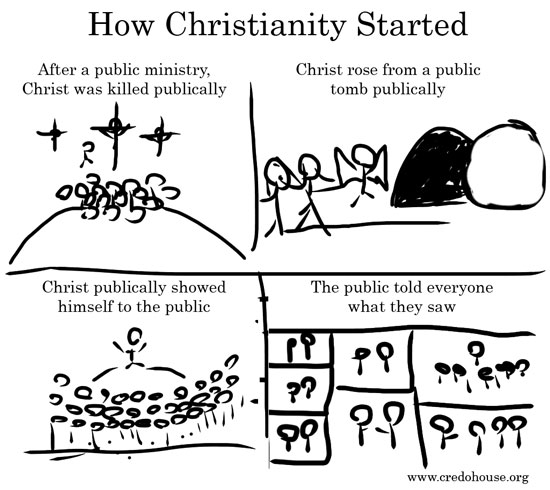
The Gospels are Eyewitness Accounts

This video (yes, it's long) will be helpful if you're working with people who can only see the Gospel accounts as legends, not eyewitness accounts.  When I read the New Testament as a young adult, I was astounded at the Gospel stories in particular.  I realized that made-up stories are not like these.  The disciples would have made themselves look a LOT smarter, for example, if they made up the tale.  This insight was part of what God used to convict me of the Truth and reliability of Scripture.

Saturday, June 11, 2011

Does Difficulty Mean We're "Outside" God's Will?

16 As soon as Jesus was baptized, he went up out of the water. At that moment heaven was opened, and he saw the Spirit of God descending like a dove and alighting on him. 17 And a voice from heaven said, “This is my Son, whom I love; with him I am well pleased.”
1 Then Jesus was led by the Spirit into the wilderness to be tempted by the devil.
Matthew 3:16-4:1

After reading Carl Medearis’ new book (Speaking of Jesus), I’ve committed myself to investing in the four Gospel books this summer.  I need to be re-immersed in the stories of Jesus, and the stories Jesus tells.

There’s an important insight here that helps us understand God’s design for ministry. 

Jesus is baptized by his cousin John, then receives a special baptism of the Holy Spirit at the start of his three-year public ministry which will result in salvation for us.  (We don’t have time to go into it here, but we must think carefully about this baptism – the Holy Spirit was always with Jesus.  Here is a special recognition service of Jesus’ submission to the Father’s will, not some evidence of a 2nd baptism as some would say.) 

The Father says “I love Jesus and with him I am well pleased.”  He’s pleased with His son!  And what does He do?

The Father who is pleased with His Son sends Jesus into the wilderness to be tempted!  Right here at the start of the public ministry is a huge challenge, which could threaten the whole effort. 

We could talk more about fasting – which is how Jesus successfully prepares for the temptations that come at the end of 40 days – but today I just want you to see that the loving Father sends Jesus into a terrible struggle at the start of ministry.

Many great ministry efforts in history have started the same way. In retrospect we see how God was pleased with His servants, and then launched them with temptations and challenges.  The fact that we face ministry struggles may have nothing to do with God’s displeasure with us!  Early adversity does not mean that we’ve failed to follow God’s direction or made a mistake (the Spirit led Jesus into the wilderness).  Difficulty and adversity does not necessarily mean we’re outside God’s will – which should encourage us!

One of our most important roles as leaders is to encourage and teach others about this truth.  They can persevere in the strength of Christ!

Friday, June 10, 2011

Updates to My Favorite Bible Site: BibleGateway

I use BibleGateway almost every day.  It's fast, reliable, easy (and free).  Check out the updated look at this valuable site!  There some new features, too -- see the video on the main page for an overview.  Highly recommended!

Wednesday, June 08, 2011

Jesus is the Best Teacher Ever

Who would be the best teacher ever?  Jesus.  And if anyone would
understand how to get a message across, how to help people
recognize God, how to engage people and help them learn, it would
be Jesus!   He created us, right?  He knows how we're wired,
what we need, how to connect with us.

So I spent about two months studying the Gospels, looking for
clues about how Jesus taught.  I believe the Holy Spirit helped
me see it clearly, how to teach like Jesus.

Here's the big idea: Jesus Taught Using Questions, Story, and
Dialogue Because These Are the Most Effective Ways to Help People
Learn - Really Learn.

Many "traditional" methods of teaching have limited
effectiveness.  One friend of mine calls it the "line 'em up,
spray 'em down with gobs of information, and pray some of it
sticks" approach to Bible teaching.

You and I both know that isn't good enough!

If you examine Jesus' teaching approach you'll see that:

* He didn't host opinion-fests; He taught with a purpose

* His approach was effective for all ages, and for all
theological backgrounds

* He asked questions, told stories, helped people understand
things through dialogue.  He was truly present with people,
engaging them in deep dialogue (No "how's the weather?" conversations)

* His teaching was strictly oral - but so effective because he
painted pictures in people's minds through imagery and use of
visual illustrations.

* He didn't give people three-point outlines and lists

* He referred to Scriptures frequently, helped them understand
the meaning

* He got to the heart of issues, and the real issue behind the
apparent issue. Jesus understood a person's history, fears,
desires, and experiences -- and bridged from those to
experiencing God.

* He gave people what they needed at the moment, but not
everything at once

* His stories had enormous "sticking" power - and they were deep
enough that people continued to learn from them years later.

* He taught with authority. He never taught with arrogance, but
with compassion and grace.

* He never compromised on the Truth.

* He used words to break-through barriers and to build up, but
never as weapons.

You might be thinking right now, "But Glenn, Jesus is special,
He's God.  I couldn't teach like He did!"

How does your teaching compare to Jesus?  Ok, you and I are  not
equal to our Lord - but He made a promise to us that we should
take seriously:

"A student is not above his teacher, nor a servant above his
master.  It is enough for the student to be like his teacher, and
the servant like his master." (Matthew 10:24-25)

Did you catch it - it's enough for us to teach *like* Jesus did.


What About YOU?  Can You Teach the Jesus Way?

The answer is YES.  This is my conviction.  You need some
guidance, and can learn through practice.  This Jesus way of
teaching is "advanced" in some ways - but accessible even to newer
teachers and study leaders.  These are learnable skills!

And I'm confident that you can learn this Jesus way of teaching
using questions, story, and dialogue.

Is this the only way to teach?  No.  But didactic, linear, lists
and outlines teaching methods are more effective with a subset
of students -- people who are motivated to learn in that format.
But how many of those things do you remember years later?

Compare that to the meaningful conversations you've had with
another person.  Which has been more influential in transforming
your life?

Can you learn to teach the Jesus way if you're accustomed to
teaching other ways?  That's up to you.  I believe you have the
potential, I really do.  And I'm prepared to help you through the
learning process.

Monday, June 06, 2011

It's Summer -- Do You Know What Bible Teachers Should Be Doing?

Here in Iowa it's the end of the school year, and the weather is definitely summer. The corn is up, the grass is growing faster than I'd like, and the rabbits are fat from devouring our flowers. It's that odd time of year when families are sighing in relief that graduations are done, vacations are still ahead, and September feels blissfully far in the future. A lot of churches shift their schedules in the summer, too -- and many teachers take a break.

So let me give you my advice about how to use this between school-year season well.

First, take an intentional break. A change-up in rhythm is healthy.  In addition to weekly sabbath rests, we Bible teachers need seasons of rest and rejuvination.

Second, don't be lazy. Use time well, and intentionally -- it is a gift from our loving God!  Laziness dishonors our Lord.

My counsel: take the summer months to pray and study and meditate and prepare yourself for future teaching. Remember, that YOU are the tool God is using to present His Word to others. Tackle something completely different. Don't worry about preparing specific lessons. Take in nourishing information and experiences to strengthen you.

Let me give you examples of things I have done in previous summers:

* Studied Jewish culture in the 1st century.

* Worked my way through a systematic theology book often used in seminaries.

* Memorized Matthew 5-7 (the Sermon on the Mount chapters).  [Embarrasing note: I didn't work at keeping it.]

* Interviewed long-time Bible teachers for their ideas and experiences, asking them lots of questions about what they've learned.

* Immersed myself in the Psalms, but only allowing myself to read one Psalm a day. I slowly prayed through that one Psalm.

There was a very special summer of 2007 when I did a season of study which forever revolutionized how I teach.

It finally occurred to me to study how *Jesus* taught.  He's the greatest teacher ever, right?  Jesus used questions, story, and dialogue to teach.  I don't think he taught that way because it was the tradition of the time.  I think Jesus used questions, story, and dialogue because it's the BEST way to teach people, period -- any time, any age, any status, whether they are in a relationship with God or not.

This summer I'm going to invest in Matthew, Mark, Luke, and John.  I want to immerse myself in the stories about Jesus, and in the stories he tells.

I hope you'll think about what you might intentionally work on this summer to develop yourself as a teacher.

Wednesday, June 01, 2011

Where Did the Apostles Die?

Here's a map -- based on known accounts and legends -- indicating where each of the apostles died.

It's amazing how far they traveled, and the diversity of cultures they reached!  What other lessons do you observe?  How might you be able to use this in a teaching situation?

Wednesday, May 25, 2011

Human Brain Mapping

I've been watching a lot of neurobiology and psychology research these past few years, hoping to gain more insights into how people learn -- which helps us teach to change lives!

There is a remarkable scientific cataloging project going on to map the features of the human brain and patterns of gene expression.  Here is one sentence that captivated my attention:

"As they assembled the brain images and genetic data, the researchers were surprised to discover that by this neural measure, any two people are 94% alike."

Teachers, take some comfort in this: your teaching approach can be effective with many, many people. God has prewired people to be influenced powerfully by His Word!

Wednesday, May 11, 2011

Taking a Blogging Break

Folks, I'm taking a short break from blogging to focus on another project.  Be back later!  Until then, keep on teaching to change lives!

Monday, May 09, 2011

Saturday, May 07, 2011

Mining Proverbs About Money and Possessions

Kevin DeYoung gives a wonderful outline on money and possessions from Proverbs.  This would be a good foundation for some nice lessons!

Here are the ten key truths from Proverbs:

1. There are extremes of wealth and poverty that provide unique temptations to those who live in them (Prov. 30:7-9).
2. Don’t worry about keeping up with the Jones’ (Prov. 12:9; 13:7).
3. The rich and poor are more alike than they think (Prov. 22:2; 29:13).
4. You can’t out give God (Prov. 3:9-10; 11:24; 22:9).
5. Poverty is not pretty (Prov. 10:15; 14:20; 19:4).
6. Money cannot give you ultimate security (Prov. 11:7; 11:28; 13:8).
7. The Lord hates those who get rich by injustice (Prov. 21:6; 22:16, 22-23).
8. The Lord loves those who are generous to the poor (Prov. 14:21, 31; 19:7; 28:21)
9. Hard work and good decision-making usually lead to increased prosperity (Prov. 6:6-11; 10:4; 13:11; 14:24;  21:17, 20; 22:4, 13; 27:23-27; 28:20
10. Money isn’t everything. It does not satisfy (Prov. 23:4-5). It is inferior to wisdom (Prov. 8:10-11, 18-19; 24:3-4). It is inferior to righteousness (10:2; 11:4; 13:25; 16:8; 19:22; 20:17; 28:6). It is inferior to the fear of the Lord (Prov. 15:16). It is inferior to humility (Prov. 16:19). It is inferior to good relationships (Prov. 15:17; 17:1).


And then he crafts these themes or principles -- this is good teaching! Help your students learn how to derive principles from the whole of Scripture.


    * You’ll probably acquire more money if you work hard and are full of wisdom. But if all you care about is getting more money, you are the biggest fool.
    * Money is a blessing from God, but you’ll be more blessed if you give it away.
    * God gives you money because he is generous, but he is generous with you so that you can be generous with others. And if you are generous with your money, God will likely be more generous with you.
    * It is wise to save money, but don’t ever think money gives you real security.
    * Wealth is more desirable than poverty, but wealth is not as good as righteousness, humility, wisdom, good relationships, and the fear of the Lord.

And best of all, he ties is back to Jesus Christ by reviewing 1 Cor 1:30-31.  Excellent teaching model!

Read the whole article.

If you'd like more information about how to study the Bible for principles and not be limited to "verse" theology, check out Biblical Frameworks.

Thursday, May 05, 2011

Uhm...Some "Bible" Things Which Are Not True

Here are some "Bible things" that are often told...which are not true.  Worth studying, dear teachers!


1. The “eye of the needle” refers to a gate outside Jerusalem.
2. The high priest tied a rope around his ankle so that others could drag him out of the Holy of Holies in case God struck him dead.
3. Scribes took baths, discarded their pens, washed their hands, etc. every time they wrote the name of God.
4. There was this saying among the sages: “May you be covered in your rabbi’s dust.”
5. Voltaire’s house is now owned by a Bible-printing publisher.
6. Gehenna was a burning trash dump outside Jerusalem.
7. NASA scientists have discovered a “missing day” which corresponds to the Joshua account of the sun standing still.

Tuesday, May 03, 2011

What Olive Oil Teaches Us About Gethsemane

This would be a fun video to share as part of a lesson -- practical story about how olive oil was produced in the first century, but also a key insight into the sacrifice of Jesus.

Monday, May 02, 2011

Free Audio Book: The Next Story

Flash update: Tim Challies' excellent book on how we should think about this massive rush of technological change, "The Next Story" is available as this month's free audiobook download.  Recommended.

Sunday, May 01, 2011

Making Your StoryTelling More Engaging

Andy Le Peau gives some excellent suggestions to improve the engagement and interest level for your stories.  Don't just tell them chronologically! 

Start with the first half of a story and leave it hanging.
Loop back to the beginning.
Use in medias res.
Tell a story within a story.
Tell the story of how you learned something.
Raise a problem.

I encourage you to read his article for the details.  Excellent!

Friday, April 29, 2011

It's Not Enough to Ask the Lord What to Do

(This is from a short devotion I led recently for a small group of men. -- Glenn)

47 While he was still speaking a crowd came up, and the man who was called Judas, one of the Twelve, was leading them. He approached Jesus to kiss him, 48 but Jesus asked him, "Judas, are you betraying the Son of Man with a kiss?"
 49 When Jesus' followers saw what was going to happen, they said, "Lord, should we strike with our swords?" 50 And one of them struck the servant of the high priest, cutting off his right ear.

 51 But Jesus answered, "No more of this!" And he touched the man's ear and healed him.

 52 Then Jesus said to the chief priests, the officers of the temple guard, and the elders, who had come for him, "Am I leading a rebellion, that you have come with swords and clubs? 53 Every day I was with you in the temple courts, and you did not lay a hand on me. But this is your hour-when darkness reigns." 
Luke 22:47-53

This event is told in all four gospel accounts; Peter is named as the sword-swinger in John, but not the others.  It would have been an emotionally-charged, memorable event!  Situation difficult: Outnumbered, inferior weapons ("two swords" which were probably more like kitchen knives), at night, hampered terrain. 

Detail in the Luke account: the disciples ask what to do! (v49)  Then Peter charges ahead, going after (probably) the least threatening man in sight - a servant.  Of course, Peter wasn't aiming at the man's ear!  

Jesus' response is not only to Peter, but to the group.  This suggests the other disciples were going to attack as well.  Certainly the temple guards would be prepared for violence (clubs and swords v.52) It's a natural response to defend your rabbi and yourselves.  

Key application for leaders:  How often do we ask the Lord for instruction and guidance - and then move ahead with the assumption that our idea is correct?  Let's be leaders who listen carefully to God. 

Power of Words

This video is an excellent illustration of the power of words.  Teachers, it's not just what you say but how it's said.  Be willing to work hard at finding alternative ways to communicating the same truth. 

Wednesday, April 27, 2011

So You've Got a Blind Person in your Church

(This is a guest post from my friend Marda, who shares her experiences teaching the Bible to people with physical and intellectual difficulties.  We have much to learn! -- Glenn)

So You've Got a Blind Person in your Church

What to do?  Blindness!  It's always one of those disabilities that rank
high on the list of what non-disabled people think would be the worst
disability to happen to them.  That's probably because so much of what
sighted people do, from academic pursuits to transportation and many other
things,  rely upon sight, sometimes to the exclusion of other senses.  So
first, let me put a different spin on things.

 Good Things About being Blind

1. You can go to parties and never have to be the designated driver.

2. When the power goes out, you have the power!

3.  Any time, light or dark, you can read provided there is enough Braille
material.

4.  Your husband doesn't care if you don't put makeup on, assuming he is
also blind which isn't always the case.

5.  You get to know the person before worrying about the outward
appearance.

6. If you happen to slip up and go out with a pair of unmatched shoes on,
you can just say they're all the rage and you have another pair just like
them at home.

7. If you have a guide dog, you can get away with going around all of the
people and cutting to the front of the line because that's where your dog is
leading you and most people will just let you pass.

8. You never have to be responsible for whatever responsibilities  the
people in those exit rows in airplanes have to do.

9. If you can't read the hymnal, nobody worries if you don't know all of the
words.

10.  Generally, you're not called on to read Scripture in Bible study.

All right.  That's the humor for this time.  Now let's get to the serious
stuff.  How can you help a blind person who comes to your church or Sunday
school class?

1. Greet the person (by name if you know it) with a smile.  It shows in your
voice.  Identify yourself even if you have spoken to the person before.  It
takes a while for someone to recognize your voice and that varies with each
person.  When they've got it, they'll start answering you back by name.

2.  If a person appears to be wandering around unsure of their way, walk up
and ask if they need help.  Some will be too proud if you ask that way so
sometimes the more tactful approach would be to say something like, "I'm
going into the sanctuary.  May I show you to a seat?"

3.  If the person accepts your offer of help, do not grab him/her by the
elbow, belt loop, underarm or shoulder.  Some tall people (like my husband)
prefer to be guided with a hand on the shoulder.  The conventional way is to
use something simple called "sighted guide technique".  This form of
guidance is probably the safest and most dignified in many respects.  The
way to do it is to offer your arm, (which one depends on whether the person
is using a dog or cane) and walk half a step in front of the person while
they lightly hold your arm.  This way, they can follow your body movements
and know when you change direction, go up or down stairs and so on.  If you
know the person is newly blind, give more verbal direction, like "step down"
or "we're turning right" but the person walking with you will quickly tell
you if you are giving too much verbal information for them.

4.  Never, ever do the following:
A. Grab the other end of the person's cane and drag him/her around by it.
B. Grab any part of a guide dog, especially the harness, and attempt to lead
that way.  If the person has a guide dog, ask if it is best for the dog to
follow or for the person to drop the harness handle and hold the leash in
one hand while you do sighted guide with the other.

5.  When doing sighted guide and showing someone to a seat, it is a
considerate thing to put the person's hand on the back or seat of the chair
so it can be more easily located.

6.  When you have been talking to a blind person or group of blind people
and leave them for any reason, let them know you're leaving even if it's
just to run across the room to speak to someone else.  Believe me, it's no
fun talking to the air!

7.  Be specific in your directions.  "There's a seat over there," is not
helpful.  "There's an empty chair two chairs to your right." is more precise
and less likely to create confusion.

8.  If you are at a social event which involves eating, like a church supper
or picnic, ask the person whether he/she would like to go through the line
or if they would prefer you to bring a plate to them.  Many people want to
go through the line and make sure they find out about every dish and get
what they want.  Some, however, feel uncomfortable doing that and would
rather have you tell them what the food is and not have to try to balance a
plate, cup, silverware or other such things with a cane or dog and still go
sighted guide.  When you sit down to eat, ask if the person would like to be
shown where the food is on the plate.  A common practice is to treat the
plate like the face of a clock.  So it would go something like, "Your meat
is at twelve, mashed potatoes at three, carrots at six, salad at nine etc.
Some people, especially at pot luck suppers where there are a lot of
different dishes and sampling anything you like is the order of the day,
will use more than just the main four points of the clock.  I've known
people who will say, "There's some sort of rice casserole at eight-thirty,
three bean salad is at eleven etc.  You may not need to do this at all or
the person might like just a general idea of where the food is on the plate.

9.  If you are directing the person to a rest room and you tell them where
things like the sink and toilet are inside, don't forget the toilet paper!
I'm not kidding.  That stuff is the hardest thing to find in a restroom.
Sometimes it's on the left.  Sometimes it's on the right.  Sometimes it's
straight across from the throne and sometimes it's not even on a holder at
all but is perched on the back of the toilet tank!
Some other things you may want to point out are things like whether there is
a blow dryer for the hands or paper towels above (the middle, left or right)
sink, if there is a "handicapped" stall (helpful if the person has a large
guide dog) and which stall it is.

10.  Overwhelmed yet?  Please don't be.  It's not as hard as it looks.  You
don't have to tackle every situation at once.  There will be others to help
and often those to whom you are ministering will give you the cues.  Treat
them with the respect with which you'd like to be treated.  Don't talk about
a blind person as if they're not there.  Chances are they're not deaf.  If
you make a mistake telling someone left instead of right (which is easy to
do if you're facing a person) well, you're human.

Though I have tried to keep this article in a humorous tone, there really
are some things that will turn a blind person off the minute you say them.
One is something like "Oh, you're so lucky to be blind.  You don't have to
see all of the evil in the world."  Believe me, I've known plenty of evil in
this world.  Also, don't assume that just because someone is blind, that
person will automatically have deep spiritual insight.  We're people just
like you and insight varies and has little to do with whether or not a
person is blind.

I hope the foregoing information has been helpful in giving you some
specific ideas about interacting with blind and visually impaired people.
There will be more issues addressed in future articles about ministering to
this population as well as to those with other disabilities. 

Tuesday, April 26, 2011

It Only Takes One: Jenny and Helen's Story

(This is a guest post from my friend Marda, who shares her experiences teaching the Bible to people with physical and intellectual difficulties.  We have much to learn! -- Glenn)

It Only Takes One: Jenny and Helen's Story

Helen had arrived early at church that morning.  Since there was time before
her Bible study class, she headed for the church library to check out some
books for the week.  Helen loved to read and it was one of the few pleasures
left to her at age eighty-seven.  She smiled and greeted several people as
she walked slowly toward the library.

The incongruous sound of a television blaring cartoons caught her ear.  She
knew her hearing wasn't as acute as it had been but this was unmistakable.
Why, she wondered, would a video of cartoons be playing in the church
building?

Intrigued, she looked into the room.  One young woman sat alone in front of
the TV.  Helen went in and greeted the young woman.

"Hi.  I'm Helen.  Are you waiting for Sunday school to start?  It's almost
time."

"I am in Sunday school," the girl replied in a matter-of-fact and somewhat
distracted tone.  "They always let me watch cartoons in Sunday school and
church time."

Helen was stunned.  What was going on here?

"Enjoy your cartoons," she said, waving a goodbye as she left the room.

Helen went on to the library and to her Sunday school class and church.  But
she couldn't get the image of the girl in front of the TV out of her mind.
When the girl was there again the next week Helen resolved to find out more.
Maybe she was being a busybody but something just didn't seem right.

She began with the Christian Education Director.

"I'm not trying to pry," she said when they sat down together.  "But I
couldn't help noticing this young woman in front of the TV during Sunday
school time.  Do you know what that's all about?"

"Oh, that's Jenny," the director said in a tired voice.  "She just doesn't
fit in any of the Sunday school departments.  She has the mind of a child
but if we put her in a class with the kids or teens, she gets teased and
bored and then acts out.  If we put her with adults, she can't follow what's
going on and gets bored, paces the room and finally leaves to wander the
halls.  We just don't know what to do with her.  We don't want to discourage
her family from coming to the church so we keep Jenny busy, she stays out of
the way and enjoys herself."

Helen had had no previous experience teaching people with disabilities.  She
wasn't a teacher by profession.  She had been a hairdresser all her life and
even after retirement she volunteered to do hair at nursing homes.  But
standing on her feet was getting to be too much and she had recently stopped
doing that.  She needed fulfillment in her life and wanted to minister.  She
had taught children in Sunday school in the past.  Still, she hesitated.
She knew this woman needed to hear about the love of Christ.  But should she
get involved?  Or should she?

"How would it be," she began slowly, "if I started teaching her about Jesus?
I'm not sure how; I've had no experience.  But I can't get her out of my
mind.  It would sure beat the Roadrunner," she laughed gently.  "I could use
that room with the TV that she's familiar with.  I was always a good
storyteller to my kids and grandkids.  I'd be willing to try to teach her."

"She might not have the attention span," the director was doubtful.  "But
maybe one on one . . . You could try.  She may be resistant to giving up her
cartoons though.

"Nonsense!  She can watch cartoons at home.  She probably does.  Let me give
her some special time.  I've been praying about it and I really do feel that
it's what God would like me to do."

Arrangements were made and Helen began teaching Jenny the next week.  Using
an illustrated "Good News for Modern Man" Bible, she began to talk about the
love of Jesus.  It was slow going.  But after a year, Jenny had understood
enough that she knew she was a sinner in need of Jesus and she had accepted
him.  In addition, she had asked two of her friends from the goodwill store
where she worked to come to the class as well and they were attending on a
regular basis.  In church, she learned to sing some of the songs and
actually had a nice singing voice.  She began reaching out to others,
spontaneously greeting them on Sundays.  Helen convinced church staff that
she would make a good greeter so she began passing out bulletins at the
church door.  It became clear that Jenny was starting to pray as she often
prayed for requests in her small Sunday school class.  And Helen?  She had a
new lease on life.

Do you have a Jenny or a John in your church who may be in a similar
situation?  Is there someone who has an intellectual disability who just
doesn't seem to fit anywhere?  If an eighty-seven-year-old woman could reach
out and start such a ministry, could you accept the challenge?  If not,
could you pray for someone who would?

(Marda's next article will be published tomorrow.)

Monday, April 25, 2011

Teaching Those with Physical and Intellectual Difficulties

(This is a guest post from my friend Marda, who is herself blind and has had an effective ministry teaching the Bible to those with physical and intellectual difficulties of many types.-- Glenn)

Reaching and Teaching the World for Christ?
 Can you think of any population groups in your church or community that
may be under-served or not ministered to at all?

My name is Marda and my calling is to minister to and teach people of all
walks of life and classes who happen to have special needs.  These needs may
range from one-on-one mentoring during Sunday school and church services to
providing help to a person with medical needs to providing materials in
accessible format for visually impaired, blind or learning disabled students
to having a special class or group for those with intellectual disabilities,
to providing transportation for those who can't get to church  or to finding
various ways to welcome those who have serious mental illness.

In this series of articles, drawn from my years in disability ministry in
various settings, I plan to share some ideas which I hope will inspire you
to reach out to those who are often forgotten, people with disabilities.

Who am I?  I am a middle-aged woman, a special ed. teacher and music
therapist by profession and have been a Christian for over thirty years.
I've got the letters after my name and the diplomas to show my education
but, while it was a good one, most of what I am going to share comes from
life experience.  Within the Christian community I have worked in a wide
variety of capacities from starting Sunday school departments for adults who
have intellectual disabilities to teaching children and adults with a
diverse array of learning differences to working with families, caregivers
and other church members in helping to make the church experience a little
easier for those whom the world sees  as disabled.  I currently work with a
special ed. ministry in a church and with a Bible study for blind
participants.  In addition, I am working to develop a ministry resource that
can be used for increasing outreach to those who have special physical,
emotional and learning needs.  We all have these basic needs and most
importantly, everyone, no matter how disabled they seem, deserves to have
the chance to know the love of Christ and of His church.

What can you do, even as one person, to reach out to this special
population?  You can begin with those already in your church who seem
different and who often seem lonely.  I have a blind friend whose pet peeve
is that he sits in an empty pew every Sunday.  He feels frustrated because
he feels that he can't simply ask to sit with a group of people.  He doesn't
want to impose.  But he's a wonderful, fun, intelligent articulate person.
Maybe there is someone in your church like that.  But how would you know
unless you engaged that person?  Start with a smile and a greeting.  But
don't just stop there.  If someone is sitting alone, ask if they'd like to
join your group in the pew or sit beside you in Bible study class.  The
worst someone can do is say no and at least you know you've tried.

In future articles I plan to offer information about various special needs
groups and how you can reach out to and teach those who are already in your
church or reach out into the wider community to welcome them in.  I pray
that reading this will be the beginning of a wonderful journey as you get to
know some of your brothers and sisters that you may not have thought to try
to get to know in the past.  I pray that God will put that desire into your
hearts.

(Marda's next article will be published tomorrow)

Saturday, April 23, 2011

The Story of the King James Bible

I heartily recommend to you to this DVD which tells the story of the King James Bible.  Wonderfully done, with outstanding presentation by John Rhys-Davies (who doesn't love this man's voice?).  This would be fun for a small group to watch and discuss.  You'll see the Providence of God at work.

Thursday, April 21, 2011

"Communication is What the Listener Does"

The guys at Manager Tools have a saying: "Communication is what the listener does." 

Sidebar: if you're in business, or manage people, you need to listen to Manager Tools -- free podcasts, outstanding content! 

There's truth here for Bible teachers.  You may think all the communication rests on you, but the key part rests with the people you are teaching.  No learning happens without their engagement.  Let me say that again, clearly: No learning happens without their engagement.

Therefore you want to make it easy for them to learn from you, by keeping them engaged.  Make it easy and enjoyable for them to listen (even if the message is sometimes hard).  Don't overload them, or it will all drain out the ears without getting in any deeper. 

Tuesday, April 19, 2011

Holy Week Timeline

This visualization of the Holy Week timeline is amazing, well-worth your time. It's exactly the sort of presentation that can help your students understand the sequence and placement of events.

Simple Small Group Curriculum

You can do a lot worse than this small group curriculum!   Read a passage together and answer these questions:

1. What did you like about the passage?


2. What did you NOT like about the passage?

3. What did you not understand in the passage?

4. What did you learn about God in the passage?

5. What are you going to do with what you learned?

Teachers, remember that your task is to facilitate learning and application.  Don't underestimate the power of this simple approach!

Friday, April 15, 2011

Good overview of Biblical History

Here are two excellent outlines of Biblical history by Goldsworthy:

Outline of Biblical History
Main Chapters in the Biblical Storyline

Here is a corresponding 15 page chronological Bible reading plan (PDF file)

I recommend these because as a Bible teacher one of our more challenging tasks is helping our students understand the big picture of the Bible.  Too many of us are stuck down in the verses and not fitting those verses into the overall story!

Wednesday, April 13, 2011

Want to Be Wiser? Read This Book

If you want to be wiser working with people and situations, there is one book that will help you more than any other: Proverbs. 

Proverbs frames the world in the fundamental differences between wise people and fools.  It's your success manual for practical wisdom in dealing with people. 

Now you read the 31 chapters in an hour, and then lay it aside.  But that's not my recommendation.  Instead, read a chapter a day.  There are 31 chapters, so simply read the chapter that corresponds to the day of the month.  Takes 5-10 minutes.  Trust me, a verse or two will "pop out" for you to reflect on more. 


You'll find that new insights come as you read this way, over a period of years, and encounter new people and situations.  

Monday, April 11, 2011

Be a Book Reader, Not Just a Book Buyer

From Tim Challies:

"Alexander Whyte loved books, and he read them to his dying day. The Puritans in general and Thomas Goodwin in particular were his main diet. But he also thrived on the mystics and the princes of the Scottish church, such as Samuel Rutherford. Whyte constantly ordered books for himself and his friends in the ministry. However, he cautioned young pastors against becoming book-buyers instead of book-readers. “Don’t hunger for books,” he wrote a minister friend. “Get a few of the very best, such as you already have, and read them and your own heart continually.” Whyte often contrasted two kinds of reading—“reading on a sofa and reading with a pencil in hand.” He urged students to keep notebooks and to make entries in an interleaved Bible for future reference. “No day without its line” was his motto. He wrote to Hubert Simpson: “for more than forty years, I think I can say, never a week, scarcely a day, has passed, that I have not entered some note or notes into my Bible: and, then, I never read a book without taking notes for preservation one way or another.” "

Saturday, April 09, 2011

A Key Question to Ask

We read something critically important for teachers in Romans 15:4:

"For everything that was written in the past was written to teach us, so that through endurance and the encouragement of the Scriptures we might have hope."

Therefore, here is a key question you should ask when you prepare to teach from a passage:

Why is this in the Bible, and what are we to learn from this?

Prayerful explore answers to that question, and you'll be teaching to change lives.

Thursday, April 07, 2011

If/Then in John 1

This would make the foundation for a wonderful lesson or series of devotions! 

Tuesday, April 05, 2011

Getting Feedback

Open question today: How do you get feedback on your teaching, so you can improve?  Comment away. 

Sunday, April 03, 2011

What Bible Study Tools You Need

I'm often asked which Bible study tools teachers need, or I recommend.  I wrote a whole report on this (it's free) where I cover what I think is essential, what you should have, and what you should consider adding. It's less than you might think.  Enjoy the free report.

Friday, April 01, 2011

Communicating For a Change

Teaching is centered on communicating for change -- and the one of the best books written on this subject is from Andy Stanley:

Communicating for a Change


Recommended!

Thursday, March 31, 2011

Thinking Wisely Using Biblical Frameworks

This week I've had four different conversations with people who were struggling to understand how to deal with complex situations -- but situations the Bible does speak to!  The issue for them is that it didn't fall neatly into a phrase they could find in their concordance. 

If you'd like to improve your ability as a teacher to understand how the Bible speaks to contemporary and challenging situations (like bioethics, parenting styles, dealing with local tax laws, or job choices), then I recommend you get Think Wisely Using Biblical Frameworks. 

Sunday, March 27, 2011

Ask for Prayer

I humbly remind you, dear teacher, to ask people to pray for you and your ministry of teaching God's Word.  Do not hesitate, do not think it makes you look weak, put aside any pride on this -- ASK for prayer support. 

People to ask:

Your pastor(s) or minister(s)
Your spouse
Other teachers
Key people who know you well, especially your weaknesses
Your students

Friday, March 25, 2011

How to OverCome Fear

Check out my free report on overcoming fear.  You'll learn:
  • The #1 Way to Overcome Fear of Teaching
  • Why the right kind of Fear gives you boldness and energy
  • The two best ways to deal with the "stress-response" fear produces in your body
  • The psychological truth about your students that will help you overcome fear

Wednesday, March 23, 2011

Grudem's Systematic Theology in Different Formats

I've been blessed by Wayne Grudem's Systematic Theology -- terrific, readable, deep in the right places, gentle-spirited.  I believe it deserves a handy spot on your reference shelf. But it's a long book, and I know many you struggle with reading long books.

The good news is that Systematic Theology is now available as a series of paperbacks or DVD talks.   Great stuff, excellent for yourself or working with teachers you are coaching.

HT: Between Two Worlds

Saturday, March 19, 2011

We Don’t Get to Rebuke the Lord

(This is from a short devotion I led recently. -- Glenn)

21 From that time on Jesus began to explain to his disciples that he must go to Jerusalem and suffer many things at the hands of the elders, the chief priests and the teachers of the law, and that he must be killed and on the third day be raised to life.22 Peter took him aside and began to rebuke him. “Never, Lord!” he said. “This shall never happen to you!”
23 Jesus turned and said to Peter, “Get behind me, Satan! You are a stumbling block to me; you do not have in mind the concerns of God, but merely human concerns.
24 Then Jesus said to his disciples, “Whoever wants to be my disciple must deny themselves and take up their cross and follow me. 25 For whoever wants to save their life[a] will lose it, but whoever loses their life for me will find it. 26 What good will it be for someone to gain the whole world, yet forfeit their soul? Or what can anyone give in exchange for their soul? 27 For the Son of Man is going to come in his Father’s glory with his angels, and then he will reward each person according to what they have done.


28 “Truly I tell you, some who are standing here will not taste death before they see the Son of Man coming in his kingdom.”


Matthew 16:21-28


Observations to apply in our lives:
• We don’t get to rebuke the Lord. We don’t get to say “No, Lord.”

• Geographic orientation – don’t get between me and my destination (Jerusalem)

• Personal orientation – we are to follow Jesus

• Top of mind concerns should be the concerns of God

• May we be small or non-existent stumbling blocks to Jesus!

Thursday, March 17, 2011

Hell is the Default Destination


Joel Beeke on Hell from Puritan Reformed on Vimeo.

It's not always comfortable to speak clearly about the reality of hell, but it's biblical.  I would add a few points to the short video above:
  • Understanding that hell is our default destination enables us to appreciate God's grace, and heaven.
  • Our ability to forgive others is rooted in the FACT that every sin against us is either dealt with by the cross of Christ, or in hell.  God is just.

Tuesday, March 15, 2011

People Do Not Drift Toward Holiness

Terrific quote from D.A. Carson, worth pondering:

“People do not drift toward holiness. Apart from grace-driven effort, people do not gravitate toward godliness, prayer, obedience to Scripture, faith, and delight in the Lord. We drift toward compromise and call it tolerance; we drift toward disobedience and call it freedom; we drift toward superstition and call it faith. We cherish the indiscipline of lost self-control and call it relaxation; we slouch toward prayerlessness and delude ourselves into thinking we have escaped legalism; we slide toward godlessness and convince ourselves we have been liberated.”

Sunday, March 13, 2011

"That Scumbag Piper!"

I recently corresponded by email with a subscriber who was furious that I referred anyone to John Piper's sermons or videos or book.  In one email he wrote "That scumbag Piper..." and ranted on about some unspecified heresies and apostasies.

As teachers we share a great responsibility to teach with integrity, to the best of our understanding, and model gracious dialogue and mutual edification for our students.

I lean conservative in my theological views, but am happy to relay good information and insights from more liberal theologians and pastors, too.  If someone disagrees with me about disputable matters, it's wrong to break fellowship and tear that person down.  We must deal with wrong teaching about non-disputable matters, of course.  Even then there is a grace-saturated process which honors the Lord and His Church.)

I strongly disagree on economic and political matters with millions of my fellow US citizens -- but they're my fellow citizens, not my enemy.  By the grace of God, I have more in common with Palestinian Christians and Pakistani Christians and Iranian Christians than I do even with my fellow American citizens. We all have a common enemy, Satan, who is delighted when we attack our fellow Christians, forgetting that we are all servants of Jesus.

In your teaching, model graciousness towards all fellow Christians.  If you feel a person has taught something wrong, work from Scripture and address it that way.  Remember that we are all under THE higher authority!

Friday, March 11, 2011

Four Parts of a Great Bible lesson

(I've published this before, but thought it was worth sharing again. -- Glenn)

Let me share with you a basic Bible lesson structure that you can use over and over again.

But first I want to warn you about some dangers.

Is there anything too hard for God? No.

Is there anything God cannot do? Yes.

God cannot tell a lie.

But people do tell lies. Some self-declared "coaches" for Bible teachers work very hard to scare you with the "complex, arcane art" of creating a bible lesson. More than one person has told me that it was so difficult that ordinary Sunday School teachers should leave it to the professionals. "Just stick with the bible lessons in X guide, and you won't have to work hard at all."

I'll be blunt: This garbage drives me nuts. It's a lie.

There is no reason for a whole generation of Sunday School teachers and small group Bible study leaders to be limited to using study guides and outlines that were written for some other audience. One lady wrote me to complain about a particular series (I'll protect the guilty by not naming it here, because I haven't examined that one myself). "Who are they writing these questions for? Someone on Mars maybe? They don't make sense to my ladies at all."

Let me give you the basic lesson structure that you can use all the time. It's proven. It works. It's easily adapted to whatever part of the Bible you are studying, or a biblical topic. It's not complicated.

Here are the four parts of a great Bible lesson:

1. Introduction. I prefer to call this a "hook," because your job is to get their attention and help them understand that what's coming is relevant and meaningful for them. One teacher friend says he aims to "hook a nerve." The hook should take about 1-3 minutes, tops.

2. Main lesson points. This is the meat of the lesson, where you are going to spend 85% of your time, maybe more. Remember that you are not doing a sermon here -- so you can build the main lesson points around key elements from the Scripture text(s), plus your questions that are designed to promote discussion. People learn better when they're engaged.

By the way, I recommend you cover less information with more discussion and engagement. If you're accustomed to racing through material, this will be hard and "feel" wrong. But real-world teaching shows that greater learning comes when you focus on fewer points and help people grasp those well.

3. The application. Teachers who are teaching to change lives ALWAYS have a life application. What are your students going to do differently this next week because of what they've learned? How can they put this into practice? How does this enhance their understanding of God's ways? We're not doing this to fill heads and tickle ears!

Ideally, this isn't a separate "section" of the lesson, but is integrated into the main lesson points.

4. The close. It's traditional to do a quick recap, maybe a preview of the next lesson, and then a closing prayer. You can do that, but there is a better way: launch them.
I taught for more than 18 years before I figured out that "close" is the wrong mindset. You just provided them with a great lesson, with good application. Don't shut it down, don't kill the energy. Instead, LAUNCH them into ministry. Make your final statements and prayer about launching them into works of service (see Ephesians 4; teachers teach and equip so that people are able to do the work of ministry in the areas God has placed them.)

So those are the four parts of a great Bible lesson.

It's not a hard concept, and I know you can make your own lesson using this format -- I've coached thousands of teachers now to do this effectively.

Even though it's a simple concept, even experienced Bible teachers are always learning how to make it better. Great Bible Teaching is a craft, not a formula.

Don't listen to the "gurus" and "professionals" who tell you that you can't create lessons or improve upon what "they" wrote. Because you can, and with God's direction and help, you'll be able to give lessons that lead to changed lives. And that's what counts!

Wednesday, March 09, 2011

Free Weekly Teaching Tips

You can sign up for my free weekly teaching tips by email.  Over 14,300 people have found helpful information this way and you can, too.

Monday, March 07, 2011

Sunday School Revolutionary

If you're teaching adult classes -- even if you're not part of a "Baptist-like" system for Sunday School, I recommend you subscribe (free) to updates from the Sunday School Revolutionary blog.  Good stuff, practical, encouraging. 

Saturday, March 05, 2011

Encouraging People!

I believe one of our roles as teachers is to encourage and build up the people God has put in our sphere of influence. I use short emails or text messages to do this, to let people know that I'm praying for them. Here's the story of one method: Bzzzzz! messages.

Thursday, March 03, 2011

What's the One Thing?

As you work on preparing your lessons, prayerfully going over material, considering opening hooks and life application, illustrations, stories, etc -- all to help people engage and understand! -- here's the powerful question I implore you to ask:

What's the One Thing God wants them to get from this?

Notice that you should ask what God wants them to get from this.

Notice that it's ONE THING. They may get more, but they need to get at least ONE THING.

Sometimes it's not going to be obvious to you. Sometimes you might have several candidates. But I guarantee that diligently, prayerfully asking this question will improve your lessons! This is teaching to change lives.