Teaching Resources, including Maps and PowerPoint Slides
Check out EBibleTeacher.com for a large collection of resources for Bible teachers, many free.
Monday, July 31, 2006

Sunday, July 30, 2006
What to Study Next?
Small group Bible studies often wrestle with the question about what to study next. Here's some good advice you should consider. One concern I have is that people assume that you need a commercially prepared study guide or a book. Please just open the Word of God and dive in as a group.
If you're teaching, and need to know what to teach next, then I highly recommend my free report:
http://www.teachtochangelives.com/whattoteach.pdf
Small group Bible studies often wrestle with the question about what to study next. Here's some good advice you should consider. One concern I have is that people assume that you need a commercially prepared study guide or a book. Please just open the Word of God and dive in as a group.
If you're teaching, and need to know what to teach next, then I highly recommend my free report:
http://www.teachtochangelives.com/whattoteach.pdf
Saturday, July 29, 2006
Bible Name Pronunciation Guide
You might want to bookmark this site.
http://www.briannelsonconsulting.com/bible/pronunciation.html
It lists hundreds of names found in the Bible. Each name is a link that opens a new page so you can hear how it is pronounced. (Make sure your computer speakers are turned on.)
There are a lot of ads near the top of the page, so you have to scroll down to get to the names.
You can use the "find" feature of your browswer (it is Ctrl-F in Internet Explorer) to quickly get to the name you want.
You might want to bookmark this site.
http://www.briannelsonconsulting.com/bible/pronunciation.html
It lists hundreds of names found in the Bible. Each name is a link that opens a new page so you can hear how it is pronounced. (Make sure your computer speakers are turned on.)
There are a lot of ads near the top of the page, so you have to scroll down to get to the names.
You can use the "find" feature of your browswer (it is Ctrl-F in Internet Explorer) to quickly get to the name you want.
Pray Confidently
This article lists 8 reasons we can stand confidently before God in prayer -- it's an encouraging reminder! (This would also be a nice short lesson on prayer.)
Teachers, pray for your students! Ask God to open their ears, open their minds, and transform their hearts.
This article lists 8 reasons we can stand confidently before God in prayer -- it's an encouraging reminder! (This would also be a nice short lesson on prayer.)
Teachers, pray for your students! Ask God to open their ears, open their minds, and transform their hearts.
Friday, July 28, 2006
InstaVerse
Here's a nifty tool (free) that you can install on your PC: InstaVerse. If you type in a Bible verse reference in your word processor or email message, it will show you the full verse if you mouse "hover" over it. Available in many translations. Slick!
Here's a nifty tool (free) that you can install on your PC: InstaVerse. If you type in a Bible verse reference in your word processor or email message, it will show you the full verse if you mouse "hover" over it. Available in many translations. Slick!
Thursday, July 27, 2006
Encourage Them to Read the Bible
Here's a helpful article with suggestions to help you encourage people to read the Bible. It's organized around these common excuses:
"I don't have time to read."
"I don't know where to begin."
"I just don't get it."
"The Bible is so dull."
"I don't see how the Bible applies to my life."
"I hear Bible readings in church every Sunday."
"The Bible makes me feel uncomfortable."
Here's a helpful article with suggestions to help you encourage people to read the Bible. It's organized around these common excuses:
"I don't have time to read."
"I don't know where to begin."
"I just don't get it."
"The Bible is so dull."
"I don't see how the Bible applies to my life."
"I hear Bible readings in church every Sunday."
"The Bible makes me feel uncomfortable."
Wednesday, July 26, 2006
Get Free Cartoons and Humor You Can Use for Teaching
Sometimes the fastest way to a person's heart and mind is through their funny bone! I recommend you take advantage of the free cartoons and humor from Christianity Today. Go here to sign up for a weekly email that delivers a cartoon and other humor.
Sometimes the fastest way to a person's heart and mind is through their funny bone! I recommend you take advantage of the free cartoons and humor from Christianity Today. Go here to sign up for a weekly email that delivers a cartoon and other humor.
Monday, July 24, 2006
Two Tips
Angie Frederickson sent me these two tips recently, and gave me permission to share them.
Tip 1: Use different color paper for multiple handouts
"I am teaching a class on how to teach the Bible and have used many handouts for reference sake. I learned from a professor at Multnomah Bible School to use various colors of paper so I can say, "Take a look at the blue page, or yellow or whatever." It has been beneficial as a time saver and avoiding confusion."
Tip 2: Practice with props ahead of time
"I might suggest practicing the prop ahead of time. I was using an empty glass on a sponge to show we are employ glasses without God's Holy Spirit (however, sometimes filled with hot air). I explained the glass was us, the water was God's Spirit. I poured some water in the glass demonstrating God's Spirit filling us and as there was more of Him, there was less of us. When I got to the top of the glass exemplifying being filled with The Spirit, I stopped and asked what happens if this is left like that. They got it when they said, "It become stagnant and the water begins to evaporate." I told them they had to keep on being filled. Then I showed them that as this happens, you begin to overflow into the dried up Christians lives (the sponge) and they begin soaking up God's Spirit. Thirsty non-believers desire the Spirit. But ,when we stop overflowing they can dry up and you become an ineffective vessel.
"So, the point is, as I practiced this at home I discovered I needed to cut a hole in the sponge because the glass tipped over. This would have been disastrous in class. Yes, I already had the sponge in a shallow container so everyone could see."
* * * *
If you have tips you'd like to share, send them to me at info@teachtochangelives.com
Angie Frederickson sent me these two tips recently, and gave me permission to share them.
Tip 1: Use different color paper for multiple handouts
"I am teaching a class on how to teach the Bible and have used many handouts for reference sake. I learned from a professor at Multnomah Bible School to use various colors of paper so I can say, "Take a look at the blue page, or yellow or whatever." It has been beneficial as a time saver and avoiding confusion."
Tip 2: Practice with props ahead of time
"I might suggest practicing the prop ahead of time. I was using an empty glass on a sponge to show we are employ glasses without God's Holy Spirit (however, sometimes filled with hot air). I explained the glass was us, the water was God's Spirit. I poured some water in the glass demonstrating God's Spirit filling us and as there was more of Him, there was less of us. When I got to the top of the glass exemplifying being filled with The Spirit, I stopped and asked what happens if this is left like that. They got it when they said, "It become stagnant and the water begins to evaporate." I told them they had to keep on being filled. Then I showed them that as this happens, you begin to overflow into the dried up Christians lives (the sponge) and they begin soaking up God's Spirit. Thirsty non-believers desire the Spirit. But ,when we stop overflowing they can dry up and you become an ineffective vessel.
"So, the point is, as I practiced this at home I discovered I needed to cut a hole in the sponge because the glass tipped over. This would have been disastrous in class. Yes, I already had the sponge in a shallow container so everyone could see."
* * * *
If you have tips you'd like to share, send them to me at info@teachtochangelives.com
Carved on the Palm of His Hands
I have been singing the hymn below frequently this past week. The lyric "my name is graven on his hands" comes from Isaiah 49:16. Some thoughts that occurred to me as I've meditated on this image:
* My name is carved on his palms, not scrawled there in ballpoint pen. It took significant purpose to put my name there. It's not going to wear off.
* Hands are remarkably sensitive. There would be some pain involved to carve my name there!
* If the Father has a question about Glenn Brooke for Jesus -- who is at his right hand interceding for me (Rom 8:34), Jesus will just hold out his hand to the Father. Question answered. And then they'll give each other a high five!
I have been singing the hymn below frequently this past week. The lyric "my name is graven on his hands" comes from Isaiah 49:16. Some thoughts that occurred to me as I've meditated on this image:
* My name is carved on his palms, not scrawled there in ballpoint pen. It took significant purpose to put my name there. It's not going to wear off.
* Hands are remarkably sensitive. There would be some pain involved to carve my name there!
* If the Father has a question about Glenn Brooke for Jesus -- who is at his right hand interceding for me (Rom 8:34), Jesus will just hold out his hand to the Father. Question answered. And then they'll give each other a high five!
Saturday, July 15, 2006
Great Hymn
I really enjoyed this hymn at PK this year. I was delighted to find that it dates from 1863! I was particular blessed by the refrain "my name is graven on His hands, my name is written on His hears" -- see Isaiah 49:16. Solid theology, Christ-centered praise!
I really enjoyed this hymn at PK this year. I was delighted to find that it dates from 1863! I was particular blessed by the refrain "my name is graven on His hands, my name is written on His hears" -- see Isaiah 49:16. Solid theology, Christ-centered praise!
Before the throne of God above
I have a strong and perfect plea.
A great high Priest whose Name is Love
Who ever lives and pleads for me.
My name is graven on His hands,
My name is written on His heart.
I know that while in Heaven He stands
No tongue can bid me thence depart.
When Satan tempts me to despair
And tells me of the guilt within,
Upward I look and see Him there
Who made an end of all my sin.
Because the sinless Savior died
My sinful soul is counted free.
For God the just is satisfied
To look on Him and pardon me.
Behold Him there the risen Lamb,
My perfect spotless righteousness,
The great unchangeable I AM,
King of glory and of grace,
One in Himself I cannot die.
My soul is purchased by His blood,
My life is hid with Christ on high,
With Christ my Savior and my God!
Words: Charitie L. Bancroft, 1863.
Friday, July 14, 2006
Dual Destiny
Pastor Mark Batterson points out that we have a dual destiny.
"One destiny is universal and is to be conformed to the image of Jesus Christ. "
"The other destiny is unique, to become unlike anyone who has ever lived...The goal is for each of us to be a unique expression of praise to God."
(From his 7/5/06 Evotional email)
Pastor Mark Batterson points out that we have a dual destiny.
"One destiny is universal and is to be conformed to the image of Jesus Christ. "
"The other destiny is unique, to become unlike anyone who has ever lived...The goal is for each of us to be a unique expression of praise to God."
(From his 7/5/06 Evotional email)
Thursday, July 13, 2006
Do Our Faces Reflect the Wonder of the Lord?
Gordon MacDonald points us to this excerpt from the biography of John Henry Jowett:
"We leave our places of worship, and no deep and inexpressible wonder sits upon our faces. We can sing these lilting melodies, and when we go out into the street our faces are one with the faces of those who have left the theater and the music halls. There is nothing about us to suggest that we have been looking at anything stupendous and overwhelming. Far back in my boyhood I remember an old saint telling me that after some services he liked to make his way home alone, by quiet by-ways, so that the hush of the Almighty might remain on his awed and prostrate soul. That is the element we are losing, and its loss is one of the measure of our poverty, and the primary secret of inefficient life and service."
Let us be teachers of the Word, powerfully used, so that people see the awesomeness of God in the Word, and their faces are changed!
Gordon MacDonald points us to this excerpt from the biography of John Henry Jowett:
"We leave our places of worship, and no deep and inexpressible wonder sits upon our faces. We can sing these lilting melodies, and when we go out into the street our faces are one with the faces of those who have left the theater and the music halls. There is nothing about us to suggest that we have been looking at anything stupendous and overwhelming. Far back in my boyhood I remember an old saint telling me that after some services he liked to make his way home alone, by quiet by-ways, so that the hush of the Almighty might remain on his awed and prostrate soul. That is the element we are losing, and its loss is one of the measure of our poverty, and the primary secret of inefficient life and service."
Let us be teachers of the Word, powerfully used, so that people see the awesomeness of God in the Word, and their faces are changed!
Wednesday, July 12, 2006
Monday, July 10, 2006
Theology and Application Go Hand-in-Hand
Here's a nice article about teaching for practical holiness (life application) on the foundation of strong, life-sustaining theology.
Here's a nice article about teaching for practical holiness (life application) on the foundation of strong, life-sustaining theology.
Tuesday, July 04, 2006
Discerning God's Voice
Nice article in Today's Christian Woman, "Is That You, God?" Would be useful material if you're teaching about discerning God's voice, or looking for encouragement as you are seeking Him.
Nice article in Today's Christian Woman, "Is That You, God?" Would be useful material if you're teaching about discerning God's voice, or looking for encouragement as you are seeking Him.
Saturday, July 01, 2006
Friday, June 30, 2006
Speak Boldly
If you're in teaching ministry, then I encourage you to read this passionate post from Perry Noble. Hit the issues, teaching with passion, and it's ok to hate cats. Don't worry about that one person who inevitably picks apart your lessons with fine-toothed criticisms.
If you're in teaching ministry, then I encourage you to read this passionate post from Perry Noble. Hit the issues, teaching with passion, and it's ok to hate cats. Don't worry about that one person who inevitably picks apart your lessons with fine-toothed criticisms.
Wednesday, June 28, 2006
What Do Not-Yet Believers Ask?
Figuring out what people ask questions about is part of cultural anthropology. Sales, Marketing, Advertisers, Copyrighters, media producers are all searching this out -- what do people ask about? Because it's the window to their emotions and will to buy.
We need to study what not-yet believers are asking about.
Here's my observation: Very few not-yet believers are asking the question, "What must I do to be saved?" But nearly everyone is asking "How do I make my life work better?"
Figuring out what people ask questions about is part of cultural anthropology. Sales, Marketing, Advertisers, Copyrighters, media producers are all searching this out -- what do people ask about? Because it's the window to their emotions and will to buy.
We need to study what not-yet believers are asking about.
Here's my observation: Very few not-yet believers are asking the question, "What must I do to be saved?" But nearly everyone is asking "How do I make my life work better?"
Tuesday, June 27, 2006

Christianity and the American Revolution
Christianity Today has a wonderful collection of articles discussing the Christian influences during the colonial period and the American Revolution. Recommended!
Here's one interesting excerpt from an article about preaching in colonial times:
"Over the span of the colonial era, American ministers delivered approximately 8 million sermons, each lasting one to one-and-a-half hours. The average 70-year-old colonial churchgoer would have listened to some 7,000 sermons in his or her lifetime, totaling nearly 10,000 hours of concentrated listening. This is the number of classroom hours it would take to receive ten separate undergraduate degrees in a modern university, without ever repeating the same course! The pulpits were Congregational and Baptist in New England; Presbyterian, Lutheran, and German Reformed in Pennsylvania and New Jersey; and Anglican and Methodist in the South. But no matter the denomination, colonial congregations heard sermons more than any other form of oratory. The colonial sermon was prophet, newspaper, video, Internet, community college, and social therapist all wrapped in one. Such was the range of its influence on all aspects of life that even contemporary television and personal computers pale in comparison."
Monday, June 26, 2006
Benefits of Blogging
I agree with Mark Batterson about the benefits of blogging. I think the technology has real potential for teachers who want to carry on conversations that are not close in time or space.
I agree with Mark Batterson about the benefits of blogging. I think the technology has real potential for teachers who want to carry on conversations that are not close in time or space.
Toothpick Duct-Taped to a Lead Pipe
I liked this Perry Noble post, reminding us of our position in Christ:
"Christ Jesus makes us unstoppable. Yes, I know that there is an enemy named satan…but folks–HE LOSES! Jesus defeated him on the cross and one day will ultimately kick his butt and send him to hell! WE WIN! We are empowered! And God has not called any of us to sit on the sideline–but rather to “go for it.” One of the things we need to STOP doing is imagining ourselves as weak, pathetic human beings that are not capable of accomplishing anything significant–well…if you are NOT in Christ then that is true–but in Christ you are like that lady in the truck–a powerful force. OR–like the great scholar Lee McDerment said once–that we are all like little toothpicks…and we are easily broken…but when you accept Christ then you become a toothpick that gets duct-taped to a lead pipe–and then NOTHING can shatter you because of WHO you are attached to!"
I liked this Perry Noble post, reminding us of our position in Christ:
"Christ Jesus makes us unstoppable. Yes, I know that there is an enemy named satan…but folks–HE LOSES! Jesus defeated him on the cross and one day will ultimately kick his butt and send him to hell! WE WIN! We are empowered! And God has not called any of us to sit on the sideline–but rather to “go for it.” One of the things we need to STOP doing is imagining ourselves as weak, pathetic human beings that are not capable of accomplishing anything significant–well…if you are NOT in Christ then that is true–but in Christ you are like that lady in the truck–a powerful force. OR–like the great scholar Lee McDerment said once–that we are all like little toothpicks…and we are easily broken…but when you accept Christ then you become a toothpick that gets duct-taped to a lead pipe–and then NOTHING can shatter you because of WHO you are attached to!"
Wednesday, June 21, 2006
Why Email is Good
It's fashionable to complain about email. I think we need more genuine dialogue, including face-to-face conversations. All communication, to be effective, takes training -- and we are ever learning.
David Maister makes some excellent points about why email is good:
"[E]ven though it's traditional to bemoan the increasing use of email, let me (just for the heck of it) take the other side and try to make the case (my points are serious here) why using email is INCREASING our abilities to connect:
a) You can type, re-type and re-re-type an email until it says what you want, the way you want it. Done right, there are none of the ambiguities of human speech ( "What I meant to say was..") Email can promote clarity
b) You can ask a friend or a spouse or anyone else to help you say it right. Try doing THAT in the real world. Email can promote collaboration and friendship
c) You can keep five or six (or more) conversations going at once without anyone feeling slighted that you do not have all your focus on them alone. Email means you can make everyone feel special.
d) You can keep track of what people said and hold them to their promises. Email can promote honesty.
e) Email removes the visual, body-language, verbal-accent cues that we over-rely on when reacting to other people: email can promote the importance of reason and logic, and reduces bias due to gender, racial or national background or appearance. It is profoundly democratic and politically important.
f) Email allows us to think before we react, thereby promoting less stress, thoughtless comments and knee-jerk reactions. It allows people who are not naturally quick at interpreting other people's remarks to reflect and respond with greater emotional intelligence. Email can facilitate good relationship interactions and language."
It's fashionable to complain about email. I think we need more genuine dialogue, including face-to-face conversations. All communication, to be effective, takes training -- and we are ever learning.
David Maister makes some excellent points about why email is good:
"[E]ven though it's traditional to bemoan the increasing use of email, let me (just for the heck of it) take the other side and try to make the case (my points are serious here) why using email is INCREASING our abilities to connect:
a) You can type, re-type and re-re-type an email until it says what you want, the way you want it. Done right, there are none of the ambiguities of human speech ( "What I meant to say was..") Email can promote clarity
b) You can ask a friend or a spouse or anyone else to help you say it right. Try doing THAT in the real world. Email can promote collaboration and friendship
c) You can keep five or six (or more) conversations going at once without anyone feeling slighted that you do not have all your focus on them alone. Email means you can make everyone feel special.
d) You can keep track of what people said and hold them to their promises. Email can promote honesty.
e) Email removes the visual, body-language, verbal-accent cues that we over-rely on when reacting to other people: email can promote the importance of reason and logic, and reduces bias due to gender, racial or national background or appearance. It is profoundly democratic and politically important.
f) Email allows us to think before we react, thereby promoting less stress, thoughtless comments and knee-jerk reactions. It allows people who are not naturally quick at interpreting other people's remarks to reflect and respond with greater emotional intelligence. Email can facilitate good relationship interactions and language."
Wounded Worship
I know many of you are very interested in worship issues. Read this tender interview with Michael Card about worship when we are wounded and hurting.
I know many of you are very interested in worship issues. Read this tender interview with Michael Card about worship when we are wounded and hurting.
Tuesday, June 20, 2006
What Kind of Teaching Are You Doing?
Andy Stanley suggests there are three kinds of Bible teaching:
1. Teaching the Bible to people
2. Teaching People the Bible
3. Teaching People how to live a life that reflects the values, principles, and truths of the Bible
What kind are you doing? I'm recommending that you go with #3!
Read the whole article here -- worth your time.
Andy Stanley suggests there are three kinds of Bible teaching:
1. Teaching the Bible to people
2. Teaching People the Bible
3. Teaching People how to live a life that reflects the values, principles, and truths of the Bible
What kind are you doing? I'm recommending that you go with #3!
Read the whole article here -- worth your time.
Saturday, June 17, 2006
Writing "Today's Psuedochristian Version"
Sometimes the best way to get the real meaning of a Bible passage across to a group is to give them a made-up version that is ironic, satirical, or sarcastic. The made-up version has to sound like how some people really think -- the contrast effect is what helps people learn!
I'm teaching tomorrow on Hebrews 12:1-3. Here's the made-up version I've created to help this group recognize and grip the REAL instruction:
“Anyway, as long as you think people are watching, don’t be seen holding on to extra trinkets and gear, but leave them conveniently nearby so you can pick them up again. Since nobody really knows what’s around the bend, don’t push yourself beyond a sensible run-walk pace, and take breaks at every scenic turnout in the road. Look at Jesus occasionally, certainly on Sunday morning, and make sure others see you doing it. It’s his fault your in this mess, after all. Just because Jesus suffered doesn’t mean you have to, and besides, he died a long time ago in a country far, far away. If you get discouraged, well, other people sometimes feel that way. Buck up, plan to start again soon, and hopefully you’ll feel more like running later on.”
(I refer to this as "Today's Pseudochristian Version")
Here's the authentic text (NIV) so you can the comparison effect:
“Therefore, since we are surrounded by such a great cloud of witnesses, let us throw off everything that hinders and the sin that so easily entangles, and let us run with perseverance the race marked out for us. Let us fix our eyes on Jesus, the author and perfecter of our faith, who for the joy set before him endured the cross, scorning its shame, and sat down at the right hand of the throne of God. Consider him who endured such opposition from sinful men, so that you will not grow weary and lose heart.”
This approach generates great discussion -- and changed lives.
Sometimes the best way to get the real meaning of a Bible passage across to a group is to give them a made-up version that is ironic, satirical, or sarcastic. The made-up version has to sound like how some people really think -- the contrast effect is what helps people learn!
I'm teaching tomorrow on Hebrews 12:1-3. Here's the made-up version I've created to help this group recognize and grip the REAL instruction:
“Anyway, as long as you think people are watching, don’t be seen holding on to extra trinkets and gear, but leave them conveniently nearby so you can pick them up again. Since nobody really knows what’s around the bend, don’t push yourself beyond a sensible run-walk pace, and take breaks at every scenic turnout in the road. Look at Jesus occasionally, certainly on Sunday morning, and make sure others see you doing it. It’s his fault your in this mess, after all. Just because Jesus suffered doesn’t mean you have to, and besides, he died a long time ago in a country far, far away. If you get discouraged, well, other people sometimes feel that way. Buck up, plan to start again soon, and hopefully you’ll feel more like running later on.”
(I refer to this as "Today's Pseudochristian Version")
Here's the authentic text (NIV) so you can the comparison effect:
“Therefore, since we are surrounded by such a great cloud of witnesses, let us throw off everything that hinders and the sin that so easily entangles, and let us run with perseverance the race marked out for us. Let us fix our eyes on Jesus, the author and perfecter of our faith, who for the joy set before him endured the cross, scorning its shame, and sat down at the right hand of the throne of God. Consider him who endured such opposition from sinful men, so that you will not grow weary and lose heart.”
This approach generates great discussion -- and changed lives.
Thursday, June 15, 2006
Using Biblical Terms
Part of our responsibility as teachers is to help people think biblically, and counter-culturally. Let me give you two examples.
The first is aptly described in this quote from Cal Thomas: "Remember sin? Sinful is what we were before we became 'dysfunctional.' "
It's popular now to attribute all kinds of behaviors -- from alcoholism to homosexuality to road rage (or as it was recently documented by researchers as 'intermittant explosive disorder') -- to genetics. The real objective, I believe, is to give people an excuse from personal responsibility.
My second example is 'apology.' Search the Bible and you will not find this word used as we do. You've all witnessed the scene a child is commanded, "Say your sorry." Usually it's said with derision and scorn, and not meant. This is light-years from the biblical model of asking forgiveness.
Help your students see these things, using biblical language and examples.
Part of our responsibility as teachers is to help people think biblically, and counter-culturally. Let me give you two examples.
The first is aptly described in this quote from Cal Thomas: "Remember sin? Sinful is what we were before we became 'dysfunctional.' "
It's popular now to attribute all kinds of behaviors -- from alcoholism to homosexuality to road rage (or as it was recently documented by researchers as 'intermittant explosive disorder') -- to genetics. The real objective, I believe, is to give people an excuse from personal responsibility.
My second example is 'apology.' Search the Bible and you will not find this word used as we do. You've all witnessed the scene a child is commanded, "Say your sorry." Usually it's said with derision and scorn, and not meant. This is light-years from the biblical model of asking forgiveness.
Help your students see these things, using biblical language and examples.
There's More to Learn
"The best teachers drive themselves to be continuous learners." —Wendy Kopp
We are always sharpening our craft of teaching. There is no teacher who cannot improve, and does not have more to learn. And the Bible is inexhaustible! So great Bible teachers are always on the learning track.
What a privilege!
"The best teachers drive themselves to be continuous learners." —Wendy Kopp
We are always sharpening our craft of teaching. There is no teacher who cannot improve, and does not have more to learn. And the Bible is inexhaustible! So great Bible teachers are always on the learning track.
What a privilege!
Wednesday, June 14, 2006
Free Teaching Tips
Just a quick reminder -- you can sign up to get a teaching tip each week by email.
Just a quick reminder -- you can sign up to get a teaching tip each week by email.
Monday, June 12, 2006
Do You Use This Speaker's Trick?
You may have learned this speaker's "trick" in school: "Webster's Dictionary defines ________ as...." It's supposed to give you extra credibility, educate your audience, and get their attention.
My opinion: this trick isn't effective on audiences, and is overused.
It's good to define words. Just don't reference Webster's Dictionary. Instead ask people in the group to give you a definition of a the word, or give you related words (even antonyms) -- that engages people. You follow-up their answers with any additional insights, and steer the conversation where you want to go.
You may have learned this speaker's "trick" in school: "Webster's Dictionary defines ________ as...." It's supposed to give you extra credibility, educate your audience, and get their attention.
My opinion: this trick isn't effective on audiences, and is overused.
It's good to define words. Just don't reference Webster's Dictionary. Instead ask people in the group to give you a definition of a the word, or give you related words (even antonyms) -- that engages people. You follow-up their answers with any additional insights, and steer the conversation where you want to go.
Friday, June 09, 2006
Thoughts on Preparation
Here is how T.D. Jakes prepares to preach:
1. Study yourself full
2. Think yourself clear
3. Pray yourself hot
4. Let yourself go
This is good advice for Bible teachers, as well. I love the image of praying until we're hot, so we can clearly pour out what we've studied.
He points out that #2 is critical, often overlooked. If you know what to communicate -- what's the end result God wants to see in your class, in these individuals -- then it's so much easier to design a learning session that will change lives.
Here is how T.D. Jakes prepares to preach:
1. Study yourself full
2. Think yourself clear
3. Pray yourself hot
4. Let yourself go
This is good advice for Bible teachers, as well. I love the image of praying until we're hot, so we can clearly pour out what we've studied.
He points out that #2 is critical, often overlooked. If you know what to communicate -- what's the end result God wants to see in your class, in these individuals -- then it's so much easier to design a learning session that will change lives.
Doing Greater Things
Here's a useful discussion about what Jesus meant in John 14:12, "I tell you the truth, anyone who has faith in me will do what I have been doing. He will do even greater things than these."
Here's a useful discussion about what Jesus meant in John 14:12, "I tell you the truth, anyone who has faith in me will do what I have been doing. He will do even greater things than these."
Pray for Our Brothers and Sisters in China
The Church is flourishing in China, despite persecution. Please continue to pray for God's holy fire to sweep through millions of hearts in this country, and around the world.
The Church is flourishing in China, despite persecution. Please continue to pray for God's holy fire to sweep through millions of hearts in this country, and around the world.
Tuesday, June 06, 2006
Spiritual Beachheads
Remember today, the 62nd anniversary of D-Day, and remember that God is at work creating and using His Church and His people as spiritual beachheads. I write about this today on Be Bold, Be Gentle, my blog to encourage men.
Remember today, the 62nd anniversary of D-Day, and remember that God is at work creating and using His Church and His people as spiritual beachheads. I write about this today on Be Bold, Be Gentle, my blog to encourage men.
Sunday, June 04, 2006
Hendricks on Teaching
Howard Hendricks has influenced thousands directly, and hundreds of thousands indirectly. I highly recommend his instruction for teachers. You can read a tip-packed excerpt from Mastering Teaching here.
Howard Hendricks has influenced thousands directly, and hundreds of thousands indirectly. I highly recommend his instruction for teachers. You can read a tip-packed excerpt from Mastering Teaching here.
Saturday, June 03, 2006
English Standard Version?
I'm looking for people who have been using the English Standard Version translation of the Bible. I continue to read positive press, but would like some personal testimonies. Please contact me at info@teachtochangelives or add a comment about your experience. Thanks!
I'm looking for people who have been using the English Standard Version translation of the Bible. I continue to read positive press, but would like some personal testimonies. Please contact me at info@teachtochangelives or add a comment about your experience. Thanks!
Friday, June 02, 2006
Hooking Your Audience
Bruce Johnson claims it's the number one mistake preachers make -- failing to "hook" the audience at the start of the sermon. I think this is critical for teachers also, because if you don't engage people's attention, there just flat-out won't be much learning or growing or thinking.
Bruce Johnson claims it's the number one mistake preachers make -- failing to "hook" the audience at the start of the sermon. I think this is critical for teachers also, because if you don't engage people's attention, there just flat-out won't be much learning or growing or thinking.
Thursday, June 01, 2006
Loving God With Your Medial Ventral Prefrontal Cortex
That's the idea that Mark Batterson proposes in his blog. He's starting a sermon series on neurology and faith. He makes an excellent point:
"I have this conviction: every ology is a branch of theology. That is based on Romans 1:20. Every branch of science reveals a new dimension of the Creator."
Yes!
That's the idea that Mark Batterson proposes in his blog. He's starting a sermon series on neurology and faith. He makes an excellent point:
"I have this conviction: every ology is a branch of theology. That is based on Romans 1:20. Every branch of science reveals a new dimension of the Creator."
Yes!
Kevin Gets It! How About You?
My good friend Kevin Nelstead marks up his wide-margin Bible. He's creating a fabulous study and teaching tool, and interacting with the Word. This is what I do myself and recommend to all my students -- and to every serious Bible teachers.
My good friend Kevin Nelstead marks up his wide-margin Bible. He's creating a fabulous study and teaching tool, and interacting with the Word. This is what I do myself and recommend to all my students -- and to every serious Bible teachers.
Sunday, May 28, 2006
America's Similarities to Corinth
Christianity Today has posted an excellent article pointing out similarities between post-modern American culture and 1st century life in Corinth. Worth your time.
Christianity Today has posted an excellent article pointing out similarities between post-modern American culture and 1st century life in Corinth. Worth your time.
Saturday, May 27, 2006
Do You Have These Ministry Skills?
Rick Warren has compiled "35 Ministry Skills You'll Need in the 21st Century." There's no way any one person could have all 35 skills in sufficient amounts, but that's ok. We're a body, right?
Read through these and ask yourself how many of these skills would have been appropriate in the first century, and the second, etc.
Rick Warren has compiled "35 Ministry Skills You'll Need in the 21st Century." There's no way any one person could have all 35 skills in sufficient amounts, but that's ok. We're a body, right?
Read through these and ask yourself how many of these skills would have been appropriate in the first century, and the second, etc.
Death by Ministry
If you're a pastor and/or serious Bible teacher, or want to understand how to help your church leadership and staff, you must read this article: Death by Ministry.
Mark Driscoll begins with some sobering statistics about burnout in ministry, then gives some outstanding counsel for how to prepare yourself and guard yourself for long-term Kingdom impact.
Give this to your pastors. Even if they know these things (and they may). "It is as important to be reminded as to be informed." -- Richard Halverson
If you're a pastor and/or serious Bible teacher, or want to understand how to help your church leadership and staff, you must read this article: Death by Ministry.
Mark Driscoll begins with some sobering statistics about burnout in ministry, then gives some outstanding counsel for how to prepare yourself and guard yourself for long-term Kingdom impact.
Give this to your pastors. Even if they know these things (and they may). "It is as important to be reminded as to be informed." -- Richard Halverson
Getting People to Talk about Their Passions
One of the useful skills for teachers and leaders -- which anyone can sharpen -- is the skill in starting and sustaining conversations. I'm not talking now about formal class or bible study times but in the other times when we're with people. Here are some practical ways to invite people to talk about what they're passionate about.
Once people begin talking, you're ability to understand how to present information to them is going to skyrocket! And people love to be listened to. It's one of the measures each of us has for whether we're liked and loved.
One of the useful skills for teachers and leaders -- which anyone can sharpen -- is the skill in starting and sustaining conversations. I'm not talking now about formal class or bible study times but in the other times when we're with people. Here are some practical ways to invite people to talk about what they're passionate about.
Once people begin talking, you're ability to understand how to present information to them is going to skyrocket! And people love to be listened to. It's one of the measures each of us has for whether we're liked and loved.
Wednesday, May 24, 2006
"Attend Church, Get a 10% Raise"
The Economist, a formidable magazine with high reputation, reports on an MIT study that examined data for church-attenders. People who attended twice as often were 10% wealthier. better educated, and less likely to divorce.
I suspect this economist is looking at the system backwards.
When people people begin to live in right relationship with God and with others, obeying biblical precepts, their lives will often be "better" as the world measures it. You're simply working with a strong foundation, rather than on a foundation of lies and deceipt and lonliness.
The Economist, a formidable magazine with high reputation, reports on an MIT study that examined data for church-attenders. People who attended twice as often were 10% wealthier. better educated, and less likely to divorce.
I suspect this economist is looking at the system backwards.
When people people begin to live in right relationship with God and with others, obeying biblical precepts, their lives will often be "better" as the world measures it. You're simply working with a strong foundation, rather than on a foundation of lies and deceipt and lonliness.
Monday, May 22, 2006
Using The Style God Gave You
One of the curious and delightful things about great communicators is that they have a whole range of styles. There is not a single style that's effective. I see teachers working hard to contort themselves around so they're teaching "like so-and-so, because I want to be able to communicate like that," and getting frustrated.
There are characteristics of great Bible teachers. But there's not one style.
Work with the style that God has given you! Be yourself in this matter. You are the tool that God wants to sharpen and use to reach others with His Word in order to change lives.
I can recommend this book (and accompanying CD) if you'd like to sharpen your style (not imitate someone else with a completely different style) and become a more effective communicator:
One of the curious and delightful things about great communicators is that they have a whole range of styles. There is not a single style that's effective. I see teachers working hard to contort themselves around so they're teaching "like so-and-so, because I want to be able to communicate like that," and getting frustrated.
There are characteristics of great Bible teachers. But there's not one style.
Work with the style that God has given you! Be yourself in this matter. You are the tool that God wants to sharpen and use to reach others with His Word in order to change lives.
I can recommend this book (and accompanying CD) if you'd like to sharpen your style (not imitate someone else with a completely different style) and become a more effective communicator:
Refining Your Style: Learning from Respected Communicators
By Dave Stone / Group Publishing
In this remarkable volume Dave Stone helps you to Refine Your Style by providing:
- Introductions to 13 different communication styles
- Explanations of how Jesus used these speaking styles
- Interviews with top Christian communicators
- A bonus CD with audio clips of many of these successful speakers in actions
Saturday, May 20, 2006
Mike Swaim Talks Psalm 112
Last month I pointed you at Mike Swaim's outstanding talk to men about Psalm 112. That's no longer available at the America's Family Coaches site, so I parked a copy for you here. It's 12MB, and worth listening to several times.
Last month I pointed you at Mike Swaim's outstanding talk to men about Psalm 112. That's no longer available at the America's Family Coaches site, so I parked a copy for you here. It's 12MB, and worth listening to several times.
Thursday, May 18, 2006
Disclaimer Needed?
http://www.worldmagblog.com/blog/archives/024505.html A "Da Vinci Code" cast member added fuel to the firestorm when he said the Bible should carry a disclaimer. Actor Ian McKellen made the statement during an NBC "Today Show" interview after Matt Lauer asked whether the movie should have a disclaimer saying it is fiction. "Well, I've often thought the Bible should have a disclaimer in the front saying this is fiction," McKellen said. "I mean, walking on water, it takes an act of faith. And I have faith in this movie. Not that it's true, not that it's factual, but that it's a jolly good story. And I think audiences are clever enough and bright enough to separate out fact and fiction, and discuss the thing after they've seen it."...
I would encourage anyone to seriously read the New Testament. Ask and answer two questions:
1. Who is Jesus?
2. What will you do about that?
I was challenged to do just this, and God used the Word to change my life. It's not enough, by the way, to answer the first question. I regularly meet people who casually say, "Yeah, Jesus is the son of God, so what?" God promises that every knee will bow. You can begin bowing now, or bow later. You won't like later.
http://www.worldmagblog.com/blog/archives/024505.html A "Da Vinci Code" cast member added fuel to the firestorm when he said the Bible should carry a disclaimer. Actor Ian McKellen made the statement during an NBC "Today Show" interview after Matt Lauer asked whether the movie should have a disclaimer saying it is fiction. "Well, I've often thought the Bible should have a disclaimer in the front saying this is fiction," McKellen said. "I mean, walking on water, it takes an act of faith. And I have faith in this movie. Not that it's true, not that it's factual, but that it's a jolly good story. And I think audiences are clever enough and bright enough to separate out fact and fiction, and discuss the thing after they've seen it."...
I would encourage anyone to seriously read the New Testament. Ask and answer two questions:
1. Who is Jesus?
2. What will you do about that?
I was challenged to do just this, and God used the Word to change my life. It's not enough, by the way, to answer the first question. I regularly meet people who casually say, "Yeah, Jesus is the son of God, so what?" God promises that every knee will bow. You can begin bowing now, or bow later. You won't like later.
Communicating for Change
Perry Noble reviews Andy Stanley's book, Communicating for Change. There is a wonderful emphasis on helping people understand WHY they need the WHAT that you preach or teach on. Best quote: "If you preach from your weakness, you'll never run out of material!"
Perry Noble reviews Andy Stanley's book, Communicating for Change. There is a wonderful emphasis on helping people understand WHY they need the WHAT that you preach or teach on. Best quote: "If you preach from your weakness, you'll never run out of material!"
Christ and Creation
Kevin Nelstead continues to hit it out of the park on his blog, The Earth Is Not Flat. I recommend you add it to your regular reading list(and please consider supporting their ministry in Romania), especially if you have a technical or scientific background.
His sermon on Christ and Creation is fabulous. Kevin clearly explains why creation testifies to God's existence, nature, and power, but is incomplete revelation. If you have not-yet-believing friends and family who are interested in the natural environment, or aren't thinking about God, check out this sermon and the other postings.
Kevin Nelstead continues to hit it out of the park on his blog, The Earth Is Not Flat. I recommend you add it to your regular reading list(and please consider supporting their ministry in Romania), especially if you have a technical or scientific background.
His sermon on Christ and Creation is fabulous. Kevin clearly explains why creation testifies to God's existence, nature, and power, but is incomplete revelation. If you have not-yet-believing friends and family who are interested in the natural environment, or aren't thinking about God, check out this sermon and the other postings.
Wednesday, May 17, 2006
Resource for Children's Sunday School
Here's an excellent source of information and ideas for children's Sunday School teaching:
www.sundayschoolsources.com
They have an excellent teaching tips section, with several helpful articles. Good stuff.
Here's an excellent source of information and ideas for children's Sunday School teaching:
www.sundayschoolsources.com
They have an excellent teaching tips section, with several helpful articles. Good stuff.
Perry Noble Gets My Votes for Best Title of the Month
Perry Noble has a great blog post about our works-based righteousness being offensive to God.
Go here to see why he gets my vote for best title of the month.
This is a very useful strategy when you are teaching and working with people -- help them understand viscerally what the biblical text says.
Perry Noble has a great blog post about our works-based righteousness being offensive to God.
Go here to see why he gets my vote for best title of the month.
This is a very useful strategy when you are teaching and working with people -- help them understand viscerally what the biblical text says.
Monday, May 15, 2006
Analyze the Audience
We always remain dependent upon the Holy Spirit to move in the hearts and minds of people, and lives will not be changed without His drawing each person to Himself. Great Bible Teaching cooperates with the Spirit, and tailors teaching to a specific audience.
This article has a few tips on audience analysis, and matching the Scripture text to them without violating the purpose of the text. Check it out.
We always remain dependent upon the Holy Spirit to move in the hearts and minds of people, and lives will not be changed without His drawing each person to Himself. Great Bible Teaching cooperates with the Spirit, and tailors teaching to a specific audience.
This article has a few tips on audience analysis, and matching the Scripture text to them without violating the purpose of the text. Check it out.
Sunday, May 14, 2006
Saturday, May 13, 2006
Verse-by-Verse study
Here's a nice article about helping people learn to do verse-by-verse Bible study.
Here's a nice article about helping people learn to do verse-by-verse Bible study.
Friday, May 12, 2006
Bible Study with Not-Yet Believers
People ask me this kind of question occasionally:
"I am running a Bible study, (if you didn't know) and I have people who are homosexual in it (they're here to see what this 'christian' thing is all about). I don't want to scare them off because I believe it's good that they are attending, but how do I address the fact that their lifestyles are not what God intends? Thank you for listening, and if you can, please help me on this situation."
Here was my response:
"Thanks for writing! It sounds like our good and gracious Lord has given you a wonderful opportunity to minister to people in this Bible study. Keep in mind that He has each person there, and it is no coincidence or accident.
Many Christians "freak out" about homosexual sin, and downplaypride, for example, as a sin. We all fall short of the glory of God.
My recommendation is to make Jesus your focus. When people fall in love with Jesus, and experience the love of Jesus in and through Hispeople, then their desires for obeying Jesus increase. The Bible will rebuke, encourage, and teach. For any sin, then, use the Bible as our plumb line. Keep on loving people, and be transparent about your own failings and shortcomings with them -- relaying to them how repentance works in your own life.
Now this is all easier to write about than to do. Living in community is hard, but it is our calling.
Really, the first thing is to pray for God's power to work in the lives of each person in your Bible study group. Pray that their eyes, mind, and heart will be opened. Pray that they will respond to God's call on their lives, and give themselves completely to Christ. Ask the Lord of the Universe to save each one from darkness, and bring them into greater and greater Light!
Teach to change lives,
Glenn"
People ask me this kind of question occasionally:
"I am running a Bible study, (if you didn't know) and I have people who are homosexual in it (they're here to see what this 'christian' thing is all about). I don't want to scare them off because I believe it's good that they are attending, but how do I address the fact that their lifestyles are not what God intends? Thank you for listening, and if you can, please help me on this situation."
Here was my response:
"Thanks for writing! It sounds like our good and gracious Lord has given you a wonderful opportunity to minister to people in this Bible study. Keep in mind that He has each person there, and it is no coincidence or accident.
Many Christians "freak out" about homosexual sin, and downplaypride, for example, as a sin. We all fall short of the glory of God.
My recommendation is to make Jesus your focus. When people fall in love with Jesus, and experience the love of Jesus in and through Hispeople, then their desires for obeying Jesus increase. The Bible will rebuke, encourage, and teach. For any sin, then, use the Bible as our plumb line. Keep on loving people, and be transparent about your own failings and shortcomings with them -- relaying to them how repentance works in your own life.
Now this is all easier to write about than to do. Living in community is hard, but it is our calling.
Really, the first thing is to pray for God's power to work in the lives of each person in your Bible study group. Pray that their eyes, mind, and heart will be opened. Pray that they will respond to God's call on their lives, and give themselves completely to Christ. Ask the Lord of the Universe to save each one from darkness, and bring them into greater and greater Light!
Teach to change lives,
Glenn"
Thursday, May 11, 2006
Top 10 Issues Facing Families
Factor these into your teaching ministry!
1. Anti-Christian culture; 2. Divorce; 3. Busyness; 4. Absent father figure; 5. Lack of discipline; 6. Financial pressures; 7. Lack of communication; 8. Negative media influences; 9. Balance of work and family; 10. Materialism.
More here.
Factor these into your teaching ministry!
1. Anti-Christian culture; 2. Divorce; 3. Busyness; 4. Absent father figure; 5. Lack of discipline; 6. Financial pressures; 7. Lack of communication; 8. Negative media influences; 9. Balance of work and family; 10. Materialism.
More here.
Wednesday, May 10, 2006
Desiring God Radio
I frequently recommend John Piper's books, articles, and sermons. These have been SO helpful to me. God uses his ministry to regularly rebuke, exhort, and excite my heart for Jesus.
If you're not a big reader, and prefer listening, then check out Desiring God Radio. They have hours of great information available, no cost. It's delightful to hear Pastor Piper's heart as he talks and preaches.
(You can also learn a lot from Pastor Piper about *how* to deliver information. Notice how he goes back to Scripture again and again, often repeating the text. Very powerful.)
I frequently recommend John Piper's books, articles, and sermons. These have been SO helpful to me. God uses his ministry to regularly rebuke, exhort, and excite my heart for Jesus.
If you're not a big reader, and prefer listening, then check out Desiring God Radio. They have hours of great information available, no cost. It's delightful to hear Pastor Piper's heart as he talks and preaches.
(You can also learn a lot from Pastor Piper about *how* to deliver information. Notice how he goes back to Scripture again and again, often repeating the text. Very powerful.)
Biblical Frameworks
If you're interested in learning about biblical frameworks, you can sign up for a free 3 part minicourse.
Few things are sadder than Christians who are making poor decisions -- needlessly -- because they haven't learned howto work from a biblical framework.
What I'm talking about is not just an overall biblical worldview on Creation, Fall, and Redemption, but a specific biblical framework that's tailored to an issue or theme.
Let me explain.
If you're considering issues around stem cells, what schooling options are best for your kids this year, whetherto change jobs, or how to relate to your tattooed, multi-pierced neighbor who says she's a Christian, then you need a biblical framework tailored to the situation! The Bible does speak to ALL these situations, but good luck finding"pluripotent stem cell" in your concordance.
But creating and using such a framework to guide your thinking and decisions is practically a lost art. Mosteverybody would have to ask their pastor or minister, or depend on the snap judgments of their own conscience.
I believe the Lord gave us His Word as the authoritative guide for our lives - all areas of our lives. And Hischildren should be able to extract and apply principles from the Bible to all situations.
But this isn't commonplace today.
Instead we have hordes of people running after "experts"and making decisions on single verses and sound bites. Fewpeople have the skills or knowledge to do better. This is NOT what our Lord intends!
I developed and have been using a straightforward six-step process to create biblical frameworks and use them.They're wonderful for teaching and discussion. They're critical to wise thinking that uses the whole counsel of God as the plumb line to assess every situation.
I believe one of the greatest opportunities we have today is for a critical mass of Bible teachers -- like you! -- tolearn how to create and use biblical frameworks for effective decision-making. Then they in turn can be teaching this approach to others. In time we can have tens of thousands of wiser thinkers, because they'll be able to understand and use the Bible more effectively to address real-world, rubber-meets-the-road, complicated situations.
In this minicourse I'll explain more about
* The problems from operating without a biblical framework
* The key characteristics of useful biblical frameworks
* The process to create frameworks
* What you can expect to happen when you use biblical frameworks
If you're interested in learning about biblical frameworks, you can sign up for a free 3 part minicourse.
Few things are sadder than Christians who are making poor decisions -- needlessly -- because they haven't learned howto work from a biblical framework.
What I'm talking about is not just an overall biblical worldview on Creation, Fall, and Redemption, but a specific biblical framework that's tailored to an issue or theme.
Let me explain.
If you're considering issues around stem cells, what schooling options are best for your kids this year, whetherto change jobs, or how to relate to your tattooed, multi-pierced neighbor who says she's a Christian, then you need a biblical framework tailored to the situation! The Bible does speak to ALL these situations, but good luck finding"pluripotent stem cell" in your concordance.
But creating and using such a framework to guide your thinking and decisions is practically a lost art. Mosteverybody would have to ask their pastor or minister, or depend on the snap judgments of their own conscience.
I believe the Lord gave us His Word as the authoritative guide for our lives - all areas of our lives. And Hischildren should be able to extract and apply principles from the Bible to all situations.
But this isn't commonplace today.
Instead we have hordes of people running after "experts"and making decisions on single verses and sound bites. Fewpeople have the skills or knowledge to do better. This is NOT what our Lord intends!
I developed and have been using a straightforward six-step process to create biblical frameworks and use them.They're wonderful for teaching and discussion. They're critical to wise thinking that uses the whole counsel of God as the plumb line to assess every situation.
I believe one of the greatest opportunities we have today is for a critical mass of Bible teachers -- like you! -- tolearn how to create and use biblical frameworks for effective decision-making. Then they in turn can be teaching this approach to others. In time we can have tens of thousands of wiser thinkers, because they'll be able to understand and use the Bible more effectively to address real-world, rubber-meets-the-road, complicated situations.
In this minicourse I'll explain more about
* The problems from operating without a biblical framework
* The key characteristics of useful biblical frameworks
* The process to create frameworks
* What you can expect to happen when you use biblical frameworks
Tuesday, May 09, 2006
Monday, May 08, 2006
How to Pray for Your Pastor
I have a special desire to pray for pastors. I liked Perry's Noble's advice in this endeavor:
#1 - Pray For His Walk With God
#2 - Pray For His Marriage
#3 - Pray For Him As A Father
#4 - Pray For His Leadership
#5 - Pray For His Creativity
#6 - Pray For "Thick Skin."
#7 - Pray For His Health
Perry gives some details for each request.
I have a special desire to pray for pastors. I liked Perry's Noble's advice in this endeavor:
#1 - Pray For His Walk With God
#2 - Pray For His Marriage
#3 - Pray For Him As A Father
#4 - Pray For His Leadership
#5 - Pray For His Creativity
#6 - Pray For "Thick Skin."
#7 - Pray For His Health
Perry gives some details for each request.
Thursday, May 04, 2006
U.S. Church in Decline
Christianity Today has a special report: The American Church in Crisis. I recommend you read the report and reflect on it.
But don't despair or be discouraged.
Ask God what He wants you to do to serve Him. Today.
For me, I'm going to keep on teaching the Bible to change lives. I'm going to continue to love my wife and shepherd my family. I'm going to continue to encourage and challenge men to be bold and be gentle.
Christianity Today has a special report: The American Church in Crisis. I recommend you read the report and reflect on it.
But don't despair or be discouraged.
Ask God what He wants you to do to serve Him. Today.
For me, I'm going to keep on teaching the Bible to change lives. I'm going to continue to love my wife and shepherd my family. I'm going to continue to encourage and challenge men to be bold and be gentle.
Wednesday, May 03, 2006
Albert Einstein Didn't Do This
There is an (admittedly delicious) story about Albert Einstein refuting a university professor by arguing [logically] that evil exists because of the absence of God. Turns out not to be true.
When this story came around to my inbox again recently, I explained that it was a fable. The person who sent it to me was outraged that I would challenge it! "It should be true," he wrote.
We all have the tendency to believe reported stories and facts when they agree with our worldview, even when they are demonstrably false. Let's watch ourselves, teachers, and keep our doctrine pure.
There is an (admittedly delicious) story about Albert Einstein refuting a university professor by arguing [logically] that evil exists because of the absence of God. Turns out not to be true.
When this story came around to my inbox again recently, I explained that it was a fable. The person who sent it to me was outraged that I would challenge it! "It should be true," he wrote.
We all have the tendency to believe reported stories and facts when they agree with our worldview, even when they are demonstrably false. Let's watch ourselves, teachers, and keep our doctrine pure.
Friday, April 28, 2006
The Limits of Education
Kevin Nelstead, a missionary science teacher in Bucharest, reminds us about the limits of education:
"Education doesn’t always have a positive effect: 'What do you get when you educate sinners? The answer is simple enough—clever sinners. Knowledge, by itself, does not make people better; it may make them worse.' —Douglas Wilson, Recovering the Lost Tools of Learning
Education can be social engineering of the worst sort—think of education under the Nazis or the communists. But even in the Christian classroom, I need to be aware that I, a sinner, am teaching students who are sinners, and I need to constantly be in prayer (I need to work on this) and to “take captive every thought to make it obedient to Christ” (2 Cor 10:5 NIV)."
Kevin Nelstead, a missionary science teacher in Bucharest, reminds us about the limits of education:
"Education doesn’t always have a positive effect: 'What do you get when you educate sinners? The answer is simple enough—clever sinners. Knowledge, by itself, does not make people better; it may make them worse.' —Douglas Wilson, Recovering the Lost Tools of Learning
Education can be social engineering of the worst sort—think of education under the Nazis or the communists. But even in the Christian classroom, I need to be aware that I, a sinner, am teaching students who are sinners, and I need to constantly be in prayer (I need to work on this) and to “take captive every thought to make it obedient to Christ” (2 Cor 10:5 NIV)."
Thursday, April 27, 2006
Sharing
Is there someone else who can use your literature, Sunday School materials, and books? You bet! I was delighted to read about Edwin Hodges Ministries, which has collected and sent over six million pounds of literature to needy brothers and sisters around the world! "Studies show that 80 percent of Christian believers outside of the U.S. have no Christian literature available to them."
"You will be made rich in every way so that you can be generous on every occasion, and through us your generosity will result in thanksgiving to God." (2 Cor 9:11)
Is there someone else who can use your literature, Sunday School materials, and books? You bet! I was delighted to read about Edwin Hodges Ministries, which has collected and sent over six million pounds of literature to needy brothers and sisters around the world! "Studies show that 80 percent of Christian believers outside of the U.S. have no Christian literature available to them."
"You will be made rich in every way so that you can be generous on every occasion, and through us your generosity will result in thanksgiving to God." (2 Cor 9:11)
Prayer Myths
Here's a wonderful article about our false assumptions about prayer. Recommended. (This would make a nice lesson for you to teach.)
Here's a wonderful article about our false assumptions about prayer. Recommended. (This would make a nice lesson for you to teach.)
Tuesday, April 25, 2006
End Strong
In the past year I've been working on stronger class endings. Lots of times we wind up asking -- with about 30 seconds of official time left -- "Any questions?" Of course we, and everyone in the room, secretly hope there are none, so we can go through the perfunctory prayer and get on to the next thing.
Here's a strategy that may help.
Plan for a strong ending statement -- a summary of the key points from the lesson, an application or assignment before the next class, or a challenge to godly living. This should be 90-120 seconds, tops.
Before you ask for questions, say something like, "I have something else to say to you, but let's take a few minutes here for questions and your comments."
Then end with your strong statement or challenge.
This strategy lets you have more control over what tone the class ends on. So many times the questions you get in class are not in line with the key ideas you want people to leave with.
Give it a try, and let me know how it works for your classes.
In the past year I've been working on stronger class endings. Lots of times we wind up asking -- with about 30 seconds of official time left -- "Any questions?" Of course we, and everyone in the room, secretly hope there are none, so we can go through the perfunctory prayer and get on to the next thing.
Here's a strategy that may help.
Plan for a strong ending statement -- a summary of the key points from the lesson, an application or assignment before the next class, or a challenge to godly living. This should be 90-120 seconds, tops.
Before you ask for questions, say something like, "I have something else to say to you, but let's take a few minutes here for questions and your comments."
Then end with your strong statement or challenge.
This strategy lets you have more control over what tone the class ends on. So many times the questions you get in class are not in line with the key ideas you want people to leave with.
Give it a try, and let me know how it works for your classes.
Remembering Life without Christ
As we seek to be effective teachers of the Word, we need to keep our audience in mind. You, as the teacher, are not the most important person in the room -- the students are! And many (most?) times you will be teaching a mixed audience of believers and not-yet believers.
Erich Bridges reminds us that we should remember what life without Christ was like: "But I don’t want to forget what it’s like to be hopeless, because that’s the way most people in this world live. They search for light, but see only darkness. They yearn for hope, but don’t feel it. They sense deep down that God cares, but can’t find Him.All they know is the struggle to get through today -- and dread about the future."
This will help you as you teach, because you'll be able to better identify with your audience. You can also pray more effectively!
As we seek to be effective teachers of the Word, we need to keep our audience in mind. You, as the teacher, are not the most important person in the room -- the students are! And many (most?) times you will be teaching a mixed audience of believers and not-yet believers.
Erich Bridges reminds us that we should remember what life without Christ was like: "But I don’t want to forget what it’s like to be hopeless, because that’s the way most people in this world live. They search for light, but see only darkness. They yearn for hope, but don’t feel it. They sense deep down that God cares, but can’t find Him.All they know is the struggle to get through today -- and dread about the future."
This will help you as you teach, because you'll be able to better identify with your audience. You can also pray more effectively!
Monday, April 24, 2006
Looking for Good Examples
If you're recording the audio from your Sunday School class or small group Bible study, in order to share with others, please write me and let me know about your experience. I'm looking for good examples to share with the teachers who are interested in doing this. Write to info@teachtochangelives.com Thanks!
If you're recording the audio from your Sunday School class or small group Bible study, in order to share with others, please write me and let me know about your experience. I'm looking for good examples to share with the teachers who are interested in doing this. Write to info@teachtochangelives.com Thanks!
Saturday, April 22, 2006
Using Notes While Teaching
There is a whole range of ideas about how to use notes while teaching, and how many. I thought there was some good suggestions and watch-outs in this article. Though written to preachers, the ideas would apply any time you are helping people understand the Word.
There is a whole range of ideas about how to use notes while teaching, and how many. I thought there was some good suggestions and watch-outs in this article. Though written to preachers, the ideas would apply any time you are helping people understand the Word.
Great Resource on Electronic Media
If you're using electronic media (PowerPoint, video clips, etc.) in your teaching ministry, check out this great resource: ChurchMedia.Net
If you're using electronic media (PowerPoint, video clips, etc.) in your teaching ministry, check out this great resource: ChurchMedia.Net
Sobering Data
Josh Hunt has some sobering data on the quality of adult Sunday School teachers -- 1/3 are not doing well.
You can do much, much better. And the Church needs you.
Josh Hunt has some sobering data on the quality of adult Sunday School teachers -- 1/3 are not doing well.
You can do much, much better. And the Church needs you.
Measuring Effectiveness
Get this article on teaching effectiveness from Howard Hendricks. Read it, study it, talk about it with your colleagues, and start putting these ideas into practice. Print it off for you files, and make a note on your calendar to read it again in a few months.
Get this article on teaching effectiveness from Howard Hendricks. Read it, study it, talk about it with your colleagues, and start putting these ideas into practice. Print it off for you files, and make a note on your calendar to read it again in a few months.
Say No to Being Average
A Bible teacher in Tennessee corresponded with me and said he wants to improve his teaching so he's "right about the middle of the pack. I don't want to stick out as weird or really bad, just in the middle."
NO!
Great Bible teachers, the ones whom God is using to change lives, who understand teaching as a ministry, must say NO! to being average.
Don't settle, dear teacher, but keep stretching forward. Don't settle for the dull, lifeless questions in the study guide someone told you to teach from. Pester the Lord until He gives you the perfect questions for your class, this week.
Don't settle for lessons that leave people sleeping and anxious to be anywhere else. Find ways to engage the class, right from the start -- hook a nerve with your opening, and leave them with powerful application opportunities.
Don't think about how to occupy their thoughts for 60 minutes. Think about how to have the Word of the Lord occupy their hearts for 60 years, and then stretching away into eternity!
When does God honor the people in the Bible for being average, middle of the pack? Jesus condemns the lukewarm in Revelation 3:16! I don't see anyone listed in Hebrews 11, the great pantheon of faith heroes, who are commended for being average.
Honor God, reject passivity, seek to teach to change lives! It matters little what happened yesterday or last week. Start today.
A Bible teacher in Tennessee corresponded with me and said he wants to improve his teaching so he's "right about the middle of the pack. I don't want to stick out as weird or really bad, just in the middle."
NO!
Great Bible teachers, the ones whom God is using to change lives, who understand teaching as a ministry, must say NO! to being average.
Don't settle, dear teacher, but keep stretching forward. Don't settle for the dull, lifeless questions in the study guide someone told you to teach from. Pester the Lord until He gives you the perfect questions for your class, this week.
Don't settle for lessons that leave people sleeping and anxious to be anywhere else. Find ways to engage the class, right from the start -- hook a nerve with your opening, and leave them with powerful application opportunities.
Don't think about how to occupy their thoughts for 60 minutes. Think about how to have the Word of the Lord occupy their hearts for 60 years, and then stretching away into eternity!
When does God honor the people in the Bible for being average, middle of the pack? Jesus condemns the lukewarm in Revelation 3:16! I don't see anyone listed in Hebrews 11, the great pantheon of faith heroes, who are commended for being average.
Honor God, reject passivity, seek to teach to change lives! It matters little what happened yesterday or last week. Start today.
Thursday, April 20, 2006
Want to be called "Great" in heaven?
If you want to be introduced in heaven as being Great, then teach Jesus' Commands!
"19Anyone who breaks one of the least of these commandments and teaches others to do the same will be called least in the kingdom of heaven, but whoever practices and teaches these commands will be called great in the kingdom of heaven." (Matthew 5:19)
Imagine Jesus introducing you to your brothers and sisters in heaven.
"This is Susan. She taught 428 4th graders about Me, and their eyes shown and hearts were warmed."
"This is Jim. He taught 53 men how to study the Bible to hear My voice for themselves, and they in turn taught many others."
It's going to be great to be introduced as a great in heaven!
If you want to be introduced in heaven as being Great, then teach Jesus' Commands!
"19Anyone who breaks one of the least of these commandments and teaches others to do the same will be called least in the kingdom of heaven, but whoever practices and teaches these commands will be called great in the kingdom of heaven." (Matthew 5:19)
Imagine Jesus introducing you to your brothers and sisters in heaven.
"This is Susan. She taught 428 4th graders about Me, and their eyes shown and hearts were warmed."
"This is Jim. He taught 53 men how to study the Bible to hear My voice for themselves, and they in turn taught many others."
It's going to be great to be introduced as a great in heaven!
I Want to See God!
Yesterday I fell to my knees in prayer as I read this in Habakkuk 3:2
"Lord, I have heard of your fame; I stand in awe of your deeds, O Lord.
Renew them in our day, in our time make them known; in wrath remember mercy."
I've read a lot about God's deeds and fame, from the Bible, and history books, and events today. I've heard many testimonies. I've heard much more than I've seen first-hand! This is going to be my prayer for a time:
Renew your fame and deeds in our day, Lord! I want to see You.
Yesterday I fell to my knees in prayer as I read this in Habakkuk 3:2
"Lord, I have heard of your fame; I stand in awe of your deeds, O Lord.
Renew them in our day, in our time make them known; in wrath remember mercy."
I've read a lot about God's deeds and fame, from the Bible, and history books, and events today. I've heard many testimonies. I've heard much more than I've seen first-hand! This is going to be my prayer for a time:
Renew your fame and deeds in our day, Lord! I want to see You.
Wednesday, April 19, 2006
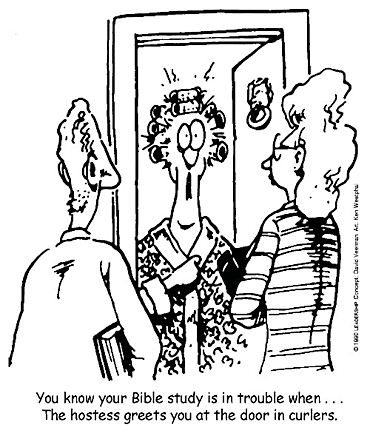
Authenticity
Great Bible teachers are authentic. They don't put on a mask or try to "look" more holy. I like the cartoon, because it plays on the normal foibles of humans.
You probably do want to fix your hair and dress appropriately, but for only one reason -- so your appearance is not a distraction. As you teach, everything about you needs to move into the background, and the Word of God needs to be the focus.
Tuesday, April 18, 2006
Fun Joke for your Files
"There was a big-game hunter out to get a grizzly bear. He prayed for prey. He tramped through the big woods for hours, but never saw even a trace of a grizzly. Weary and dejected, he finally sat down on a hickory stump and leaned his gun against a nearby sapling, to rest for a while. Suddenly, he looked up to see a mighty grizzly bearing down on him. With no time to reach for his gun, he breathed a desperate prayer: "God, give this bear religion, so he won't kill me." The bear halted dead in his tracks, rose on his hind legs, spread his mighty paws, and looked to the heavens with thanksgiving. "Thank you, God," the bear shouted, "for sending this wonderful meal I'm about to eat."
"There was a big-game hunter out to get a grizzly bear. He prayed for prey. He tramped through the big woods for hours, but never saw even a trace of a grizzly. Weary and dejected, he finally sat down on a hickory stump and leaned his gun against a nearby sapling, to rest for a while. Suddenly, he looked up to see a mighty grizzly bearing down on him. With no time to reach for his gun, he breathed a desperate prayer: "God, give this bear religion, so he won't kill me." The bear halted dead in his tracks, rose on his hind legs, spread his mighty paws, and looked to the heavens with thanksgiving. "Thank you, God," the bear shouted, "for sending this wonderful meal I'm about to eat."
Saving a Drowning Man
Scott Aughtmon relates a Watchmen Nee story about saving a drowning man -- "a drowning man cannot be saved until he is utterly exhausted and ceases to make the slightest effort to save himself." Read the whole story here.
As we teach from the Word, we remind people that we must be absolutely dependent upon the Lord. As long as we think we can save ourselves, we're still not able to do what the Lord is asking us to do!
Scott Aughtmon relates a Watchmen Nee story about saving a drowning man -- "a drowning man cannot be saved until he is utterly exhausted and ceases to make the slightest effort to save himself." Read the whole story here.
As we teach from the Word, we remind people that we must be absolutely dependent upon the Lord. As long as we think we can save ourselves, we're still not able to do what the Lord is asking us to do!
Debate: Athiesm vs. Christianity
This is an interesting video of a debate between Cliffe Knechtle and Dr. Michael Newdow, the atheist who sued to remove "Under God" from the Pledge of Allegience. I once spent part of a day with Mr. Knechtle at Northwestern University. He's an outstanding communicator.
I also recommend Mr. Knechtle's book, "Give Me an Answer."
This is an interesting video of a debate between Cliffe Knechtle and Dr. Michael Newdow, the atheist who sued to remove "Under God" from the Pledge of Allegience. I once spent part of a day with Mr. Knechtle at Northwestern University. He's an outstanding communicator.
I also recommend Mr. Knechtle's book, "Give Me an Answer."
Sunday, April 16, 2006

Friday, April 14, 2006
Remembering Names
I'm one of those people who really struggles to remember the names of people. These tips are helpful.
I'm one of those people who really struggles to remember the names of people. These tips are helpful.
Thursday, April 13, 2006
Wednesday, April 12, 2006
Listen to Mike Swaim’s teaching on Psalm 112
You can learn so much from sitting under the teaching of great Bible teachers! I’m privileged to get to hear several great teachers at CrossTrainers, a weekly men’s group here in central Iowa.
Mike Swaim taught last week from Psalm 112, and I highly recommend this talk to you.
Here’s why:
* He does a wonderful job of teaching directly from the Word.
* Few teachers I’ve seen are more capable of engaging men and inspiring them.
* This lesson is about the blessings that come from delighting in God’s Word – which is true for all of us, men, women, and children.
* Mike weaves in personal stories to illustrate and emphasize points.
It will help if you know these things:
* At the beginning of the talk, Mike is holding up his well-worn Bible when he says “this book”
You can learn so much from sitting under the teaching of great Bible teachers! I’m privileged to get to hear several great teachers at CrossTrainers, a weekly men’s group here in central Iowa.
Mike Swaim taught last week from Psalm 112, and I highly recommend this talk to you.
Here’s why:
* He does a wonderful job of teaching directly from the Word.
* Few teachers I’ve seen are more capable of engaging men and inspiring them.
* This lesson is about the blessings that come from delighting in God’s Word – which is true for all of us, men, women, and children.
* Mike weaves in personal stories to illustrate and emphasize points.
It will help if you know these things:
* At the beginning of the talk, Mike is holding up his well-worn Bible when he says “this book”
* Mike is a West Point graduate, served in Vietnam, and is a high school basketball coach
You can download Mike’s talk as an mp3 file (12MB, 52 minutes) from here:
http://www.afclive.com/crosstrainers/ct_audio_files.php
Get this and listen to Mike's important message – it will bless you, and you can learn a lot about how to teach by studying Mike’s example.
Tuesday, April 11, 2006
Positive Trends in Barna Survey
The Barna Group is reporting some positive trends, including increased adult Sunday School attendance:
"Church attendance has increased slowly in recent years. While we have not returned to the 49% of adults who attended in a typical week as recorded in 1991, there has been a significant rebound from the 37% recorded in 1996, climbing to 47% in 2006.
Involvement in small groups that meet for Bible study, prayer or personal relationships, other than Sunday school or Christian education classes, has reached a new high in 2006. Currently, nearly one out of every four adults (23%) is engaged in such a gathering during a typical week. A decade ago, one out of every six adults (17%) did so.
Church volunteerism, after experiencing the same mid-Nineties doldrums as most other religious behaviors, has returned to its 1991 level of 27%. Volunteering at a church has been one of the more stable measures during the past 15 years, ranging from a low of 20% to the current high.
Even adult Sunday school attendance has risen in recent years. Once a mainstay of Protestant churches, Sunday school lost its cache in the Nineties, but seems to be on the rebound as evidenced by attendance numbers that reached 24% in this year’s tracking survey. That is up considerably from the 17% mark recorded in 1995 and in 1996. "
The Barna Group is reporting some positive trends, including increased adult Sunday School attendance:
"Church attendance has increased slowly in recent years. While we have not returned to the 49% of adults who attended in a typical week as recorded in 1991, there has been a significant rebound from the 37% recorded in 1996, climbing to 47% in 2006.
Involvement in small groups that meet for Bible study, prayer or personal relationships, other than Sunday school or Christian education classes, has reached a new high in 2006. Currently, nearly one out of every four adults (23%) is engaged in such a gathering during a typical week. A decade ago, one out of every six adults (17%) did so.
Church volunteerism, after experiencing the same mid-Nineties doldrums as most other religious behaviors, has returned to its 1991 level of 27%. Volunteering at a church has been one of the more stable measures during the past 15 years, ranging from a low of 20% to the current high.
Even adult Sunday school attendance has risen in recent years. Once a mainstay of Protestant churches, Sunday school lost its cache in the Nineties, but seems to be on the rebound as evidenced by attendance numbers that reached 24% in this year’s tracking survey. That is up considerably from the 17% mark recorded in 1995 and in 1996. "
Friday, April 07, 2006
Free Resource for Bible Teachers
Mini-course on how to be a dynamic teacher
Weekly teaching tip by email
Multiple Free reports and articles
Mini-course on how to be a dynamic teacher
Weekly teaching tip by email
Multiple Free reports and articles
Thursday, April 06, 2006
Really?
The Barna Group has released some new survey results that I find difficult to believe:
1. 47% of Americans read their Bibles in a given week (away from church)
2. 47% of Americans go to church
3. 23% are are part of small groups (other than Sunday School/CE Classes)
4. 27% of Americans volunteer in church work
5. 24% of Americans attend Sunday School
6. 84% of Americans say they prayed in the past week
7. 60% of professed Christians have personally shared their faith in the past year.
(Source)
What do you think? Barna usually has some good survey methods. If these numbers are true, then these activities are having a low impact on transforming lives and communities. For example, there is a difference between "reading their Bibles" and "delighting in His commands" (Psalm 112:1).
The Barna Group has released some new survey results that I find difficult to believe:
1. 47% of Americans read their Bibles in a given week (away from church)
2. 47% of Americans go to church
3. 23% are are part of small groups (other than Sunday School/CE Classes)
4. 27% of Americans volunteer in church work
5. 24% of Americans attend Sunday School
6. 84% of Americans say they prayed in the past week
7. 60% of professed Christians have personally shared their faith in the past year.
(Source)
What do you think? Barna usually has some good survey methods. If these numbers are true, then these activities are having a low impact on transforming lives and communities. For example, there is a difference between "reading their Bibles" and "delighting in His commands" (Psalm 112:1).
Dealing with Pride
If you are teaching the Bible well, then people will say nice and not-so-nice things to you. Check out Martin Luther's counsel:
"The ministers of the Gospel should be men who are not too easily affected by praise or criticism, but simply speak of the benefit and the glory of Christ and seek the salvation of souls. Whenever you are being praised, remember it is not you who is being praised but Christ, to whom all praise belongs. When you preach the Word of God in its purity and also live accordingly, it is not your own doing, but God's doing. And when people praise you, they really mean to praise God in you. When you understand this--and you should because 'what do you have that you did not recieve?'--you will not flatter yourself on the one hand and on the other hand you will not carry yourself with the thought of resigning from the ministry when you are insulted, reproached, or persecuted."
If you are teaching the Bible well, then people will say nice and not-so-nice things to you. Check out Martin Luther's counsel:
"The ministers of the Gospel should be men who are not too easily affected by praise or criticism, but simply speak of the benefit and the glory of Christ and seek the salvation of souls. Whenever you are being praised, remember it is not you who is being praised but Christ, to whom all praise belongs. When you preach the Word of God in its purity and also live accordingly, it is not your own doing, but God's doing. And when people praise you, they really mean to praise God in you. When you understand this--and you should because 'what do you have that you did not recieve?'--you will not flatter yourself on the one hand and on the other hand you will not carry yourself with the thought of resigning from the ministry when you are insulted, reproached, or persecuted."
Wednesday, April 05, 2006

Tuesday, April 04, 2006
Prayer of Sir Francis Drake
"Disturb us, Lord, when we are too well pleased with ourselves. When our dreams have come true because we dreamed too little. When we arrive safely because we have sailed too close to the shore. Disturb us, Lord ."
Hat tip: Mark Batterson
"Disturb us, Lord, when we are too well pleased with ourselves. When our dreams have come true because we dreamed too little. When we arrive safely because we have sailed too close to the shore. Disturb us, Lord ."
Hat tip: Mark Batterson
"Scientific" Study on Prayer
There's been much newspulper trumpeting of the study showing no effect of prayer on patients.
My friend Kevin Nelstead addresses this WONDERFULLY in his blog, The Earth is Not Flat. Just nails it.
If you are at all interested in scientific issues and a Christian perspective, add Kevin's blog to your reading list. He's sharp, dedicated, and a good writer. Kevin is a missionary teacher in Romania, currently home on furlough.
There's been much newspulper trumpeting of the study showing no effect of prayer on patients.
My friend Kevin Nelstead addresses this WONDERFULLY in his blog, The Earth is Not Flat. Just nails it.
If you are at all interested in scientific issues and a Christian perspective, add Kevin's blog to your reading list. He's sharp, dedicated, and a good writer. Kevin is a missionary teacher in Romania, currently home on furlough.
Monday, April 03, 2006
Post-it Notes in Coffee
Here's an interesting quote:
"Our minds are not supercomputers and not even good filing cabinets. They bear more resemblance to Post-it Notes that have been thrown into a bin and covered with coffee. the ease with which we can recall information is likely to be influenced by the impact that information made when it went in." -- James Montier
Great Bible Teachers acknowledge that the human brain is wired for learning and comprehension, but some ways of introducing information are more likely to lead to understanding and retention than others. Great Bible Teachers work with this flow, rather than against it.
Great Bible teaching has to engage students (no matter what their age). There has to be some emotional and sensual impact to help information get across and retained. Great questions help engage people. Creating freshness (e.g., using a different Bible translation than usual) helps, because we tend to overlook or skip the familiar. Change up the seating arrangements. Challenge people to engage with one another on a topic. (People are more likely to remember what they said than what you said.)
Work to teach to change lives! And you'll have much more fun, too.
Here's an interesting quote:
"Our minds are not supercomputers and not even good filing cabinets. They bear more resemblance to Post-it Notes that have been thrown into a bin and covered with coffee. the ease with which we can recall information is likely to be influenced by the impact that information made when it went in." -- James Montier
Great Bible Teachers acknowledge that the human brain is wired for learning and comprehension, but some ways of introducing information are more likely to lead to understanding and retention than others. Great Bible Teachers work with this flow, rather than against it.
Great Bible teaching has to engage students (no matter what their age). There has to be some emotional and sensual impact to help information get across and retained. Great questions help engage people. Creating freshness (e.g., using a different Bible translation than usual) helps, because we tend to overlook or skip the familiar. Change up the seating arrangements. Challenge people to engage with one another on a topic. (People are more likely to remember what they said than what you said.)
Work to teach to change lives! And you'll have much more fun, too.
Saturday, April 01, 2006
Value of Questions
Good group Bible studies and adult Sunday School classes are built on questions. These aren't sermons, but need to be interactive. And questions are the key! (That's why I wrote "52 Model Questions.")
I was delighted to see Scott Aughtmon's blog post, "Could you change your life if you changed your questions?" An excerpt:
"We don't have to have all the right answers, but we SHOULD know the right questions. Matt Rawlins in his book "The Lottery: A question can change your life" said these things through one of his characters in this story that's modern day parable..."...successful people ask better questions, and as a result, they get better answers."
"The right question, at the right time, in the right place, with the right people is one of the most powerful tools in the hand of any man, woman or God."Skim through the gospels and look at how many times the pharisees, the sadducees-- even the disciples were asking the wrong question -- and Jesus had to correct them."
Good group Bible studies and adult Sunday School classes are built on questions. These aren't sermons, but need to be interactive. And questions are the key! (That's why I wrote "52 Model Questions.")
I was delighted to see Scott Aughtmon's blog post, "Could you change your life if you changed your questions?" An excerpt:
"We don't have to have all the right answers, but we SHOULD know the right questions. Matt Rawlins in his book "The Lottery: A question can change your life" said these things through one of his characters in this story that's modern day parable..."...successful people ask better questions, and as a result, they get better answers."
"The right question, at the right time, in the right place, with the right people is one of the most powerful tools in the hand of any man, woman or God."Skim through the gospels and look at how many times the pharisees, the sadducees-- even the disciples were asking the wrong question -- and Jesus had to correct them."
Subscribe to:
Posts (Atom)